
From SEO to AI Agents: Amazon Rufus’s Strategic Shift
Amazon Rufus is redefining how products are discovered on Amazon. At the same time, it anticipates a future where the AI agent, not the consumer, will be the one deciding which brands make it to the shopping basket.
That is precisely the friction point with the traditional Digital Shelf we know so far and the origin of the disruption promised by agentic commerce.
Rufus and the New Algorithmic Shop Window
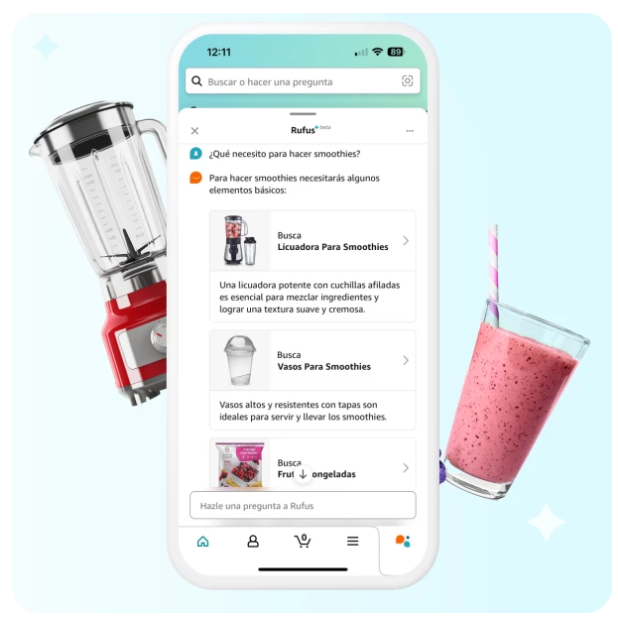
Rufus is Amazon’s conversational shopping assistant, integrated directly into the app. From the product detail page itself, it answers specific questions, facilitates comparisons between alternatives and, ultimately, accompanies the user in the purchasing decision. Currently, more than 250 million shoppers use Rufus. Its adoption is transforming rapidly the way products are discovered and prioritised within Amazon. According to Similarweb data, its usage grew by 127% between Prime Week (July) and Black Friday (November) 2025. This confirms a clear trend: consumers feel increasingly comfortable delegating part of the purchasing decision to AI.
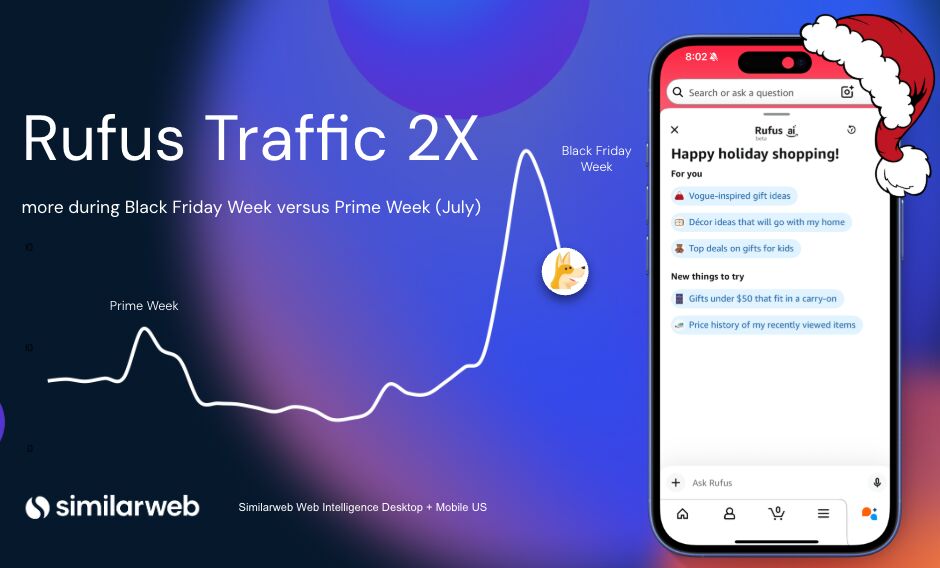
Source: Ben Parks @LinkedIn – Similarweb, 2025
Early analyses on the impact of Rufus demonstrate the extent to which this assistant is giving rise to a new algorithmic shop window, distinct from the traditional listing. Only 22% of the products appearing on Amazon’s first results page coincide with those recommended by Rufus. On the other hand, 36% of the assistant’s suggestions were not even present on that first page. In practice, this implies that a brand can maintain good SEO positioning and, even so, end up invisible to the AI assistant. More than a penalty, it is a clear signal that the digital shelf is reconfiguring itself around relevance criteria for the conversational agent. And not solely based on historical ranking position.
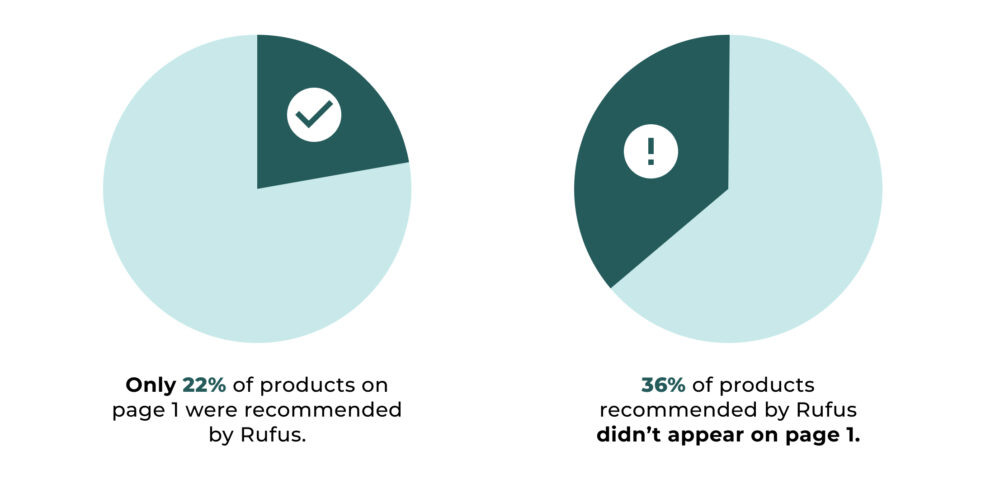
Source: What Makes Rufus Tick? Insights into Amazon’s Agentic AI Search – Mars United, December 2025
How Rufus Decides Which Products to Show
Rufus behaves less like a traditional search engine and more like a highly selective curator of options. Unlike the classic search bar, which demands explicit input from the user, forcing them to know what they want, type it, sort results and apply filters, with the corresponding cognitive load, Rufus operates by inference. Upon opening Amazon, the assistant adopta an increasingly proactive role. It analyses previous searches, reviews the basket and takes recent browsing patterns into account. Even if the user has explored a specific category, such as anti-ageing creams, on several occasions inside or outside Amazon.
Research by Mars United, based on the analysis of more than 1,000 products, confirms just how selective this approach is: Rufus only recommends items with a minimum rating of 4 stars and an average close to 9,000 reviews per product, whilst those with few opinions practically do not appear. This agent does not limit itself to the content of the product page. It also incorporates signals such as the brand’s external reputation, reviews inside and outside Amazon, purchasing patterns and expectations for each category.
In parallel, other analyses indicate that Rufus understands purchasing intent with greater depth than the keyword-based search engine. It maintains context, interprets complex questions and proposes alternatives by comparing benefits and real objections expressed by other users. Therefore, a product can be perfectly optimised at the keyword level and, even so, be displaced by another with less SEO work, but with a superior fit regarding the needs that the AI infers from the buyer’s behaviour and signals.
Rufus as a Prelude to AI-Driven Retail
Rufus can be considered a prelude to agentic commerce, a scenario in which AI agents recommend products and also buy directly on behalf of the user. These autonomous systems search, evaluate, compare and execute transactions according to the consumer’s preferences, constraints and objectives. Unlike traditional e-commerce, based on active browsing and clicking, the user delegates a large part of the purchasing process to an agent that decides for them within certain parameters.
Consultancies and platforms agree that this adoption will be massive: more than half of consumers expect to use AI assistants to shop before the end of 2025. Those who interact with these agents show a significantly higher purchase intention than traditional visitors. It is a shift in power: the dominant interface ceases to be the search engine, the category or the banner, and becomes an algorithmic system that filters the assortment before the user sees any option.
Why Agentic Commerce Could Disrupt Traditional Retail
This change redefines competition in retail, which historically revolved around controlling the shop window: shelves, gondola ends, top search positions or Retail Media spaces. In a world of agentic commerce, the shop window is no longer negotiated with people, but with AI agents that decide what to show according to relevance, trust and performance. This change introduces three key frictions for the current model:
- Brands lose direct contact with the consumer, because the relationship becomes mediated by an agent.
- The corporate brand value may become diluted if the agent optimises exclusively for price, performance and reviews. This reduces the weight of emotion and visual storytelling at the point of sale.
- Retail Media, as conceived today, risks stalling. Marketing budgets will migrate “upwards” in the chain, towards the environments where agents’ decisions are formed, instead of paying for impressions in a list that users no longer look at.
The war for the shelf focuses on a single objective: becoming the agent’s preferred option.
From Optimising for the Shelf to Optimising for Agents
The good news for brands is that the optimisation logic does not disappear, but shifts. Rufus prioritises elements such as clarity of the value proposition, structure of the listing, complete attributes, quality reviews and coherence of the product story. Sellers using Rufus as a research tool are discovering unexpected demand segments (for example, a product intended for athletes that is actually bought mostly by healthcare staff). By adjusting positioning and images, they skyrocket engagement and conversions.
With a view to agentic commerce, several recommendations are repeated in reports from consultancies, payment processors and marketplace platforms:
- Treat AI agents as the “first customer”, ensuring that product data is machine-readable, complete and consistent.
- Invest in APIs and connectivity to expose inventory, prices, deadlines and conditions transparently to external agents.
- Build proprietary brand agents capable of negotiating, responding to complex queries and keeping the value proposition alive in a machine-to-machine interaction environment.

Becoming the Preferred Option: Strategies for AI-Guided Retail
The shelf that an AI assistant like Rufus sees differs significantly from the one a traditional search engine shows. This redefines the retail control point. It is no longer enough to appear in lists. The priority is to become the option that agents choose and recommend. To adapt to this new scenario, retailers and brands can focus on three lines of action:
- Rethink catalogue management: continuously audit attributes, images, descriptions, claims and reviews, thinking about how AI interprets them and not just how a human user perceives them.
- Design intent-oriented content: answer clearly and with context the questions that buyers ask in natural language, incorporating objections, uses and comparisons in a conversational manner.
- Measure performance “seen by agents”: evaluate visibility and selection in recommendation blocks and conversions generated after interactions with assistants, beyond traditional search metrics.
At the same time, the most advanced players are exploring how to connect their payment, promotion and loyalty systems to this new ecosystem. In this way, agents not only find the products, but prefer them for an optimal combination of value, convenience and experience.
Ultimately, the divergence between what Rufus shows and what the classic search shows is not a system error. It is the symptom that retail’s centre of gravity is moving from the list to the algorithm. In an environment of agentic commerce, the true challenge will no longer be “appearing on the Digital Shelf”, but becoming the preferred option of the agents that are redesigning that shelf, query by query, in real time.