
Universal Commerce Protocol: How Google Aims To Turn AI Search into Instant Purchases
Google’s Universal Commerce Protocol (UCP) is an open standard designed to turn AI interactions into instant purchases. It seeks to reduce friction at the checkout and solve one of e-commerce’s major bottlenecks: one-to-one integrations between retailers, platforms, and AI agents.
It represents a key step towards “agentic commerce”: shopping experiences where conversational AI agents (such as Gemini or Search AI Mode) not only recommend products, but also execute the transaction from start to finish on the user’s behalf.
What is the Universal Commerce Protocol?
UCP is an open-source standard driven by Google alongside companies like Shopify, Etsy, Wayfair, Target, and Walmart. Furthermore, it has the support of major players in the payments and retail ecosystem, such as Mastercard, Visa, Stripe, and Adyen.
Its goal is to create a common language for digital commerce. Thanks to this standard, the purchasing process can be more fluid and consistent. AI search engines, chatbots, and applications can easily connect with retailers and payment providers throughout the customer journey.
In practice, the Universal Commerce Protocol allows a single AI agent to manage the entire shopping experience. It can search for products, create the basket, apply discounts, process the payment, and update the order status. All this without each retailer having to develop specific integrations for every platform or assistant.
This approach standardises communication between AI agents and businesses. Additionally, it eliminates the well-known problem of multiple integrations, which until now limited the scalability of artificial intelligence-powered commerce.
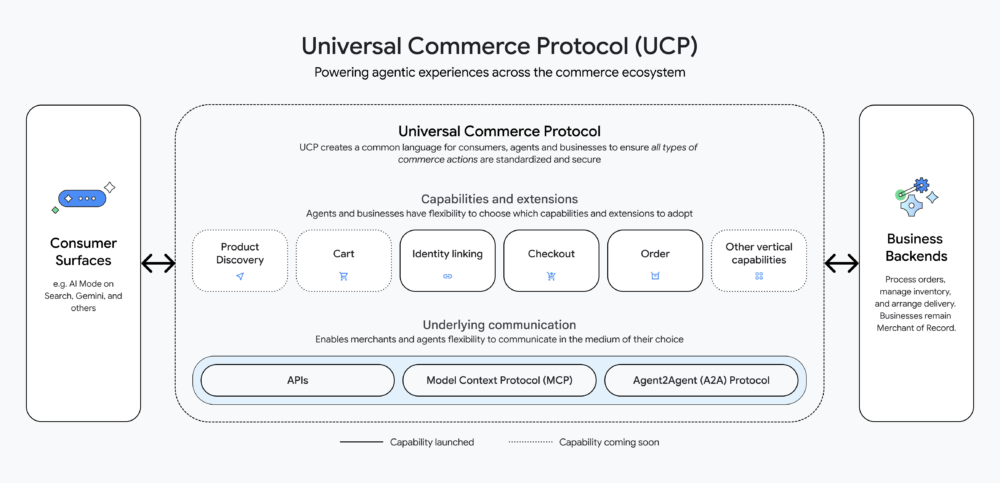
Source: Under the Hood: Universal Commerce Protocol (UCP) – Google, January 2026
What Changes for Retailers, Marketplaces, and Content Creators?
For retailers, one of the main advantages of UCP is that they remain the Merchant of Record. This means they maintain a direct relationship with the customer. They also retain control over data, after-sales service, returns, and loyalty programmes.
The Universal Commerce Protocol does not “keep” the sale. It does not act as a commercial intermediary. Instead, it adds a standard orchestration layer. This layer allows the purchase to be made within AI surfaces, such as search engines or assistants. However, settlement and reporting remain linked to the retailer, as they are now.
In return, businesses gain access to several clear growth levers:
- Expanded reach: Products can appear natively in environments like Search AI Mode or Gemini, where the user already expresses a specific purchase intent.
- Less friction at the checkout: The payment process is carried out without leaving the conversation. The user leverages shipping and payment details already saved. This reduces basket abandonment and shortens decision time.
- Preparation for agent-based commerce: The standard accounts for multi-item baskets, account linking for loyalty programmes, and AI-assisted after-sales experiences. All of this is part of the UCP public roadmap.
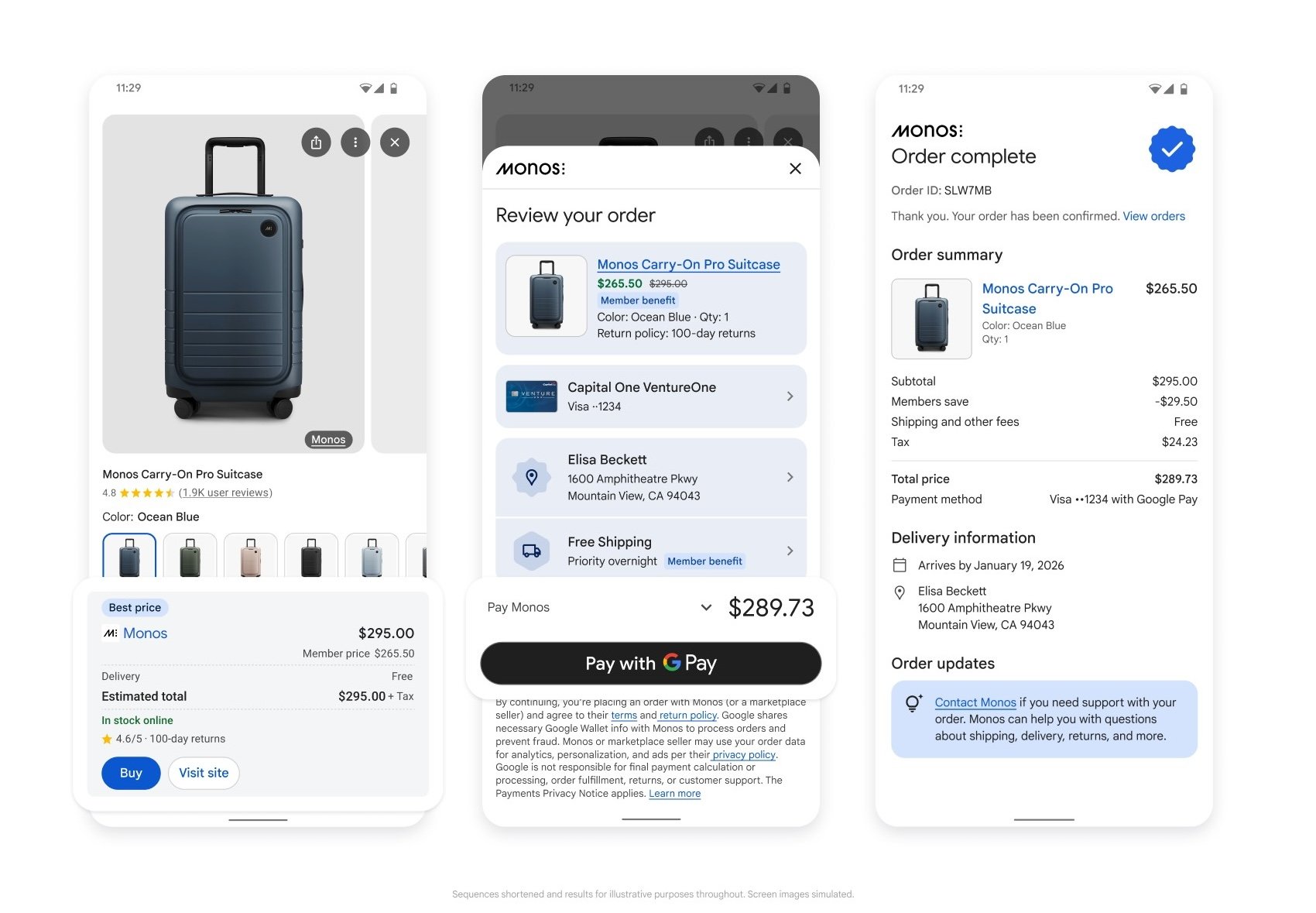
Source: Under the Hood: Universal Commerce Protocol (UCP) – Google, January 2026
For publishers and content creators, the impact is equally relevant. UCP addresses a key challenge: how to directly monetise recommendations and discovery content within AI environments. All this without relying solely on traditional affiliate links. In a scenario where search and inspiration migrate to conversational interfaces, closing the sale within the chat becomes a critical piece of survival.
Use Cases and Early Allies
Google has launched the first implementation of UCP, which allows users to buy directly from eligible retailers from Search AI Mode, the Gemini app, and the web, starting with US retailers. Users can ask for product recommendations, compare options, and complete the purchase in the same conversation, without being redirected to multiple websites or checkout forms.
Among the first allies is Walmart, as it did previously with OpenAI. Thanks to this collaboration, customers will be able to buy Walmart and Sam’s Club products directly from Gemini. The AI chatbot will show assortment, prices, and availability in real time, accessing the catalogue of both chains. Furthermore, members of Walmart loyalty programmes will be able to link their accounts with Google. This will allow for personalised recommendations based on their interests and shopping habits.
—John Furner, President and CEO of Walmart U.S
This model is not limited to physical retail or traditional e-commerce. UCP is designed for diverse verticals such as travel, financial services, or subscriptions, provided there is a transactional flow with discovery, purchase, and after-sales.
—Sundar Pichai, CEO of Google and Alphabet
In the medium term, any business that wants to be “conversationally available” for AI agents will be able to use the standard as a gateway, avoiding the need to create proprietary integrations for each platform.
Strategic Keys for the E-commerce and Retail Sector
From a strategic perspective, the Universal Commerce Protocol is Google’s bet to lead the transition from a click-based, transactional e-commerce, towards a conversational and agent-guided commerce where user intent becomes the new unit of value. By standardising how agents “talk” to retailers’ systems, Google places itself at the centre of journey orchestration, even when other AI platforms adopt the same protocol.
For retailers and brands, immediate priorities include:
- Evaluating integration with UCP through their Merchant Center account, reviewing capabilities such as native checkout, discounts, multi-item baskets, and account linking.
- Redesigning the content and SEO strategy with conversational prompts and AI-assisted journeys in mind, where the sale is closed within the chat and not necessarily on the website.
- Exploring new attribution and measurement models that connect interaction with AI agents, the use of UCP, and business results, measuring from intent to the LTV generated by these channels.
As adoption grows, UCP could become the “HTTP” of AI-powered commerce: invisible to the end user, but absolutely fundamental for searches, recommendations, payments, and after-sales to flow consistently between multiple players.
For e-commerce, Retail Media, and digital product teams, the time to understand this standard and test pilot use cases is now, before the next wave of conversational commerce turns AI agent compatibility into a condition for market entry.