
Real-time Trade Marketing: The New Era of Geolocated Store Checks in Retail
TL;DR
Real-time store checks are transforming trade marketing in retail. They enable instant monitoring of prices, stock and promotions, improving in-store execution, prioritising actions and maximising ROI, with decisions based on up-to-date and reliable data.
In retail, the difference between good planning and a good result usually lies in store execution. Real on-shelf availability, the price applied, shelf visibility, well-set promotions and installed point-of-sale material drive daily conversion. This is why store checks remain a central piece of Trade Marketing.
The problem arises when information arrives late, incomplete or difficult to verify. In high-turnover categories or those with aggressive competition, waiting days or weeks to understand what happened at the point of sale reduces the room for manoeuvre. According to a study conducted by KX and the Centre for Economics and Business Research (CEBR), 80% of companies using real-time data report increases in their revenue, contributing to a collective growth estimated at $2.6 trillion globally. Conversely, retailers that depend on delayed reports make decisions based on obsolete information and miss opportunities to capitalise on trends in the moment.
In this context, geolocated and real-time store checks are becoming a standard for sales, trade and operations teams. Below, we will explore what changes with this approach, what benefits it brings and how to make the leap from an analogue model to a data-native one, without unnecessary friction.
What Is a Store Check? (and Why the Classic Model Falls Short)
A store check is a structured in-store verification to measure how a brand, category or promotion is being executed. It serves to answer very specific operational questions such as: is there stock? Is the price as agreed? Is the planogram being respected? Has the competition gained space?
In Trade Marketing, the store check is the basis for detecting deviations, prioritising actions and justifying investments in visibility or promotion.

Traditional store checks
The traditional model usually relies on face-to-face visits carried out by sales reps, merchandisers, promoters or agencies. Data capture is done with:
- Paper forms or spreadsheets.
- Photos without a clear standard, sent via instant messaging.
- Manual reports at the end of the day or week.
- Subsequent consolidation in spreadsheets or internal tools.
This approach may work in small operations or with few stores, but it becomes cumbersome as the number of points of sale, references (SKUs) and the need to react quickly grow.
For decades, the model has worked because it was the only thing available. But today we know it has significant cracks.
Typical limitations
The problem with the traditional store check is not that it is useless, but that it is slow, unreliable and difficult to scale. The most common limitations include:
- Low effective frequency: not all stores are reached with the desired regularity.
- Data that arrives late: the “what has happened” is known when the “what to do” has already lost its impact.
- Difficulty validating data: photos without context, without confirmed location or without an exact time.
- Inconsistencies in measurement: each person interprets what “well executed” means differently.
- Biases and manual errors: incomplete loading, estimated values, duplicates.
- Poor traceability: it is difficult to reconstruct what was surveyed, where, when and under what conditions.
- Unactionable reports: too much description and too little prioritisation by impact.
These limitations are not trivial. They represent decisions made with incomplete information, missed opportunities and Trade Marketing budgets that do not generate the expected return.
The “New Way” of Doing Store Checks: Geolocated, Digital-First and Evidence-Based
The new generation of store checks in retail is based on real-time market analytics platforms that integrate data from thousands of points of sale and convert them into insights that are actionable almost instantly. Solutions like flipflow connect prices, assortment, promotions, visibility in search engines and marketplaces, along with competitor metrics, to offer a dynamic view of the market, beyond the physical store visit.
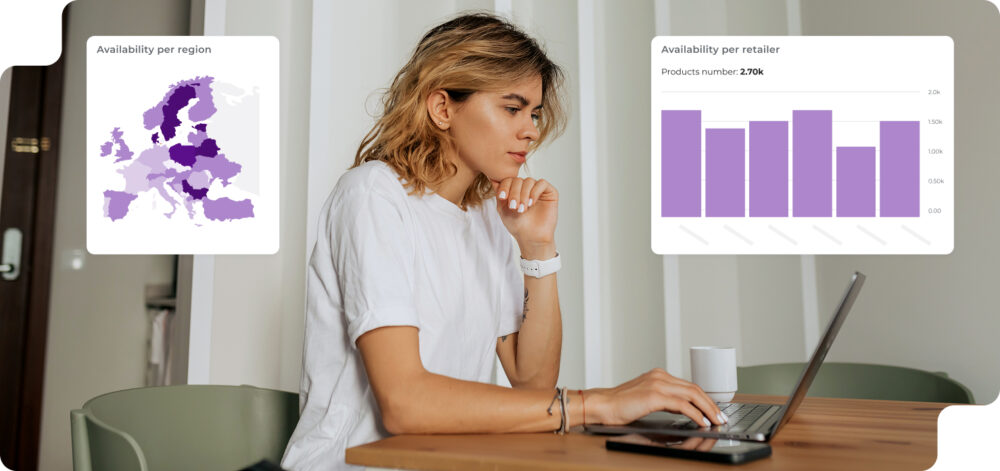
Instead of depending on manual observations, brands continuously monitor what is happening in each channel. Trade Marketing teams can detect price changes at a key retailer, poorly configured promotions on the digital shelf or aggressive launches from competitors. Information is presented in comparative dashboards with filters by retailer, category, location or period, facilitating the quick identification of risks and opportunities.
This digital-first approach reinforces decision-making with structured data updated with high frequency. It allows for the validation of hypotheses on commercial execution: for example, determining if a drop in sales is due to lower digital visibility, a price mismatch against the competition or the absence of an agreed promotion.
Furthermore, these platforms align teams under a single source of truth, which is exportable and integrable with other internal tools. With this common base, it is possible to prioritise points of sale, optimise promotional investment and systematically verify correct execution in the market.
Finally, they act as a permanent competitive radar: they detect variations in price and assortment, changes in the category or the entry of new brands. This visibility allows for quick reactions and strategy adjustments before the impact on sales consolidates.
Why the Future of Trade Marketing is Data-Native and in Real-Time
Trade Marketing no longer competes only on execution, but on reaction capacity. In an environment where prices, assortment and promotions change daily between retailers and digital channels, making decisions with delayed reports is equivalent to operating blind.
Real-time store check platforms transform the internal conversation: they replace perceptions with continuous market evidence. The result is not just better reporting, but faster execution, which is defensible before management and directly connected to commercial impact.
1. Faster decisions and better ROI
The trade spend (investment in promotions, discounts, displays and commercial agreements) requires constant operational control. With real-time store checks, you can:
- Detect poorly implemented promotions within the first few hours.
- Redirect resources to stores with the highest losses due to stockouts.
- Adjust materials and mechanics based on real response.
- Avoid paying for executions that did not take place.
ROI improves because investment stops being retrospective and starts being managed during the campaign, not after.
2. Greater visibility of in-store execution
Commercial directors have spent decades wondering what is really happening at their thousands of points of sale. Aggregated reports show averages but hide real variability.
Modern store check platforms offer dashboards that answer critical questions in seconds:
- What percentage of my stores currently has stock of the star product?
- In how many points of sale is my Christmas campaign visible?
- Which retail chains execute our promotions best?
This visibility extends to all levels. The national manager sees trends by region, the regional manager drills down into their areas, and the supervisor reviews store by store. Everyone has the information they need for their level of decision-making.
3. Field team productivity and control
The field team stops being a data collector and becomes an executor guided by data.
With planning based on real incidents:
- Routes are prioritised based on potential economic impact
- Visits focus on solving previously detected problems
- Redundant audits are eliminated in stable stores
- Each intervention remains traced and verifiable.
The supervisor not only knows what the team visited, but what problem they solved and what effect it had. This reduces low-value visits, increases effective coverage and improves coordination with sales and head office.
4. Foundation for AI and automation
The structured and consistent data generated by digital store checks are the perfect fuel for artificial intelligence and machine learning.
With enough history, algorithms can:
- Predict stockouts: Identify patterns that precede stockouts and alert before they occur
- Detect anomalies: Automatically flag stores with atypical behaviours that require attention
- Optimise visit frequencies: Determine which stores need weekly visits and which can be audited monthly
- Suggest corrective actions: Recommend the best strategy according to the type of problem detected
This layer of artificial intelligence does not replace the human team, but it does multiply their effectiveness by prioritising where to focus attention.

The KPIs that Improve with Real-Time Store Checks
The implementation of modern store checks directly impacts key business metrics:
- Product availability (OSA – On Shelf Availability): This is perhaps the most critical KPI in retail. According to IHL Group, a 1% increase in OSA can increase sales by 2-4%. The global impact of shelf availability issues represents losses of approximately $634 billion annually for the retail sector. Real-time store checks allow for the detection of stockouts on the same day and the activation of urgent replenishment.
- Perfect display compliance: Many brands have agreements with retailers on how their shelf space should look. Stanford studies show that manual audits can have error rates of up to 20%, directly affecting compliance reliability. Stores that maintain more than 95% execution compliance outperform the rest by 8-10%, demonstrating the value of continuous verification and automatic alerts.
- Issue resolution time: This used to be measured in days or weeks. Now, the full detection-assignment-resolution-verification cycle can be completed in hours. This is especially critical during product launches or seasonal peaks.
- Promotional effectiveness: Being able to correlate visit data (was the promotion executed?) with sell-out data (did it generate incremental sales?) allows for the calculation of the real ROI of each promotional mechanic and the optimisation of the following year’s calendar.
- Competitive advantage in space: Real-time dashboards allow for share of shelf analysis and relative location versus the competition. Many brands have discovered that competitors systematically displace them in certain chains, information they can use in commercial negotiations with the retailer.
How to Transition from Analogue to Data-Native Trade Marketing
Adopting store checks based on real-time market analytics does not imply replacing field operational processes, but rather changing the source of truth on which the organisation works. The transition is primarily analytical and organisational: moving from occasional reports to continuous market monitoring. It works best when structured in stages and prioritising the effective use of data.
Phase 1 — Pilot in a key category or retailer
Start by monitoring a limited perimeter (for example, a strategic category or a priority retailer). This allows you to validate metrics, define relevant alerts and demonstrate internal value before scaling. The goal is not coverage, but generating the first actionable decisions.
Phase 2 — Definition of KPIs and operational alerts
Before expanding coverage, translate the commercial strategy into clear indicators: price deviations, absence of promotion, loss of visibility, stockouts or assortment changes. The platform must be configured to point out exceptions, not to produce more reporting.
Phase 3 — Incorporation into decision processes
Data only adds value when it enters the workflow. Integrate the dashboards into commercial routines: weekly meetings, campaign tracking and promotional planning. The team stops analysing “what has happened” and starts deciding “what to do now”.
Phase 4 — Integration with internal systems
Connect the platform with CRM, commercial planning tools or revenue management. In this way, incident detection can trigger actions: renegotiations, promotional adjustments or account prioritisation.
Phase 5 — Management culture based on continuous evidence
The key change is cultural: decisions are justified with current market data, not with historical data or isolated perceptions. Management, sales and trade marketing operate on the same source of truth.

Companies that follow this approach reduce internal friction because value appears from the first few weeks: better commercial conversations, faster decisions and less dependence on retrospective analysis.
The ROI of Total Visibility
The return does not come from “measuring for the sake of measuring”. It arrives when visibility is converted into decisions and actions. In real-time store checks, ROI usually appears on four fronts:
- Recovered sales due to fewer stockouts: detect earlier, replenish earlier, lose less.
- Better promotional effectiveness: the campaign is executed as planned and corrected while it is live.
- Investment optimisation: trade spend is reassigned from stores with low execution to those that can capture demand.
- Operational efficiency: fewer reporting hours, fewer unproductive visits, better team focus.
To estimate it credibly, it is advisable to compare before and after in a pilot: stockouts, promo compliance, sales in treated versus control stores, and field operational costs.
Furthermore, there is another intangible but very valuable benefit: the peace of mind of knowing what is happening in your points of sale right now, not last week.
Conclusion: From Reactive Control to Live Management
For years, Trade Marketing has operated with a retrospective logic: measure, consolidate, analyse and, finally, act. The problem was not a lack of effort, but a lack of immediacy. In a retail environment where competitive dynamics change daily, that sequence is insufficient.
The new generation of store checks introduces a change of focus: the store —both physical and digital— moves from being audited occasionally to being monitored continuously. With information available in real-time, management evolves from corrective to adaptive.
This context modifies the role of Trade Marketing within the organisation. It becomes a constant source of operational intelligence for sales, revenue management and senior management, supporting decisions with current market signals instead of hypotheses or late reviews.
Adopting a data-native model implies working with greater precision: identifying where to intervene, when to do so and with what priority, reducing the distance between what was planned and what was executed at the point of sale.
Ultimately, the value lies in managing retail as a living and changing system. Brands that operate under this logic will execute with greater consistency and compete with an advantage thanks to their visibility and capacity to react.