

Walmart Wants to Turn your TV into its Store’s Best Shelf
TL;DR
Walmart is integrating Vizio into its advertising ecosystem to bring Retail Media to connected TV and close the loop between advertising impact and actual sales. By combining proprietary transactional data with CTV, it turns the living room into a new measurable and highly segmented point of sale.
Walmart has integrated its advertising network, Walmart Connect, with the capabilities of Vizio, a connected TV platform, to bring brand advertising directly into consumers’ homes.
This strategy leverages real purchase data to show relevant ads on smart TV screens, allowing concrete sales results to be measured. The move is part of a broader plan to expand the retail giant’s advertising business beyond physical stores and its website.
When Retail Media Sits on the Sofa
Retailers generate advertising revenue through their own channels, such as website searches or in-store screens. Walmart Connect represents this advertising network in the United States, where brands pay to appear at key moments of the purchasing decision. The acquisition of Vizio in 2025 adds a new layer: smart TVs in homes.
Vizio brings more than 18 million active accounts on its SmartCast platform, along with an operating system that facilitates ad insertion. Walmart is now combining this CTV (connected TV) inventory with its transaction data, creating opportunities for campaigns that influence actual purchases. The result shows in the numbers: Walmart’s global advertising business is growing strongly, and this integration accelerates the process.
An X-ray of Walmart’s Advertising Business
Walmart reported global advertising revenue of nearly $6.4 billion in its 2026 fiscal year (based on how large US corporations’ fiscal years operate), an increase of 46% compared to the previous year. In the fourth quarter of that fiscal year, Walmart Connect in the United States recorded year-on-year growth of 41%, driven by more advertisers and better targeting options.
These results position Walmart as a key player in the Retail Media market, a sector where retailers monetise their customer data and reach to attract brand budgets. Advertising represents one of the highest-margin segments for the group, as it leverages existing assets such as the customer base and digital platforms. The expansion into CTV via Vizio contributes directly to this momentum by opening up new video formats and audiences in the home.
The Vizio Purchase: Hardware, Software, and Data in the Walmart Ecosystem
Walmart acquired Vizio for $2.3 billion in early 2024, a deal that closed that same year. The company has a Smart TV platform called SmartCast, which reaches millions of homes, and a software division (Platform Plus) responsible for most of its gross profits.
This purchase gave Walmart control over TV hardware, the operating system that runs them, and advertising spaces within them. SmartCast allows for contextual or targeted ads, and Walmart integrates this data with its in-store and online purchase history. The effect is clear: more Vizio TVs sold generate more advertising opportunities, which fund improvements in hardware and content offerings.
The move is explained by the growing competition with Amazon, which uses Fire TV for similar purposes in streaming and e-commerce. Walmart thus manages to slip into the consumer’s living room, where it can influence purchase decisions before they reach the store or the website.
From the Shelf to the Living Room Screen: What Changes for Brands
Brands advertising on Walmart Connect now have more options within the ecosystem: CTV video, e-commerce searches, or in-store displays. Walmart segments audiences based on real purchasing behaviours, such as families buying products from a specific category.
A practical example: an appliance brand launches a spot on SmartCast aimed at recent Walmart customers who bought kitchen accessories. The advert can include calls to action that lead directly to the Walmart website or a nearby store. This integration makes the television function as an additional storefront, connected to the retailer’s actual inventory.
For brands, the benefit lies in precision: ads reach people with proven intent, and results are measured in concrete sales, not just impressions. Walmart Connect thus extends its offer to advertisers looking for impact in homes, beyond immediate online purchases.
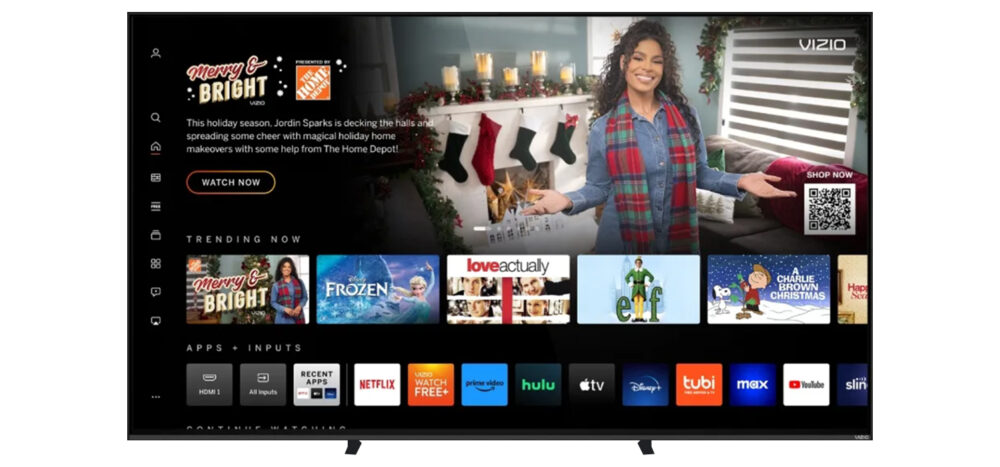
Source: Walmart’s Acquisition of Vizio is Disruptive and Explosive Combined – February 2024
Real Closed Loop: Measurement and Attribution Across Store, Web, and TV
Walmart offers what is known as closed-loop advertising: a system that tracks the entire journey from ad exposure to purchase. In CTV, a spot seen on Vizio is linked with loyalty card data or online accounts to calculate the impact on sales in physical or digital stores.
This measurement crosses multiple screens: the TV at home, the Walmart website, the mobile app, and even screens at the point of sale. Advertisers receive detailed reports on sales uplifts, justifying investment in traditional television formats that previously relied on indirect metrics.
Walmart’s strength lies in its first-party data, collected directly from transactions, which avoids relying on third-party cookies. This closed attribution capability attracts brands seeking budget efficiency, especially in an environment where privacy limits other advertising options.
Implications for the Future of Retail Media
Walmart’s move is not tactical; it is structural. It integrates data, advertising inventory, and hardware under one umbrella, reducing friction and increasing control over the advertising value chain. The projected growth of Retail Media on CTV, which is set to double in size in the coming years according to eMarketer estimates, indicates that connected TV will stop being a complement and become a central channel within brand strategies.
For European or Spanish retailers, the signal is clear: the future involves not only optimising on-site or in-store presence, but expanding the ecosystem into content consumption moments. This implies investing in first-party data, unified measurement capabilities, and technological partnerships that allow closing the circle between advertising impact and actual sales.
Television as a New Strategic Shelf
What is at stake is the redefinition of the point of sale. Walmart is turning television into an additional shelf: one that lives in the living room, operates with transactional data, and is measured in incremental sales.
The retailer no longer waits for the consumer to enter the physical store or the website. It anticipates the moment of decision, influences it, and connects it directly to its inventory. In an environment where attention is the scarcest resource, controlling the home screen means gaining presence in the moment prior to purchase.
Whoever manages to connect entertainment, data, and transaction will have a competitive advantage that is difficult to replicate.