
Beyond the Top Spot on Google: How to Get ChatGPT to Cite Your Brand
TL;DR
Most ChatGPT citations come from pages that are well-positioned on Google, but only a minimal fraction ends up being mentioned. To appear as a source, you need good classic SEO and clear, structured content focused on long-tail subtopics.
Introduction: Why it Matters that ChatGPT Cites You
ChatGPT has become a new gateway to brand content, especially for informational searches and product research. An increasing number of users are discovering products through the citations that appear beneath generated responses, not just through classic Google results.
For any marketing or SEO team, understanding what makes a page get cited by ChatGPT is a strategic matter. A recent report from AirOps helps clarify this process and connects, with data, the role of traditional SEO with a new frontier: visibility in AI-based answer engines.
What Exactly Did the AirOps Report Analyse?
AirOps studied how ChatGPT searches for, retrieves, and cites sources when generating a response, tracking the entire path from the initial query to the pages finally mentioned. The analysis is based on 15,000 original queries of different types (definitions, guides, comparisons, product validation, etc.).
During the experiment, ChatGPT retrieved 548,534 pages and generated additional internal searches (query fan-out), which raised the total set of queries to 43,233. The authors compared both the cited URLs and those that were retrieved but not cited against the top 20 Google results for each query. The goal was to measure the actual weight of organic ranking on the probability of being cited.
How Google Rankings Influence ChatGPT Citations
The report confirms that classic SEO remains the starting point. 55.8% of all pages cited by ChatGPT appear in the top 20 Google results for at least one original or fan-out query. This means that the majority of citations come from pages that already have good organic visibility.
The advantage is concentrated in the top positions. 43.2% of pages ranking at number 1 on Google were cited by ChatGPT. The probability is 3.5 times higher than for pages situated outside the top 20.
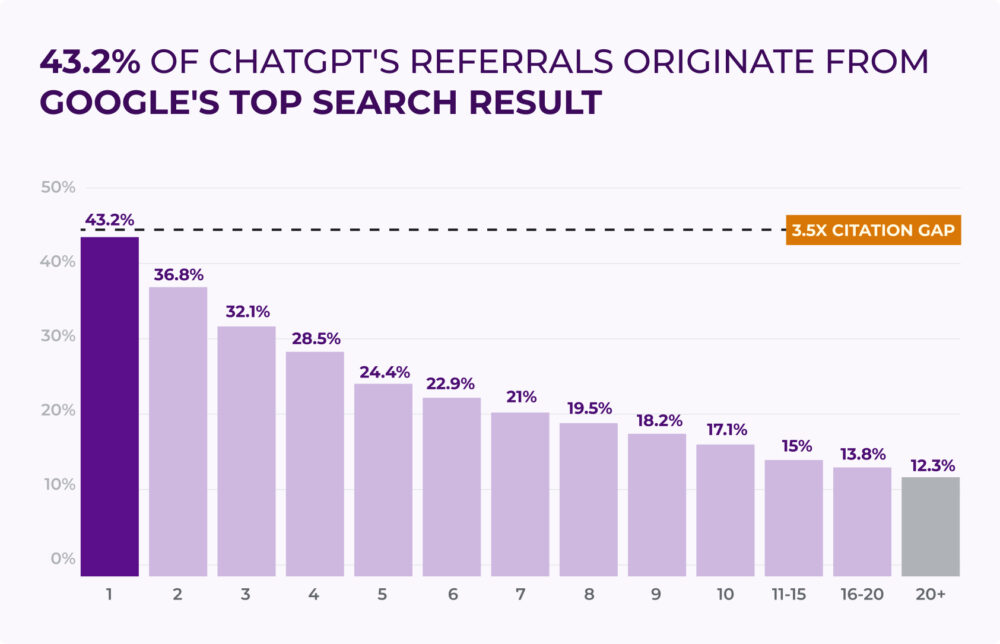
Source: The Influence of Retrieval, Fan-out, and Google SERPs on ChatGPT Citations – March 2026
For brands, this data turns ranking improvements (especially moving from the second page to the top positions) into a key factor not only for traffic but also for presence in AI responses.
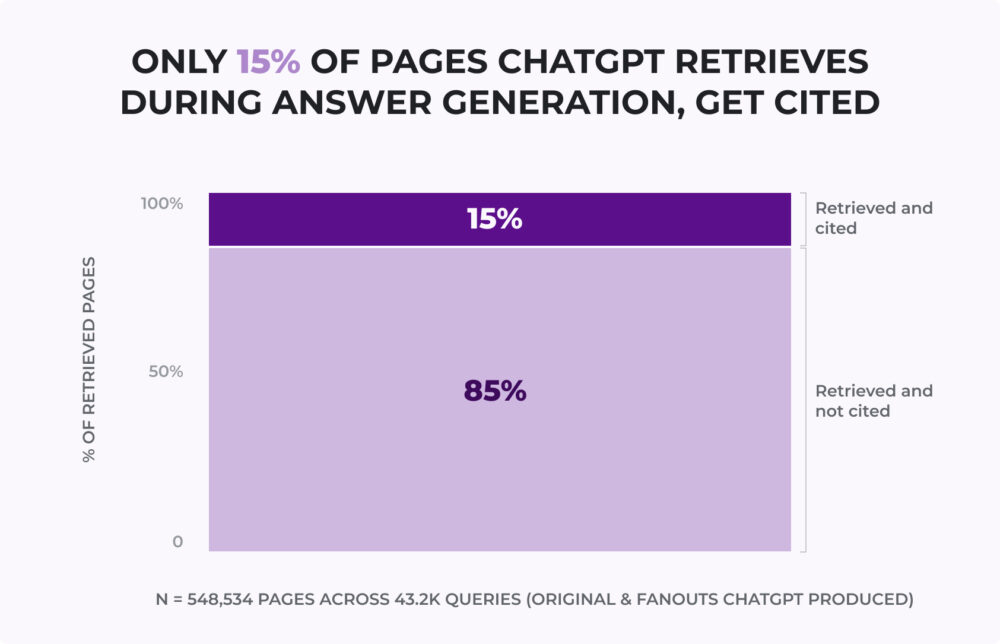
However, the study also shows that the path from “being found” to “being cited” is very demanding. Of the more than 548,000 pages retrieved, only around 15% ended up appearing as a visible citation. In other words, 85% of the sources that ChatGPT consults are never shown to the user.
Source: The Influence of Retrieval, Fan-out, and Google SERPs on ChatGPT Citations – March 2026
Fan-out: The “Second Search Circuit” you don’t See in your SEO Tool
One of the key concepts appearing in the report is query fan-out, the name given to the set of internal searches that ChatGPT generates from a single user prompt. When faced with a question, the model does not limit itself to a single query but launches several additional searches to cover definitions, nuances, comparisons, examples, prices, or use cases.
In the study, 89.6% of the 15,000 original queries generated two or more fan-out queries, significantly expanding the search surface used to build the answer. This phenomenon has direct consequences for content. 32.9% of the cited pages that appeared in a Google top 20 were discovered solely thanks to these derived queries, not the original query.
Most of these internal searches focus on very specific subtopics. Frequently, these do not even appear with a noticeable volume in keyword research tools. This reality favours sites with medium authority but highly specialised content, especially on long-tail topics, over massive domains with more general content.
What Other Studies Say: Similarities and Differences between Google and AI
Other recent analyses help contextualise the AirOps work. Ahrefs, for example, has measured that the overlap between URLs cited by ChatGPT and Google results is relatively low at the page level, although it grows when looking at the domain level. This aligns with the idea that the AI tends to prefer certain trusted sites, but not necessarily the same URL that Google places in first position.
SEO consultants and studies focused on “AI search” highlight that the majority of citations still come from the organic top 20, with an over-representation of positions 1–3. However, they describe a “gap” between ranking and citation: Google focuses on sorting relevant results, while models like ChatGPT apply an additional filter where factors such as text clarity, exact alignment between title and query, or page structure carry more weight.
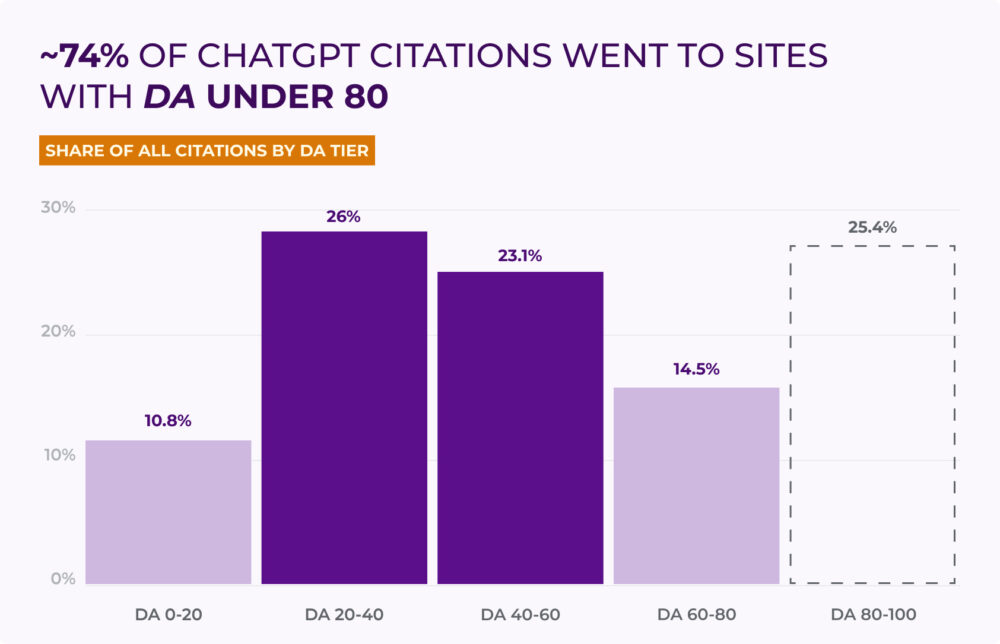
In parallel, it is observed that medium authority domains (DA 20–80) concentrate a large portion of citations in ChatGPT. The AirOps study indicates that nearly 74% of citations go to sites with less than 80 domain authority, with a particularly high weight for DA 20–40, suggesting a scenario less monopolised by large publishers than might be expected.
Source: The Influence of Retrieval, Fan-out, and Google SERPs on ChatGPT Citations – March 2026
What All This Means for your SEO and Content Strategy
The first message is clear: traditional SEO remains essential for achieving visibility in ChatGPT. Without a stable presence in Google’s top 20, the chances of the model retrieving your pages are drastically reduced. It is also important to focus efforts on moving key URLs towards the highest spots on the SERP, where the citation advantage is much greater.
The second message is that optimisation does not end with ranking. The transition from “retrieved” to “cited” depends on factors such as:
- A high match between the page title and the AI’s query (or sub-query).
- High readability, with clear sentences, relatively short paragraphs, and a well-hierarchised structure.
- Sharp thematic focus, avoiding diversions that dilute the main answer the user is looking for.
Furthermore, the existence of fan-out forces us to think of content as an ecosystem covering the main topic and its related subtopics. For a commercial query, for example, it is advisable to create pieces or blocks that address price, features, alternatives, comparisons, and use cases, because these are precisely the decomposition lines used by AI.
Thirdly, domain authority matters, but not as the only lever. AirOps research indicates that medium authority domains compete very well when their content is well-aligned with derived queries and covers long-tail niches in depth. This opens a clear window of opportunity for brands that cannot match the muscle of major media outlets but can specialise in specific segments.
A New Front for SEO in the Age of AI
Data from AirOps and other studies paint a scenario in which Google continues to be the great filter for visibility, but where ChatGPT adds an additional layer that discriminates differently regarding which sources deserve to be cited. The combination of good ranking, high editorial clarity, and intelligent coverage of long-tail topics becomes the core of the strategy to gain presence in the answers given by AI.
For marketing and SEO teams, the challenge lies in measuring to what extent the pages that already perform in organic search are converting that visibility into effective citations. Working on the alignment between title and query, reinforcing content structure, and planning the editorial calendar with potential fan-out queries in mind allows you to bring your brand closer to that privileged space where ChatGPT identifies you as a reference source.