
Carrefour Revolutionises Retail: First European Giant to Integrate the Shopping Basket into ChatGPT
TL;DR
Carrefour becomes the first major European retailer to integrate part of the shopping experience into ChatGPT. The initiative opens a new era in conversational commerce, although it still presents operational limits.
The Future of the Supermarket is Already Here
Artificial intelligence has already entered retail in many ways: customer service, demand prediction, logistics optimisation, or offer personalisation. Now it takes a visible step for the end consumer. Carrefour has announced an integration with ChatGPT in France that allows the preparation of the shopping basket through natural conversation.
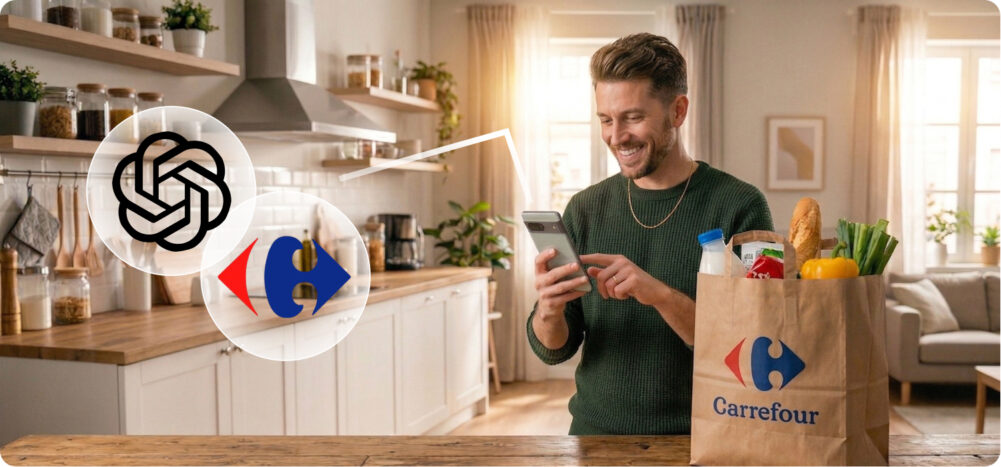
The news positions Carrefour as the first major European retailer to bring online shopping to this conversational environment. The move has a clear reading: the supermarket’s digital channel is beginning to open up to new interfaces, where the user asks, clarifies, and decides without relying so much on the traditional search engine or a website’s menus.
For the European sector, the announcement has strategic value. Conversational shopping is no longer a laboratory test and is entering real commercial ground. From here, many companies will ask the same question: Can ChatGPT become a new gateway to grocery e-commerce?
What has Carrefour Announced?
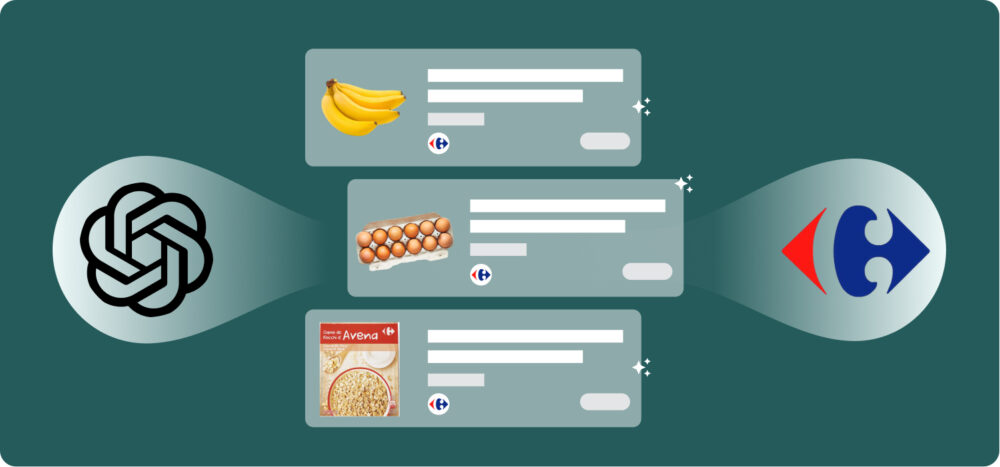
The proposal presented by Carrefour in France allows users to interact with the brand within ChatGPT to explore products, get recipe ideas, check availability, and build a basket with selected items. According to information published by various media outlets, this integration is part of a broader strategy by the company to strengthen its digital presence and experiment with new customer relationship channels.
The company is not starting from scratch. Carrefour had already developed previous initiatives linked to artificial intelligence, such as Hopla and Hopla+, aimed at improving the online shopping experience and exploring new forms of consumer assistance. The launch on ChatGPT can, therefore, be seen as a logical evolution within that roadmap.
What can the user do within ChatGPT?
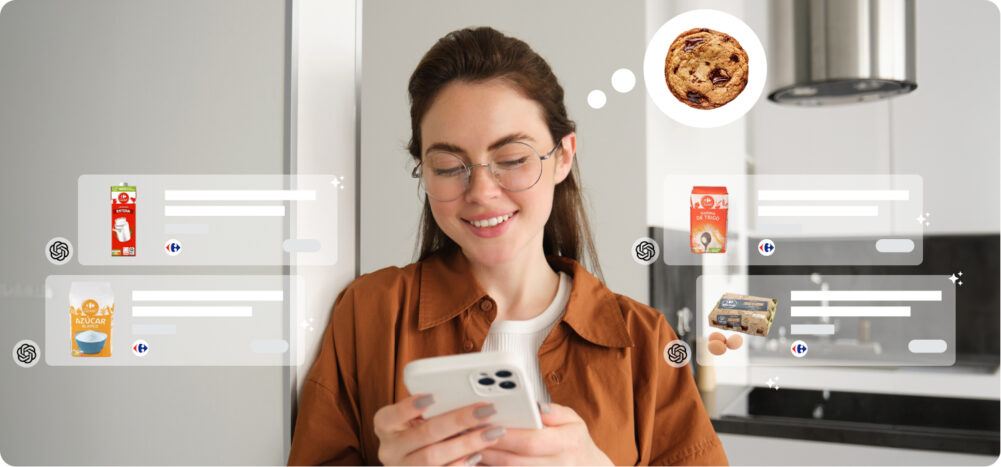
Within ChatGPT, the customer can make requests as if they were talking to a personal assistant. For example:
- Prepare a weekly shop with a specific budget.
- Look for products for a specific recipe.
- Ask for gluten-free or lactose-free options.
- Find items for a quick dinner.
- Select items according to household preferences or needs.
The big advantage lies in natural language interaction. The user does not need to navigate through multiple categories to start. They can describe what they are looking for in their own words and receive a tailored proposal.
This dynamic fits grocery shopping very well, where many decisions stem from a specific need: “I want to organise menus for five days” or “I need an economical shop”. ChatGPT helps to order that intent and translate it into a selection of items.
Furthermore, the focus is especially interesting in FMCG categories, where many purchases are repeated and where speed is as important as price or variety. A well-guided conversation can shorten several steps of the purchasing funnel and make product choice more fluid.
How the service is accessed
The functionality is available in France, which is the market chosen by Carrefour for this initial roll-out. According to coverage published by specialist and generalist media, access is through ChatGPT, where the user interacts with the experience enabled by Carrefour to start their shopping.
From that conversation, the system suggests products and organises the selection. Closing the order remains connected to the distributor’s digital ecosystem. That is, the AI helps in the discovery, recommendation, and basket preparation phase, while the purchase is validated within the commercial environment of carrefour.fr.
This detail is important because it clarifies the real scope of the launch. It is not a purchase completely resolved within the chat, but a hybrid process between conversation, recommendation, and transfer to the supermarket’s online channel.
Current Limits: Innovation is Still in the Early Stages
The technological novelty brings visibility and opens an interesting business path, but the experience must still evolve to become more solid and fluid. Several aspects stand out among the current limits:
- Recommendation accuracy: Grocery shopping requires a lot of detail. It is not enough to suggest “milk” or “pasta”. The consumer wants brand, size, price, promotions, and availability.
- Connection with real stock and offers: If an AI recommends a product that is later unavailable or changes price when moving to the shopping environment, the experience loses value.
- Friction in the process: Although the conversation simplifies the start, the purchase still needs subsequent steps in the retailer’s environment to be completed. This can take away some of the immediacy that the user expects.
- Consumer trust: In food, many decisions are sensitive: allergies, diets, brand preferences, freshness, or substitutions. The customer needs to feel that the recommendation is useful and reliable.
- The learning curve: Not all consumers are ready to do their shopping by talking to an AI. There will be profiles that find it practical and others who continue to prefer traditional navigation.
The proposal is promising but requires technical and operational maturation to reach a truly end-to-end purchase within the conversational environment. It also remains to be seen how the available catalogue, the depth of recommendations, and the system’s personalisation capacity evolve.
The launch should be read as a test for the future rather than a definitive solution. Carrefour is testing a new gateway to online commerce, but the experience still depends on other elements of the brand’s digital ecosystem.
Why Is it a Milestone for European Retail?
Carrefour’s announcement is significant for one simple reason: it sets a precedent in Europe. Until now, the conversation about generative AI in retail had focused on productivity, automation, or customer service. With this step, AI enters the commercial moment more visibly. This has several implications:
The first is competitive positioning. Being a pioneer gives visibility and places Carrefour at the centre of the debate on innovation in supermarkets, e-commerce, and artificial intelligence.
The second is a change of interface. For years, online shopping has been based on search engines, filters, and category navigation. ChatGPT introduces a different logic: the user expresses a need and the system organises a response.
The third is market learning. Whoever moves first can better understand how the customer buys in conversational environments, what questions they ask, what categories work best, and what obstacles appear in the experience.
Furthermore, there is a relevant European element. Grocery retail in Europe operates in a demanding context, with strong competition, price sensitivity, and increasing regulation around data and technology. A group like Carrefour activating this model in that environment sends a clear signal to the market.
What the Sector Can Learn from this Move
Carrefour’s decision leaves several useful lessons for any retail, FMCG, or e-commerce company:
1. Data quality rules
For an AI to recommend well, the catalogue must be well-structured. Poor descriptions, incomplete attributes, or outdated commercial information generate unhelpful responses.
2. Conversational experience requires real integration
Success does not depend only on the assistant. Stock, prices, promotions, logistics, and the checkout process also influence it. If the elements are not connected, the result will be inconsistent.
3. Natural language can reduce friction
Many consumers know what they need but do not always want to go through a website step by step. Conversation can save time and help discover products with less effort.
4. It pays to launch, measure, and correct
Carrefour has started in a specific market. This approach allows testing real use, detecting failures, and adjusting the experience before considering a larger expansion.
5. AI must provide practical utility
Technological enthusiasm alone does not guarantee adoption. The consumer will repeat if they perceive time savings, relevant suggestions, and a simple purchase.
For the sector, the message is direct: conversational AI has commercial potential, but it requires technical, operational, and strategic preparation.
Conclusion: Towards Clickless Commerce
Carrefour’s initiative does not yet inaugurate a completely autonomous supermarket within ChatGPT, but it does point to a very clear direction for the future of retail. AI-assisted shopping is beginning to consolidate as a new territory for innovation, with the potential to change how we discover products, how we compare options, and how we complete an online purchase.
For the sector, the signal is clear: clickless commerce has already begun to take shape, albeit in an early stage. And Carrefour not only confirms this but has been the first in Europe to show it in a tangible way, demonstrating that the shopping of the future will increasingly begin with a simple conversation.