
Online Presence as Commercial Infrastructure: From the Digital Shelf to the Physical Aisle
TL;DR
The Digital Shelf is no longer just about e-commerce; it is also the infrastructure that defines sales in physical stores. Managing visibility, content, and stock through Digital Shelf Intelligence is the only way to avoid shopper friction and guarantee revenue across all channels.
Introduction: The End of the Border between “Clicks” and “Bricks”
When a consumer enters a supermarket with a shopping list on their mobile, they carry with them weeks of accumulated digital influence. They have seen product pages, read reviews, compared prices across platforms and, in many cases, decided which brand they will buy before setting foot in the store. The physical aisle only confirms, or frustrates, that decision.
This phenomenon has profound implications for brands and retailers. According to data from Scandit and Nielsen, 83% of consumers use some type of shopping app on their smartphone while inside a physical store, and 88% compare prices in-store to find the best deal. Added to this is what Pricer highlights: the smartphone accompanies the consumer inside the establishment and turns the store into a connected space, where price, information, and promotions are contrasted in real time. The modern shopper arrives informed, with expectations created in the digital environment, and any inconsistency between what they found online and what they see on the physical shelf generates friction, distrust, and lost sales.
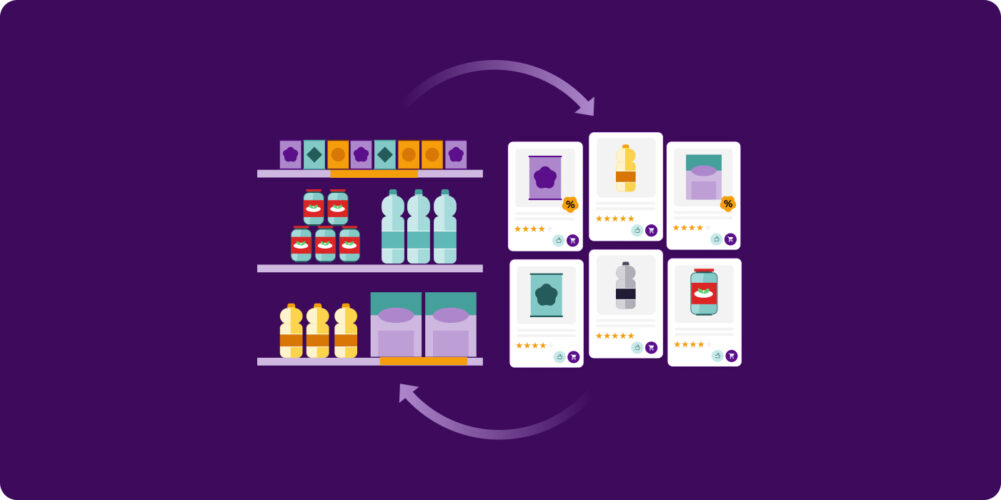
The logical consequence is that managing the digital channel well has stopped being an exclusively e-commerce matter. The Digital Shelf (the set of presences, content, and positioning of a brand in digital sales environments) now determines commercial performance across all channels, including the physical store. Treating both worlds as separate silos is one of the most costly strategic mistakes that retail and FMCG organisations can make in 2026.
The Digital Shelf as Commercial Infrastructure
Treating the Digital Shelf as commercial infrastructure means understanding it as an operational foundation that sustains visibility, consistency, and performance across all digital touchpoints. Its function is not limited to “being present,” but to ensuring that the product appears, is understandable, is credible, and is available when the consumer needs it. This foundation affects both the online channel and behaviour in the physical store.
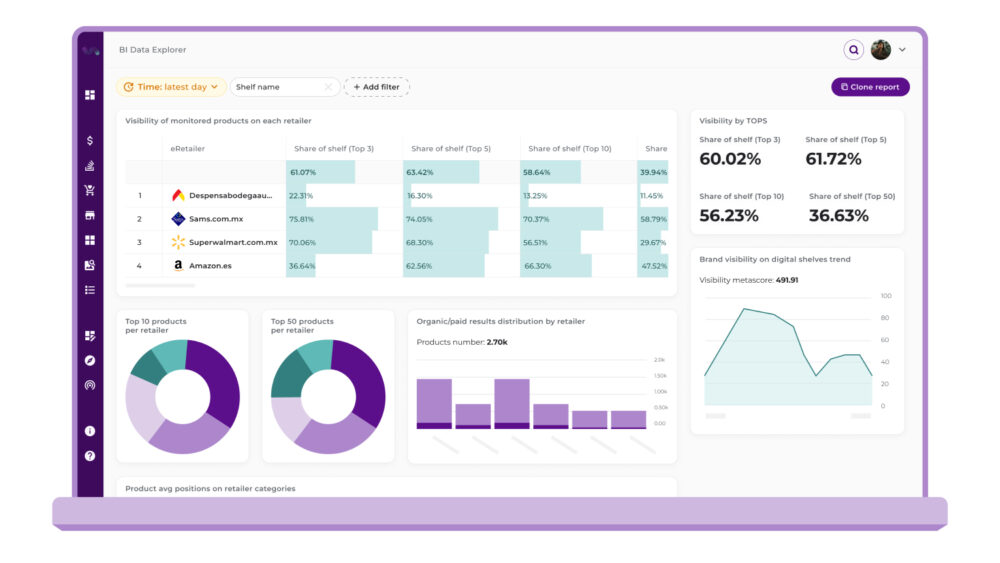
This vision is especially useful for brand, e-commerce, trade marketing, and retail intelligence teams. If the Digital Shelf is fragmented, the brand loses control over its narrative, over the comparison against competitors, and over the connection between traffic, conversion, and sales. If it is well governed, it becomes a structural asset that drives revenue on several fronts simultaneously.
Visibility, content, and availability
The three operational pillars of the Digital Shelf are visibility, content, and availability. Visibility determines whether the product appears in the top results when the consumer searches for a category. Content — images, descriptions, technical attributes, ratings — defines the quality of the product page and its ability to convert. Availability guarantees that the product is listed, in stock, and accessible at the retailers where the consumer expects to find it.
When any of these three elements fails, the impact is not limited to the digital channel. A product listing with low-quality images or incomplete attributes erodes the brand perception that the shopper will take with them to the store. A product with online availability issues generates uncertainty about whether they will find that item on the physical shelf. Consistency across these three axes is a necessary condition for effective commercial execution at all touchpoints.
Brand governance and digital shelf control
One of the most frequent challenges in organisations with wide distribution is the lack of consistency in brand presentation across different digital retailers. The same product can have listings with different content, prices, and attributes depending on the platform, which generates confusion for the consumer and dilutes the brand identity.
Digital shelf governance is the ability to ensure that the brand is presented with the same quality standards across all retailers where it operates. This includes continuously auditing the content of listings, detecting inconsistencies, correcting errors, and ensuring that product, price, or promotional updates are transferred synchronously to all channels. Without this structural control, the Digital Shelf becomes a fragmented environment where the brand loses control of its commercial narrative.
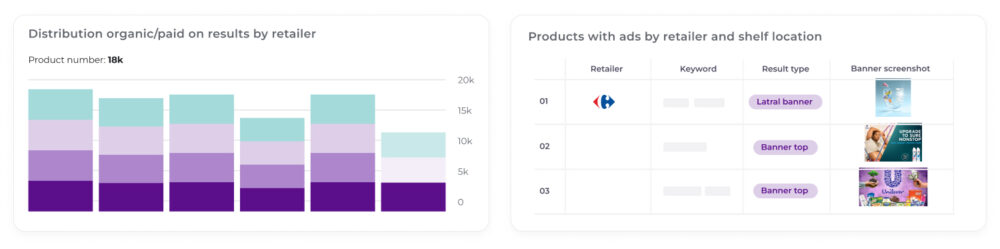
The approach we promote at flipflow with our Digital Shelf Intelligence module goes in that direction: continuously monitoring what happens with each product, at each retailer, and against each competitor. This vision allows for a move from manual and sporadic reviews to a more consistent and actionable management style.
The relationship between Digital Shelf and Retail Media
The Digital Shelf and Retail Media already operate as connected disciplines. Retail Media investment drives traffic, but that traffic lands on a product listing, a category, and a specific proposition. If the product is not well-prepared, the investment loses efficiency. Therefore, content, stock, and visibility must go hand in hand with ad spend.
Furthermore, Retail Media amplifies the importance of the Digital Shelf because it increases competition for attention. When several brands bid for the same space, the difference is not just made by the budget, but also by the quality of the digital shelf execution. The brand that appears better, responds better, and is available wins the commercial advantage.
At this point, the Digital Shelf stops being an isolated operational task and becomes part of the growth system. Investment pays for traffic; digital infrastructure converts that traffic into a decision.
5 Mechanisms by which the Digital Shelf Dictates Offline Sales
The influence of the digital environment on physical sales operates through specific and measurable mechanisms. Identifying them allows organisations to design Digital Shelf strategies that directly impact the bottom line of the physical channel.

1. Discovery
The first mechanism is discovery. Before going to the store, many consumers use search engines, marketplaces, or the retailer’s site to identify which product fits their need. If a brand does not appear, it is not part of the shortlist.
In practice, this means that digital visibility can determine which products are taken into consideration and which are left out. Good online positioning creates latent demand that later transfers to the physical shelf. The store receives a preference that is already formed.
2. Trust
Trust is built with information and social signals. Reviews, ratings, images, descriptions, and technical attributes help the shopper reduce their uncertainty.
This trust travels with the consumer to the store. If they have already validated a brand online, they are more likely to look for it on the physical shelf and be willing to pay for it. If they find poor or inconsistent information, that predisposition weakens.
3. Availability expectation
Online availability works as a promise. When the shopper checks the retailer’s website and sees a product available, they interpret that there is a high probability of finding it. If they see an out-of-stock or an uncertain delivery, they modify their expectation.
This mechanism is decisive because many decisions are made before travelling to the store. The consumer may choose another store or substitute the brand even if the product was physically available. Prior perception carries a lot of weight. That is why digital availability acts as a leading indicator of offline purchasing behaviour.
4. Price and promotion perception
The fourth mechanism is the perception of price and promotion. The consumer compares online before buying offline and carries a mental reference of value with them. If they find an attractive offer, a clear discount, or a well-explained promotion, that information influences their decision at the point of sale.
This necessitates the alignment of pricing, promotions, and communication across channels. When online and physical prices generate different messages, confusion arises. The brand may lose credibility or cause rejection if the consumer perceives inconsistency between what they have seen on screen and what they see on the shelf.
5. Consistency of commercial execution
The omnichannel experience perceived by the consumer is only as strong as its weakest link. If brand communication is impeccable in the digital channel but execution in-store (signage, product location, information at the point of sale) is not aligned, the purchase journey breaks down.
Consistency of commercial execution between the Digital Shelf and the physical shelf is the mechanism that closes the cycle and converts digital presence into a real sale.
The Mistake of Treating the Digital Shelf as a Project rather than as Infrastructure
Many organisations have approached the Digital Shelf as a project: an initiative with a beginning, development, and end, usually led by the e-commerce or digital marketing team, with limited scope and temporary resources. This approach generates partial and unsustainable results.
A project ends. An infrastructure is maintained, updated, and scaled. The difference is not semantic: it defines how resources are allocated, who is responsible for results, and how often the strategy is reviewed.
When the Digital Shelf is managed as a project, recurring symptoms usually appear:
- Product content updated occasionally, not continuously
- Absence of systematic monitoring of visibility against competitors
- Disconnection between marketing, sales, e-commerce, and supply chain teams
- Digital Shelf metrics that are not connected to global business objectives.
Most organisations believe they have control over their digital presence because they accumulate data, but data without structure hides what is really happening in the market. The difference between accumulating data and having digital governance is the same as the difference between monitoring and controlling.
Treating the Digital Shelf as infrastructure involves creating organisational structures and continuous processes: periodic content audits, alert systems for visibility losses, cross-functional teams with clear responsibilities, and metrics integrated into business dashboards.
How to Operationalise this Vision with Digital Shelf Intelligence
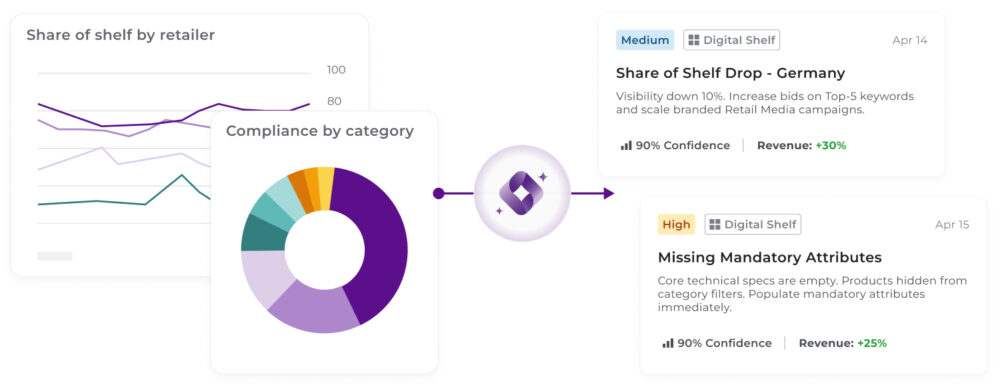
The issue is not just collecting data, but converting scattered signals into specific commercial decisions. To achieve this, a layer of intelligence is needed that observes the market continuously and translates complexity into clear priorities.
A Digital Shelf Intelligence solution allows for the monitoring of critical variables such as:
- Availability
- Price
- Promotions
- Content
- Ratings and reviews
- Search positioning
- Assortment
- Competitor activity
The value appears when this information is organised to answer business questions: Where am I losing visibility? Which retailers concentrate the most execution issues? Which SKUs have stock or content problems? Which competitors are gaining presence?
A platform of this type helps to unite teams that often work with separate data. Marketing can understand which content needs improvement. Trade marketing can review promotions and execution. Sales can anticipate risks by retailer. E-commerce can detect gaps in visibility and availability. Management obtains a clearer view of which factors are affecting performance.
Furthermore, this approach facilitates the connection between the Digital Shelf and results. If a brand observes a drop in sales in a specific category, it can check if the problem stems from a loss of visibility, an out-of-stock, a poorly activated promotion, or superior competitive pressure. This traceability greatly improves the ability to respond.
Operationalisation also involves defining a stable framework.
A useful scheme includes:
- Prioritise key retailers and categories: Not all channels carry the same weight. It is advisable to start with the retailers that have the greatest impact on sales or the highest strategic relevance.
- Define critical KPIs: Availability, share of search, content, price, promotions, ratings, and assortment are usually the most relevant.
- Establish alert thresholds: For example, quickly detecting a drop in visibility or an out-of-stock in core products.
- Assign owners: Every incident must have a clear owner to prevent problems from remaining unresolved.
- Review business impact: Monitoring makes sense when it is connected to sales, share, margin, or investment efficiency.
Finally, it is advisable to integrate the Digital Shelf into an omnichannel reading. It is not enough to know what is happening online. One must also understand how that execution translates into physical traffic, brand preference, and store turnover. This connection turns data into commercial intelligence. Organisations that adopt this structured digital governance approach manage to reduce the time spent on manual reporting tasks by between 50% and 80%, freeing up analytical capacity for strategic decision-making.
Conclusion: The Retailer of the Future will be Data-Driven
Retail has entered a phase in which the competitive advantage does not belong to the one with the most products on the shelf, but to the one who best understands what happens at every touchpoint with the consumer, digital and physical, and acts accordingly with speed and precision.
The Digital Shelf is now the infrastructure on which that advantage is built. It determines how consumers discover products, what trust they develop toward brands, what expectations they bring to the store, and what experience they have when they reach the point of sale. Ignoring this dynamic or managing it reactively carries a direct cost in sales, market share, and customer loyalty.
The retailer and brand of the future will be data-driven in the most operational sense of the term: they will make decisions about visibility, content, availability, and price based on up-to-date and comparable data, with continuous review processes and teams aligned around shared metrics.
In this scenario, having Digital Shelf Intelligence tools like those developed by flipflow helps to move from intuition to action, from a snapshot to continuous control, and from a basic digital presence to a more robust commercial execution across all channels.