

MediaMarktSaturn Expands its Retail Media Strategy to 8 European Markets
TL;DR
MediaMarktSaturn has taken a new step in its retail media strategy with the expansion of its In-Store offering to eight European markets. The company is thus strengthening a business line that is gaining weight within the retail sector. This line is increasingly interesting to brands and advertisers due to its ability to make an impact at the point of purchase.
The latest development comes via a technological infrastructure designed to operate campaigns programmatically and centrally, with the support of One Tech Group. In practice, this allows for the scaling of in-store advertising activations. It also allows for better coordination of local and multinational campaigns within a commercial network that already has a highly significant presence in Europe.

An Expansion with European Reach
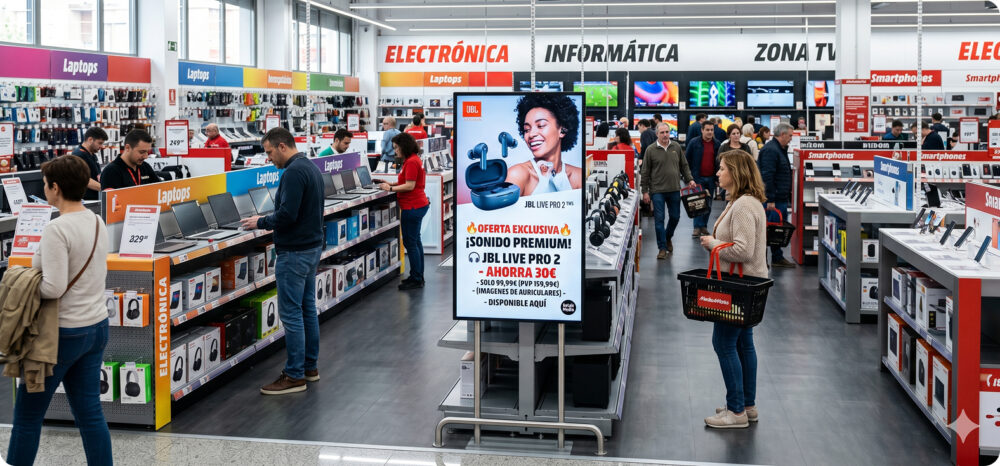
The expansion incorporates new markets into a network that was already operating in Germany and Spain, and which now adds Austria, Switzerland, Turkey, Belgium, Luxembourg and Hungary. Overall, coverage stands at around 738 stores and more than 53,000 screens, with a potential audience of some 68 million weekly contacts, according to the sources consulted.
This move places MediaMarktSaturn in a stronger position within the European Retail Media ecosystem. The company gains geographical scale and also reinforces the consistency of its commercial proposal. This is key in a market where advertisers seek measurable, segmentable and easy-to-activate solutions across several countries.
How its In-Store Model Works
MediaMarktSaturn’s proposal is based on advertising at the point of sale, an especially valuable environment because it connects brand communication with the moment when the consumer is closest to making a decision. In-store screens, digital inventory and programmatic management are all part of the same offering designed to turn the physical space into a more effective advertising channel.
In this context, the value lies not just in the presence of adverts, but in the possibility of activating relevant messages in an environment with high purchase intent, as explained by Boris Prondzinski, Managing Director at MediaMarktSaturn Retail Media & Partner Marketing:
For categories such as consumer electronics, technology, accessories or small domestic appliances, in-store retail media allows for accompanying the shopper at a very advanced stage of the decision-making process.
Furthermore, centralised technological management makes it easier for advertisers to work with greater speed and efficiency. These types of solutions typically attract both brands that already invest in Retail Media and manufacturers looking for a more precise way to connect with specific audiences within a major European distributor.
Source: Consumer electronics retailer MediaMarktSaturn taps One Tech Group retail media platform – October 2025
The Role of One Tech Group
The alliance with One Tech Group is an important part of the announcement. Thanks to this collaboration, MediaMarktSaturn can offer a more homogeneous infrastructure for booking, managing and measuring campaigns across different markets, something essential when the goal is to operate with a pan-European logic. Boris Prondzinski notes:
This type of technological integration often makes the difference between an isolated advertising network and a platform with real capacity for growth. In MediaMarktSaturn’s case, programmatic advertising provides flexibility, better operational control and more possibilities for adaptation to different formats and campaign objectives.
Daniel Siegmund, founder and CEO of One Tech Group, states:
What it Means for Brands and Advertisers
MediaMarktSaturn’s expansion comes at a time when European retail media continues to accelerate. Brands are increasingly looking for channels with their own data, clearer measurement and a direct link to sales. In this scenario, the physical store is once again taking a central role within commercial activation strategies.
The interest of this news also lies in the combination of reach, context and precision. An advert placed at the point of sale does not compete on equal terms with a generic awareness campaign. It is inserted into an environment where the customer is already exploring, comparing or deciding what to buy. This increases the potential for conversion and makes advertising investment more interesting.
MediaMarktSaturn also benefits from its specialisation in electronics, a category with high promotional frequency and great sensitivity to price, availability and contextual recommendation. For many brands, this network can become an especially useful environment for driving launches, seasonal promotions or campaigns linked to moments of high demand.
The Evolution of its Strategy
The current expansion does not appear in isolation. MediaMarktSaturn has been building a more complete Retail Media offering for some time, with launches such as Sponsored Product Ads and Sponsored Brand Ads, in addition to its progress in in-store solutions. This evolution confirms that the company is working on a phased strategy, with different formats to cover various stages of the funnel.
It is also worth remembering that the company had already strengthened its commitment to the channel through previous technological agreements, such as its collaboration with Criteo, which helped lay the foundations for part of its advertising infrastructure. This base makes it easier for it to now take a more ambitious step with a wider and better-connected network across markets.
In 2026, interest in Retail Media is not limited to online campaigns or sponsored spaces in e-commerce. The physical point of sale is gaining prominence because it combines proximity, context and conversion capacity. MediaMarktSaturn is taking advantage of precisely this trend to consolidate a more robust and commercially attractive proposal.
A Market that Continues to Mature
MediaMarktSaturn’s expansion also helps us understand where the sector is heading. Retail Media in Europe is ceasing to be a tactical initiative and is becoming a strategic line within major retailers. The ability to offer integrated, measurable and scalable solutions that work both inside and outside the store is becoming increasingly important.
For the market, this means greater competition, more technological standardisation and sustained growth in advertising investment in retail environments. For advertisers, it opens the door to formats closer to the purchasing decision and a more direct relationship between investment and results.
With this expansion, MediaMarktSaturn reinforces its position as one of the key players in point-of-sale monetisation in Europe. The company demonstrates that the physical store remains a strategic space for commercial communication when combined with data, technology and a well-structured advertising proposal.