
TikTok Shop Lands in 10 European Markets: Social Commerce Enters Scaling Phase
TL;DR
TikTok Shop is accelerating its expansion in Europe, turning social commerce into a mature business bet for brands and retailers. With its arrival in Austria, Belgium, the Netherlands, and Poland, the platform reaches 10 European markets and reinforces a clear logic: selling within content, reducing friction, and facilitating cross-border expansion from a single operation.
Context: From Pilot to European Expansion
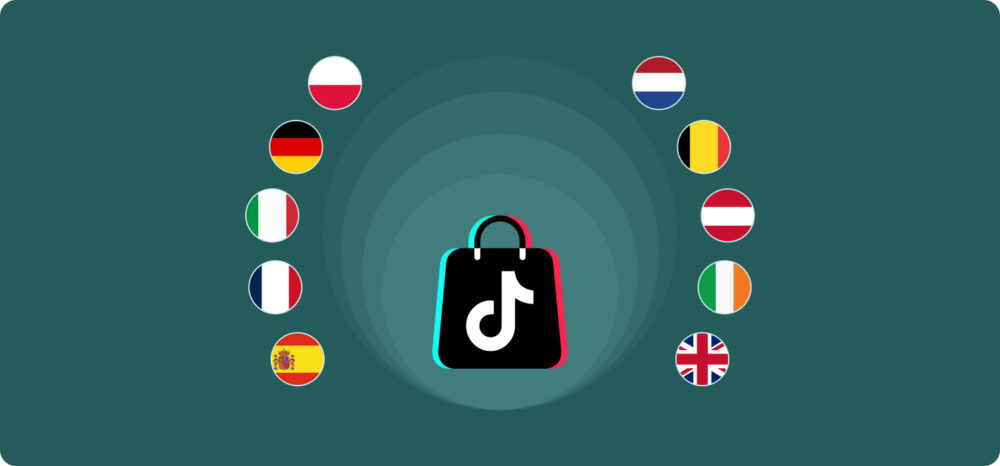
TikTok Shop arrived in Europe in phases. The UK was the first market, with the platform operating there since 2021. Spain and Ireland joined later, in late 2024, followed shortly after by France, Germany, and Italy. In just a year and a half since that second wave, the platform has gone from operating in a handful of countries to building a network of ten markets with a pan-European vision.
The data confirming the shift in phase is the consolidation of a base of over 100,000 active businesses in France, Germany, Ireland, Italy, and Spain, with triple-digit growth in daily Gross Merchandise Volume (GMV) between August 2025 and February 2026. In the UK, the most established market, the number of sellers had already exceeded 200,000 by the end of 2024. Therefore, the expansion into Austria, Belgium, the Netherlands and Poland continues a model that has already proven successful.
The Four New Markets and the Map they Complete
The four countries added since 15 June are Austria, Belgium, the Netherlands, and Poland. With them, TikTok Shop completes a European map of 10 markets. This map is significant because it shows an expansion strategy that combines mature markets, large economies, and bridge countries for cross-border trade.
The selection does not seem accidental. The Netherlands and Belgium provide a strong e-commerce culture and highly prepared logistics; Poland offers volume and digital dynamism; Austria adds an interesting position as a link market in Central Europe.
As a whole, the rollout reinforces the idea of a pan-European network where brands can test, adapt, and scale campaigns without rebuilding their operations from scratch in each country.
Sell Across Europe: What Changes for Sellers
The main operational update is “Sell Across Europe”, a single registration feature that allows selling in multiple TikTok Shop European markets without opening a separate account for each country. In practical terms, this reduces entry costs, simplifies sign-up, and facilitates the management of catalogues, orders, and customer service from a centralised structure.
For sellers, the change is important for three reasons:
- It allows for faster international expansion with less administrative friction.
- For each market, it helps with the localisation of listings and commercial messages, which is key in an environment where content sells as much as the product.
- It opens the door to more coherent cross-border operations, supported by logistics and partners compatible with the platform.
In practice, this makes TikTok Shop an attractive option for brands already working with creative assets, affiliation, and content campaigns, but which had not yet scaled outside their home country due to costs or operations. The entry barrier still exists, but it is lower than in other international marketplace models.

The Real Size of the Phenomenon, in Figures
Three figures help explain why this expansion is seen as a phase shift rather than just another step. First of all is the seller base: over 100,000 active businesses in the five most established markets. The second is the growth rate: a triple-digit increase in daily GMV in just six months. The third is the available audience: TikTok reaches 200 million users in Europe every month, the foundation on which this commercial growth is built.
Another key element is the role of creators. On TikTok Shop, conversion is closely linked to content generated by profiles that recommend products, perform demonstrations, or drive live sales. This explains why the platform places such emphasis on formats like shoppable videos, LIVE shopping, and product showcases within the profile, all with integrated checkout.
All these data points place TikTok Shop within a broader market dynamic, where social commerce is starting to behave like a structural sales channel rather than an experimental initiative linked to specific campaigns.
Opportunities for Spanish Brands and Retailers
Spain starts with a relative advantage because it was one of the first European markets to activate TikTok Shop. Furthermore, it has a seller base, operational experience, and accumulated learning.
Spain as an advanced market for TikTok Shop
For Spanish brands, the timing is particularly interesting. The local market can function as a laboratory for content, affiliation, and conversion before scaling to other European countries. TikTok Shop allows for quick testing of categories, messages, and bundles, which is very useful in sectors such as beauty, personal care, fashion, or consumer goods.
Moreover, data coming from Spain shows that the channel already attracts a broader buyer base than is usually associated with TikTok. There is a significant weight from adult audiences and a purchasing dynamic closely linked to content. According to Nielsen IQ data, Generation X accounts for 44% of spending on platforms like TikTok Shop, followed by Millennials at 33%, while Generation Z, despite having higher interaction levels, represents only 15.3% of total spending.
This data nuances the widespread idea that social commerce is an exclusively young phenomenon. It opens the door to content strategies aimed at audiences with higher purchasing power.

Keys for a winning strategy
The expansion to ten markets and the arrival of Sell Across Europe facilitate entry, but do not guarantee conversion. For the traffic generated on TikTok Shop to translate into sustained sales, it is necessary to connect social content with a solid product base. We are talking about complete listings, high-quality images, and stock availability synchronised between the social platform and the brand’s own channel. This integration between social commerce and digital shelf is what prevents the impulse generated by a video or a live stream from being lost due to an incomplete product page or misaligned pricing across channels.
Having visibility over how the product is presented in each market and on price consistency between TikTok Shop and the rest of the sales channels becomes especially relevant when operations are multiplied across ten countries.
Challenges and Next Steps for Social Commerce in Europe
The accelerated growth of TikTok Shop is not without friction. The platform has publicly acknowledged the rise in fraud linked to the use of generative artificial intelligence: in the first half of 2025 alone, it blocked more than 70 million fraudulent products and removed 700,000 seller accounts for policy violations, 40% more than in the previous period. Fake listings, ghost sellers, and domains imitating the platform’s appearance are part of the same phenomenon that accompanies any rapidly growing channel.
For brands operating or considering operating on TikTok Shop, this adds a layer of vigilance. Verifying that the listings appearing under their name are legitimate and that the shopping experience matches what the brand has designed. As the platform adds markets and simplifies access for new sellers, content governance and brand protection become as relevant as the commercial strategy itself.
The expansion to ten markets and the arrival of Sell Across Europe confirm that European social commerce has entered a scaling phase. The challenge for the coming months is no longer geographical, but one of governance. Demonstrating that this growth can be sustained without losing control over content, products, and buyer trust.