
From Data to Action: Prescriptive Intelligence Agents for Your Retail Catalogue
TL;DR
flipflow’s alerts already flag every anomaly in your catalogue: a price increase, a stock-out, a lost Buy Box. The prescriptive intelligence agents go a step further: they diagnose the root cause and deliver the prioritised action to take, in minutes rather than days.
The Cost of Finding Out Late
An unauthorised seller sets their price 6% below the reference price on Amazon. The Buy Box, which had been in the official distributor’s hands for weeks, changes owner within minutes. No one on the brand’s team notices: it’s Friday afternoon. But the algorithm managing that listing doesn’t rest at weekends.
On Monday, the e-commerce analyst opens their laptop with a coffee and a spreadsheet running to hundreds of rows. They find the drop in sales, but it takes hours to work out what caused it: Has a competitor cut their price? Is there a stock-out no one has logged? Has something changed on the product listing? By the time they reach an answer, the problem has already been eroding margin and positioning for three days.
This scene repeats, with variations, across most e-commerce, trade marketing and pricing teams managing catalogues present across multiple retailers and countries. The problem isn’t a lack of data — there’s more data available today than ever. It’s the gap between the moment something happens and the moment someone has the full context needed to act on it.
That’s why we’ve launched our Retail Agents: a suite of 15 agents that replaces the weekly spreadsheet review with continuous monitoring of price, stock, visibility and reputation across all your retailers and countries. From today, your team will stop asking what happened and start receiving the answer to why it happened, with a concrete action already on the table.
What a Retail Agent Is, and What It Isn’t
A retail agent isn’t an automated alert, nor a dashboard with extra charts. It’s a process that combines real-time data ingestion with an analytics engine capable of cross-referencing variables and forming a hypothesis about the root cause of an anomaly before proposing an action.
That’s exactly where it differs from traditional monitoring. The agent doesn’t just show that something has changed — it tries to explain why it has changed. A drop in Share of Shelf could be down to a stock-out, a change in the retailer’s algorithm, or an aggressive competitor campaign. Telling these three causes apart determines whether the right action is replenishing inventory, reviewing the product listing, or adjusting Retail Media spend.
How a Recommendation is Built: From Signal to Action in 5 Steps
The process behind every recommendation the agent makes follows five consistent steps:
- Data ingestion: flipflow’s automated, continuous collection of prices, stock, search and advertising data across every retailer and country in the catalogue.
- Cross-analysis: The engine links sales variations to changes in content, bids or competitor activity, identifying patterns that aren’t visible when each metric is analysed in isolation.
- Hypothesis testing: The agent rules out unlikely explanations and isolates the most plausible cause (an algorithm penalty, a regional stock-out, aggressive competitor pricing) before recommending anything.
- Prioritised recommendation: The proposed action is ranked by urgency and potential sales impact, rather than presented as a flat list of incidents.
- Human decision: The team reviews the evidence, validates or dismisses the recommendation, and decides how and when to act.
This order matters because it reverses the usual logic of analytics dashboards. Instead of delivering data for the team to manually build a hypothesis, the agent delivers an already-validated hypothesis for the team to confirm and act on.
The Agents, Grouped by What they Monitor
Our agents operate as a specific module within flipflow. Below, we present the agents grouped by the solution they belong to and what they monitor:
Digital Shelf Analytics Agents – Digital visibility and positioning
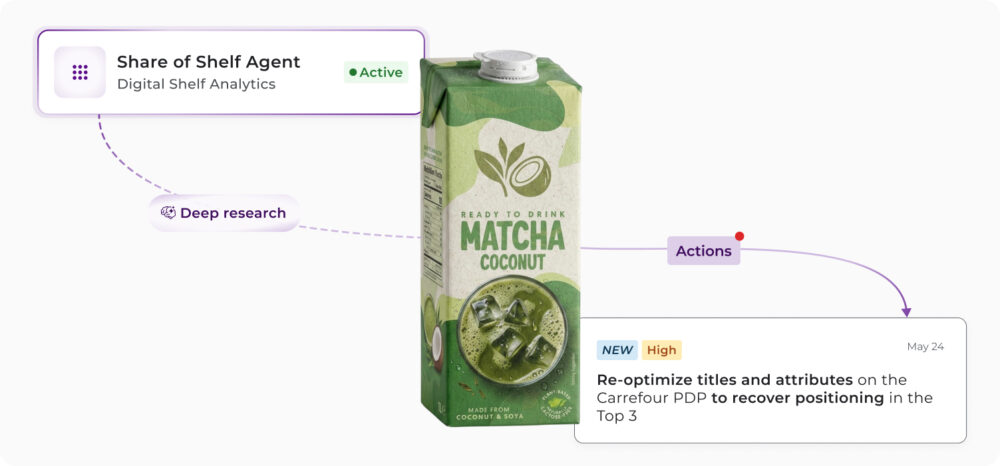
- Share of Shelf Agent: monitors organic rankings for the catalogue’s key search terms and flags when competitors overtake the brand, before the drop affects sales.
- Shelf Stock Agent: measures the real Stock Ratio at each retailer and flags stock-outs before ranking algorithms penalise you.
- Brand Reputation Agent: analyses reviews and sentiment to identify what might be behind a low or negative rating.
- Retail Media Agent: detects poorly targeted ad spend, helping prevent your budget from going to waste.
Pricing & Seller Control Agents – Prices, promotions and marketplace control
- Price Audit Agent: logs the history of increases and decreases to show whether a retailer is consistently undercutting the reference price.
- Promotion Audit Agent: tracks active promotions across each channel and checks they match what was contractually agreed.
- Buy Box Supervisor Agent: monitors Buy Box ownership in real time and detects listing suppressions before they’re mistaken for a genuine stock-out.
- Stock-Out Risk Agent: analyses inventory sell-through speed to anticipate stock-outs within 24-to-72-hour windows.
- Unauthorised Reseller Penalty Agent: identifies 3P sellers operating outside the official channel on marketplaces and Google Shopping.
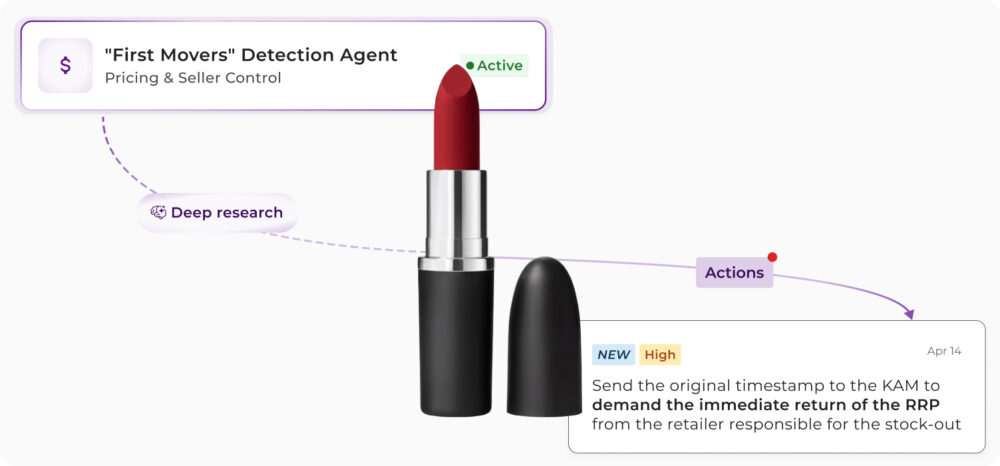
- First-Mover Detection Agent: traces the chronological sequence of a price drop to pinpoint the retailer or seller who triggered it.
Territorial Intelligence Agents – Territorial coverage and assortment
- Regional Price Monitoring Agent: maps price dispersion by country, region or postcode to stop local deals from affecting your brand’s perception.
- Regional Promotion Audit Agent: checks whether agreed campaigns are being run correctly at each local branch, or whether there are unjustified gaps by region.
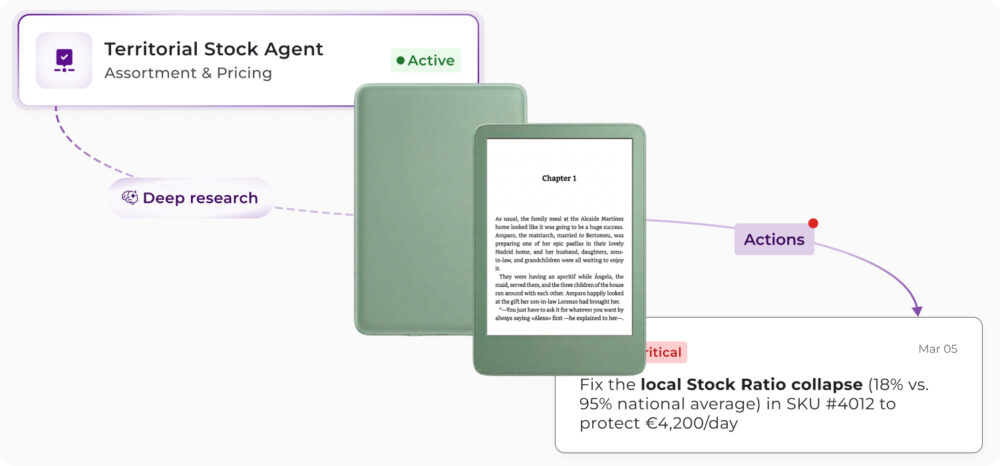
- Territorial Stock Agent: evaluates the Stock Ratio by geographic area or delivery point and isolates availability failures at local branches.
- Assortment Analysis Agent: compares the contracted catalogue against the template agreed with each retailer to detect silent delistings.
- Shelf & Private-Label Tracking Agent: flags when a retailer replaces your references with its own private label in high-conversion zones, and detects SKUs being sold outside the official catalogue.
The Final Decision Still Rests with People
Every retail agent works on a human-validation model: the agent recommends, the team decides. Each one can be switched on or off independently, depending on what’s needed in a particular area. And none of them acts autonomously by default.

This validation reflects a practical necessity, not just generic caution. Every brand’s commercial strategy carries nuances (contractual agreements, channel sensitivities, regional priorities) that no automated model can grasp without the judgement of whoever manages the account. That’s why every recommendation comes with the supporting data and reasoning behind it, so it can be checked before anyone acts on it.
Enterprise-Grade Security from Day One
The information these agents process (prices, margins, commercial agreements) is sensitive by definition. That’s why the infrastructure behind it is aligned with GDPR requirements and holds ISO 27001 certification. Each account’s data stays isolated through end-to-end encryption, is never shared between clients or used to train third-party models, and users and teams can be managed with granular profiles and permissions.
Less Time Investigating, More Time Deciding
Back to Monday morning’s analyst: the goal of the agents of prescriptive intelligence isn’t to replace their job. It’s for them to open their laptop and already find a validated hypothesis and a concrete action awaiting approval, rather than a blank spreadsheet to interpret. That’s the difference between reacting to what’s already happened and acting while there’s still something that can be done about it.