
What a Digital Shelf Analytics Agent Sees (and Recommends) About Your Catalogue
TL;DR
The digital shelf changes constantly: a search ranking, a product listing, or a review can decide a sale before the shopper even reaches the point of purchase. Digital Shelf Analytics agents monitor these signals 24/7, identify the root cause of every anomaly, and recommend the specific action to fix it, always under the team’s validation.
The Digital Shelf is Now the First Point of Contact with your Product
Before comparing prices or reading a product page, most shoppers start at a search engine or a retailer’s category page. According to Salsify’s 2026 Consumer Research, two out of three shoppers (67%) engage in “webrooming” (researching a product online before buying it in a physical store), while more than half (53%) do the reverse. The digital shelf is no longer just another channel. For most shoppers, it’s now the first point of contact with the product, wherever the purchase ultimately takes place.
This has a direct consequence for any brand present across multiple retailers. Product perception is no longer shaped at the physical point of sale, but by the whole set of signals a shopper sees before ever reaching it. A lost search position, a listing with outdated stock information, or a recent unanswered review can weigh as heavily on the purchase decision as the product itself.

That weight is also reflected in the size of the market that monitors this shelf: the global Digital Shelf Analytics market stands at around $2.11 billion in 2026 and is growing at close to 12% a year, according to Business Research Insights. As Ashley Becker, Global Vice President of E-commerce at Kraft Heinz, summed up at this year’s Digital Shelf Summit:
That alignment is precisely what these agents aim to provide. Rather than adding more data to a team that already has too much, they organise the data that already exists so it can be acted on without delay.
What Digital Shelf Analytics Agents Monitor (and What They Don’t)
In our first article in this series, we explained what a retail agent is: a process that combines real-time data with an analysis engine capable of forming a hypothesis about the root cause of an anomaly before proposing an action. Digital Shelf Analytics agents apply that logic to a specific area. Everything that determines whether your product is seen, found and chosen at the moment a shopper is deciding.
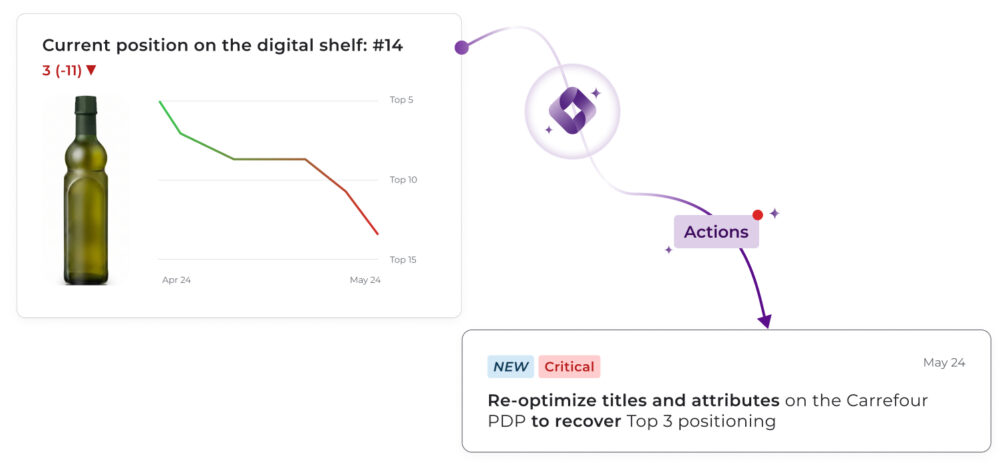
A common example illustrates the difference from traditional monitoring well. One product loses positions in a retailer’s internal search engine, dropping from the Top 5 to 14th place within days. A conventional dashboard would show that drop as an isolated data point. Leaving the team to manually investigate whether it’s down to a stock-out, a change in the retailer’s algorithm, or a competitor reoptimising their listing. Our Digital Shelf Analytics agent cross-references those variables automatically. It isolates the most likely cause and proposes a specific action before the team even has to ask the question.
This monitoring covers organic positioning in each retailer’s internal search engine, real stock availability on each listing, review sentiment, Retail Media spend efficiency, and price and promotion consistency against what was agreed. It does not, however, cover the management of unauthorised sellers on marketplaces or channel-level Buy Box tracking, which fall under the Pricing & Seller Control agents, nor regional assortment coverage, which is handled by the Territorial Intelligence agents.
The Digital Shelf Analytics Agents, One by One
Here’s what each agent monitors, the anomaly it detects first, and the action it typically triggers:
Share of Shelf Agent
It monitors organic positions for the catalogue’s key search terms and flags when competitors push the brand out of the Top 10/20 before the drop shows up in sales. For example, it can flag that a product has fallen from 3rd to 14th place with a specific retailer and suggest which listing attributes to review first.
On-Shelf Stock Monitoring Agent
It measures the real Stock Ratio at each retailer and flags stock-outs before positioning algorithms penalise the listing, distinguishing between an actual stock-out and a simple data synchronisation issue. 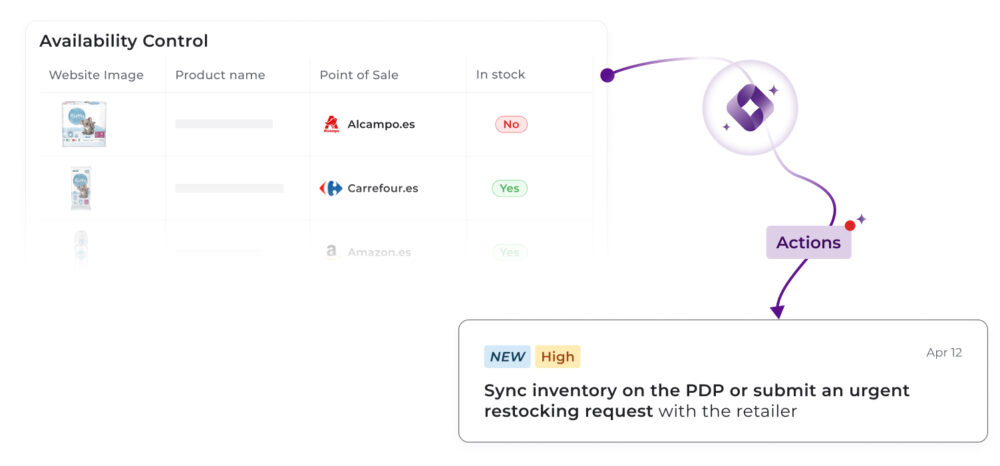
Brand Reputation Agent
It analyses reviews and sentiment to determine whether a low rating stems from a product defect or a distributor’s delivery failure, preventing both cases from being treated as the same problem. 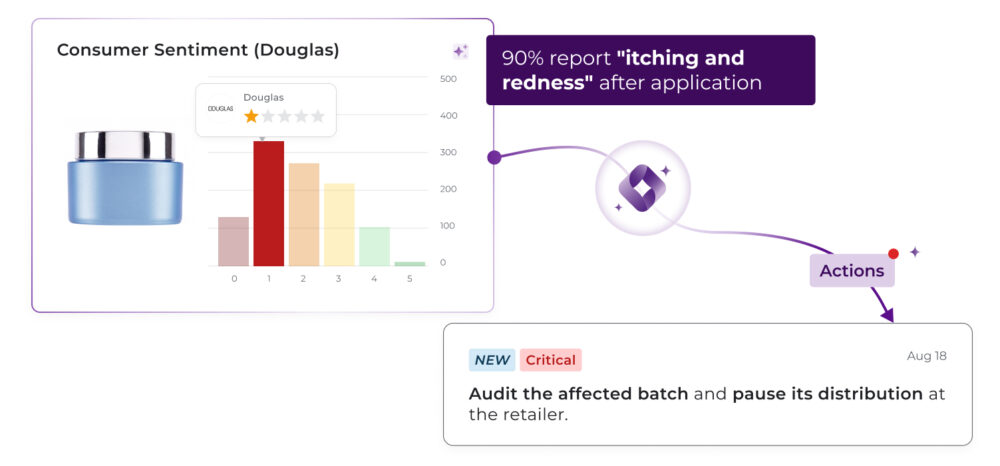
Retail Media Audit Agent
It detects whether you’re paying for keywords you already lead organically, or whether a bid is sponsoring a listing with no stock available, two common ways of wasting advertising budget. 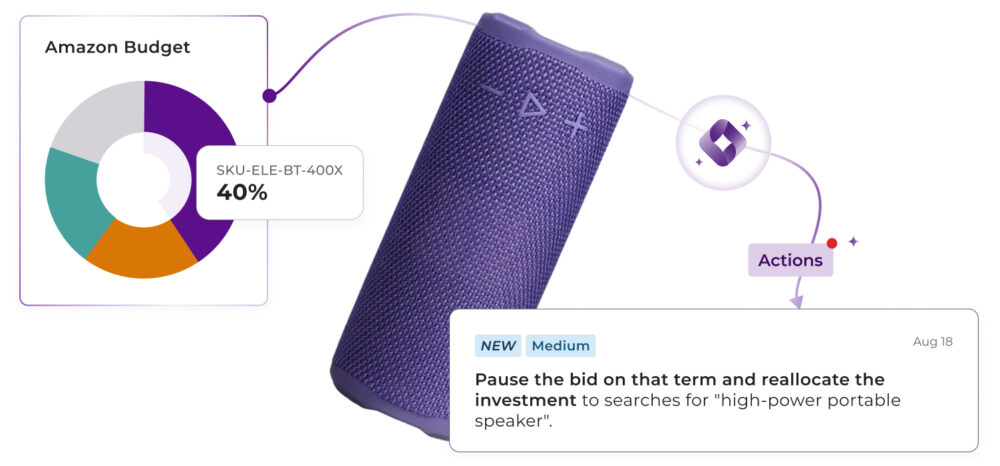
Price Audit Agent
It logs the history of price rises and falls to show whether the reference price is being steadily eroded on any channel, providing the evidence needed to raise the issue with the retailer in question. 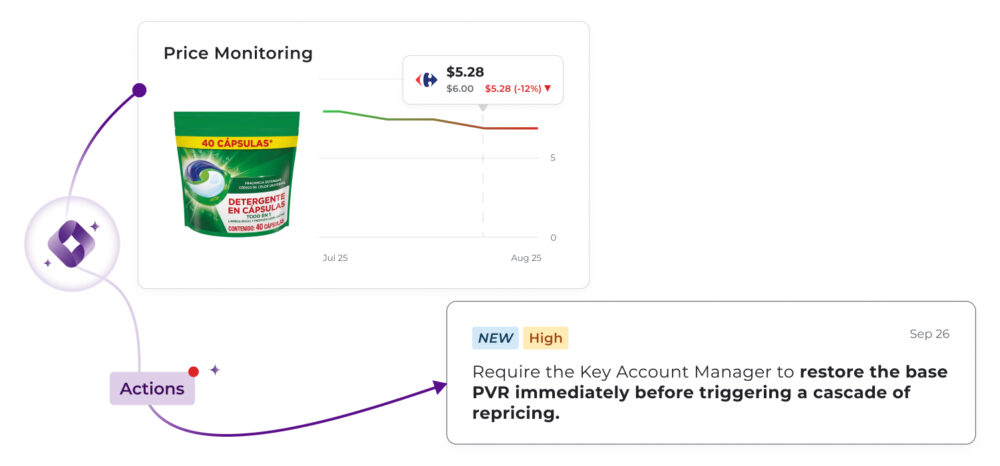
Promotions Audit Agent
It checks that active offers at each point of sale match what was agreed, and flags unauthorised promotional mechanics before they erode the base rate. 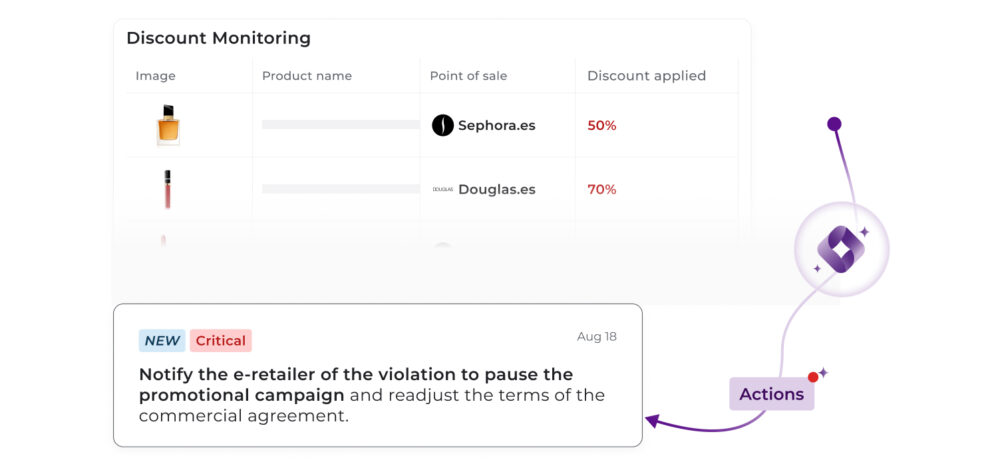
Unauthorised Reseller Penalisation Agent
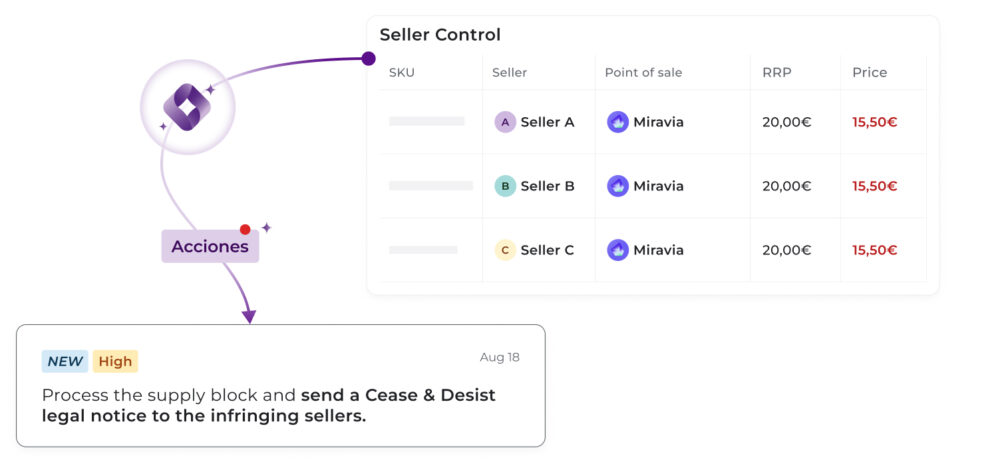
It identifies unofficial resellers on Google Shopping and marketplaces operating outside the agreed channel, providing the evidence needed to take action against them.
The common thread running through all seven is the same. Each one cross-references signals that used to live in separate reports in order to isolate the cause of a visibility drop and propose the corresponding action, rather than leaving the team to reconstruct it manually week after week.
What Changes when These Agents Are Active
The change isn’t measured only in what the team stops doing, but in when they receive the information. Previously, a drop in positioning or a stock-out would be discovered when reviewing a report, usually days after it had started affecting sales. With the agents active, that same anomaly arrives complete with its likely cause and a specific action, the moment it happens.
That shifts the work of the e-commerce and trade marketing team from one place to another. Less time cross-referencing spreadsheets or ruling out false alarms, and more time validating and executing the action the agent has already prioritised. The catalogue no longer depends on a periodic review to stay under control, because the monitoring is continuous rather than occasional. And because this monitoring never stops, not even at weekends or on public holidays, anomalies that used to be detected several days late (by which point they had already eroded sales or positioning) are now caught while there’s still room to correct them.
The Decision Still Rests with the Team
Like the rest of the retail agents, the Digital Shelf Analytics agents operate under a human-validation model. Each one can be switched on or off independently, none acts autonomously by default, and every recommendation comes with the supporting evidence so the team can verify it before acting.
That validation isn’t a generic precaution; it’s a practical necessity. Two products with the same visibility problem may require different responses. This depends on the current commercial agreement with each retailer, the strategic priority of each region, or the sensitivity of each channel. Nuances no automated model can grasp without the judgement of whoever manages the account. That’s why the agent doesn’t execute. It prepares the ground so that the person who does understand those nuances can decide in minutes rather than days.
The information these agents process — prices, stock, advertising spend — is also sensitive by nature, so the underlying infrastructure is aligned with GDPR requirements and holds ISO 27001 certification. Each account’s data remains isolated through end-to-end encryption and is never shared between customers or used to train third-party models.
Start Where it’s Needed Most
You don’t need to activate all seven agents at once to start noticing the difference. Most teams that adopt this layer of monitoring start with the agent that solves the problem costing them the most right now. And add the rest as that first agent proves its value within the team.