
The average shelf price of coffee falls in 4 out of 6 European markets from June to September
TL;DR
The average price falls in four of the six markets, and private label keeps its price advantage everywhere except the Netherlands. National brands dominate the shelf in terms of assortment, but are scaling back their promotional pressure. We compared 22 coffee brands (5 national brands and 17 private labels) in Belgium, Spain, France, Italy, the Netherlands and the United Kingdom between June and September 2026.
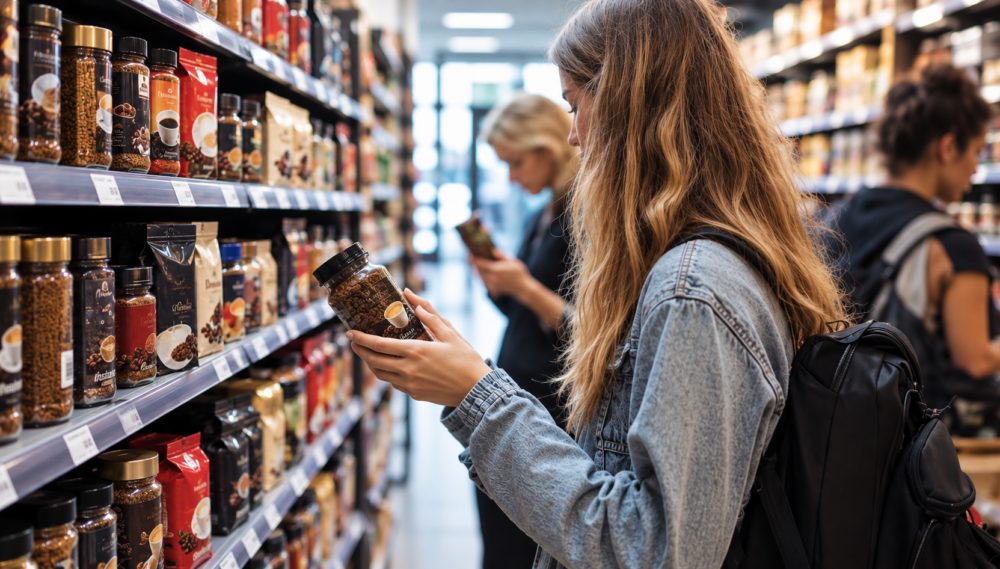
Coffee is going through one of its most volatile periods. According to the latest coffee market report published by the International Coffee Organization (ICO), after topping $3 per pound at the end of 2025, its benchmark price has gone through a series of drops and rebounds throughout 2026. In August it was trading 11.5% lower than a year earlier, but was far from stabilising.
This volatility reaches the shelf with a delay and unevenly, depending on the country, the retailer and the brand. And it reaches consumers who have been turning to private labels for years to ease the pressure of the cost of living on their households. According to Circana’s latest analysis of the European fast-moving consumer goods market, private label market share has reached 50% for the first time in France, Germany, Italy, the Netherlands, Spain and the United Kingdom.
In a category as everyday and as price-sensitive as coffee, the shelf, both physical and digital, becomes a point of friction between the major national brands and retailers’ own private labels. Who sets the price? Who takes up more space? Who relies more on promotions?
At flipflow, we compared Illy, Lavazza, L’Or, Nescafé and Starbucks with 17 private labels from the leading retailers in six European markets in June and September 2026. The result: a shelf where the same brand can have the lowest average price in one country and the highest in another, and where, in some markets, private label already costs more than national brands.
What our study on coffee in Europe analyses
The report compares 5 national brands (Illy, Lavazza, L’Or, Nescafé and Starbucks) with 17 private label ranges from the leading retailers in each country: Hacendado, Dia or Carrefour in Spain; Tesco or Sainsbury’s in the United Kingdom; Conad and Esselunga in Italy; Delhaize and Boni in Belgium; and Albert Heijn’s Perla Rossa and Perla Superiore in the Netherlands, among others.
The analysis looks at the shelf across four dimensions:
- Average price: by country, by brand and comparing national brands with private labels.
- Assortment depth: number of listed SKUs for each brand.
- Promotional pressure: percentage of SKUs on promotion.
- Format mix: capsules, ground, beans, instant and RTD (ready to drink), with their price normalised per unit.
Average price: the Netherlands soars while the rest get cheaper
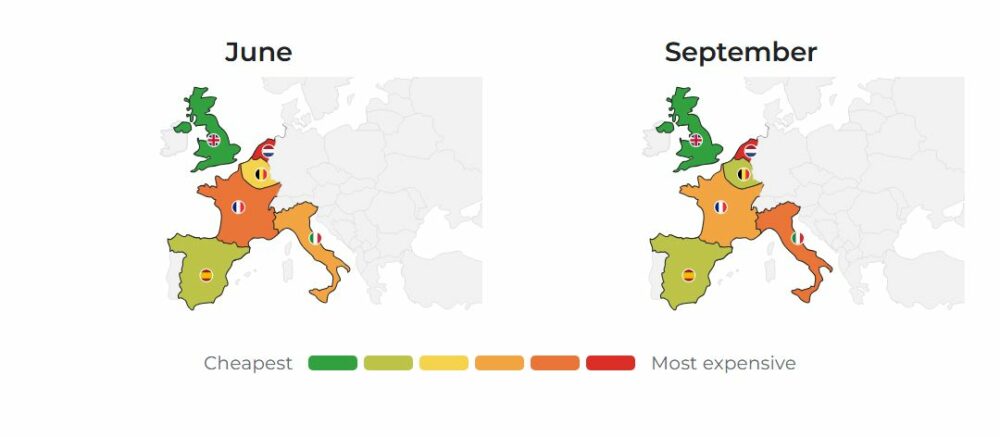
The average price of coffee falls in four of the six markets from June to September. The sharpest drops are in Belgium (from €7.51 to €5.60, down 25.4%) and Spain (from €7.26 to €5.60, down 22.9%), followed by the United Kingdom (–13.0%) and France (–7.7%).
The exceptions are Italy, which rises 8.6% to €8.25, and above all the Netherlands, the most expensive market in both periods, which goes from €9.76 to €13.70 (+40.4%). At the opposite end, the United Kingdom is the cheapest market in both months (€6.15 in June and €5.35 in September).
Lavazza has the highest average price and Starbucks the lowest, except in the Netherlands
Among national brands, Lavazza has the highest average price in five of the six countries, peaking at €15.45 in France and €16.84 in Italy in September. The exception is the Netherlands, where L’Or reaches €22.39 and accounts for much of why that market is the most expensive in the study.
At the other end, Starbucks has the lowest average price in those same five markets, with a low of €3.42 in the United Kingdom. But in the Netherlands it breaks the pattern and sits in the highest price band (€13.36).
For a brand, this confirms that there is no such thing as a European price. The same brand can be the cheapest option in one country and one of the most expensive in another, depending on the assortment and formats each retailer lists, as happens with Starbucks in the Netherlands. That is why a uniform European pricing policy does not reflect the reality of the shelf.
The gap with private label: an advantage in every market except the Netherlands
Comparing the average price of both brand types shows how much more shoppers pay for choosing a national brand in each country.
Spain is the market with the widest gap: in September, national brands cost an average of €8.07 compared with €3.53 for private labels, 128% more. It is closely followed by Belgium, where national brands cost twice as much as private labels. These two markets are also home to the cheapest private labels in September: Auchan in Spain (€1.38) and Boni in Belgium (€2.02).
France is where private label loses the most ground. Price increases by Auchan (+11.0%) and Carrefour (+10.8%) narrow the gap from €3.46 in June to €2.85 in September: national brands go from costing 69% more to 51% more.
The Netherlands is the big exception: there, private label is more expensive than national brands, with a negative gap of between 24% and 27% (€16.57 compared with €12.55 in September). Albert Heijn’s own ranges, with Perla Rossa at €21.34 (data from a single store), are positioned closer to premium coffee than to a budget alternative.
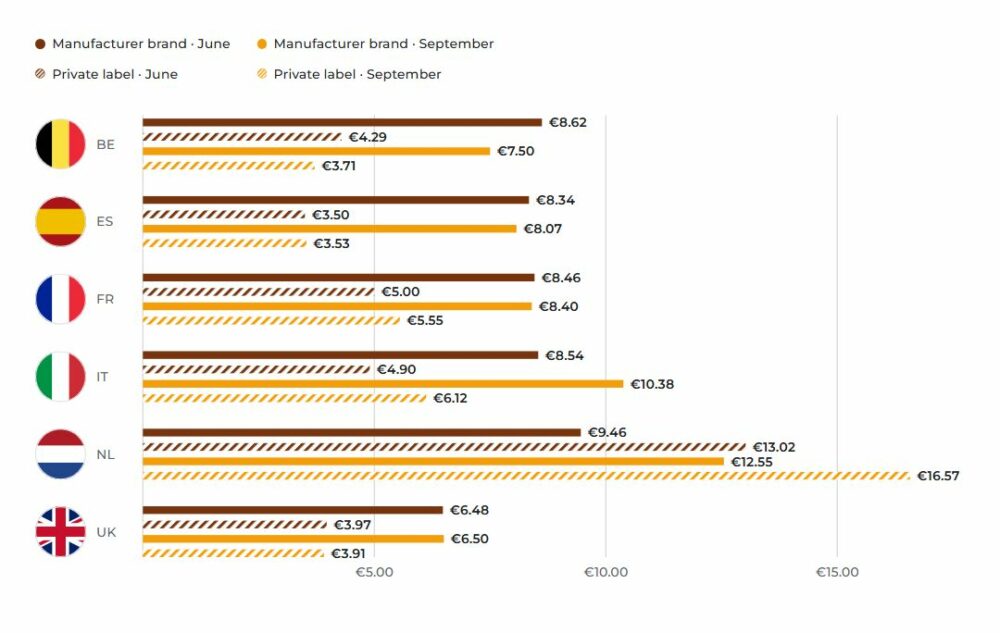
For pricing teams, the takeaway is clear: the gap with private label moves faster than it seems. In France it has narrowed by 18 points in a single quarter due to price increases in retailers’ own ranges, without national brands changing their prices. Monitoring private label prices is therefore just as important as monitoring your own.
And since this gap also varies from market to market, coffee pricing is decided country by country.
Assortment: national brands dominate the shelf, but the battle is fought retailer by retailer
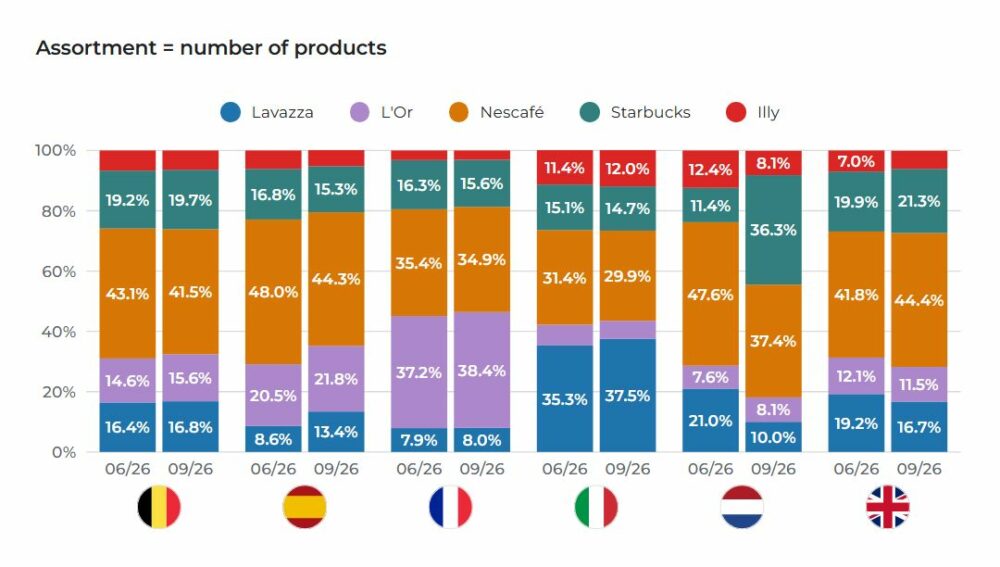
National brands outnumber private labels in SKUs in all six countries and in both periods. Across all markets, their assortment grows from 3,526 (in June) to 4,552 (in September) SKUs, while private label assortment remains practically flat (from 1,029 in June to 1,039 in September).
This growth is concentrated almost entirely in France, where the total assortment (national brands and private labels) doubles from 1,007 (June) to 2,119 (September) SKUs, and national brands list more than eight times as many products as private labels (1,896 compared with 223). In contrast, Belgium cuts its total assortment by 41%, from 1,150 to 676 SKUs.
Nescafé leads almost every shelf
Nescafé is the national brand with the largest assortment in four of the six countries (Belgium, Spain, the Netherlands and the United Kingdom), which is consistent with a portfolio highly segmented by format and flavour. The exceptions are France, where L’Or leads (from 305 to 729 SKUs), and Italy, where Lavazza leads in its home market (180 and 188 SKUs). Illy keeps the smallest assortment in most markets, in line with a more selective, premium positioning.
Albert Heijn expands; Delhaize, Esselunga and Ocado cut back
By retailer, Albert Heijn records the strongest growth: Starbucks goes from 11 to 97 SKUs between June and September, and Nescafé from 34 to 82. Elsewhere, the opposite trend prevails: Delhaize, Esselunga and Ocado reduce their assortment across all five national brands. At Delhaize, for example, Nescafé drops from 107 to 58 SKUs.
Ultimately, assortment is won and lost at each retailer. While Delhaize, Esselunga and Ocado cut SKUs from every national brand, Albert Heijn multiplies them. For a brand, losing half its SKUs at a key retailer directly reduces consumers’ purchase options, even if price and promotions stay the same. Detecting these delistings early makes it possible to act with the retailer before they turn into lost sales.
What’s more, a larger assortment does not require more promotion: Nescafé maintains the widest shelf coverage with the lowest promotional pressure in the category.
Promotional pressure: national brands promote less (except in Belgium)
Unlike assortment, promotional pressure falls from June to September for four of the five national brands at European level.
Illy, the most promoted; Nescafé, the least
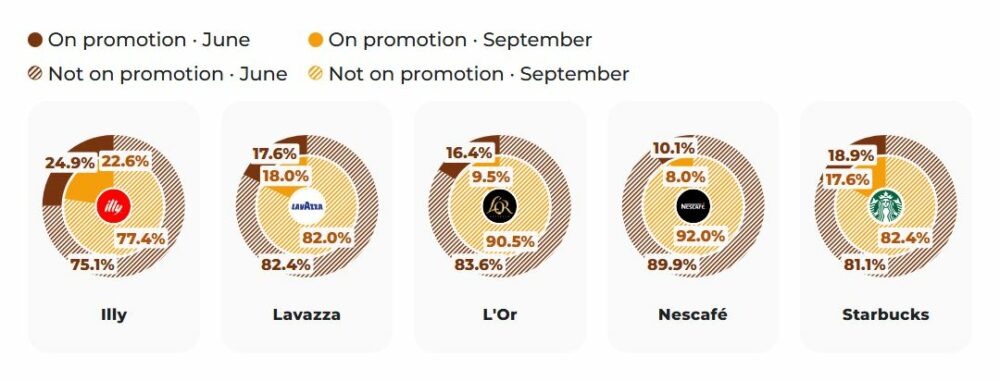
Illy is the brand with the highest promotional pressure in both periods: 24.9% of its SKUs were on promotion in June and 22.6% in September. Nescafé is consistently the least promoted (10.1% and 8.0%). The contrast is striking: the brand with the largest assortment is also the one that relies least on discounts, which points to a strategy based on availability rather than price.
L’Or cuts its promotional activity the most (from 16.4% to 9.5%), while Lavazza is the only brand to increase it, albeit slightly (from 17.6% to 18.0%).
The Netherlands, the most volatile; Belgium, against the tide
The Netherlands has the highest and most volatile promotional activity in the report. In June, four of the five national brands had more than 44% of their SKUs on promotion. In September the drop is dramatic: Illy goes from 45.8% to 0% and Lavazza from 46.3% to 15.6%. France, on the other hand, is the most restrained market: no brand exceeds 15%.
Belgium goes against the tide. Every national brand except Nescafé practically doubles its promotional pressure: Lavazza goes from 17.3% to 43.9%, while Starbucks and Illy reach 29.7%. This coincides with the sharp assortment cut in the country: fewer SKUs on the shelf, but under more promotional pressure.
Conad, Auchan and Carrefour, the most promotional private labels
Among private labels, Conad (Italy) maintains the highest promotional pressure in the study: 65.9% of its SKUs were on promotion in September. It is followed by Auchan in Spain (45.5%) and Carrefour in France (38.6%). At the opposite end, Hacendado drops from 39.6% to 6.2%, a swing more consistent with one-off campaigns than with a change in strategy.
For national brands, private label promotions matter as much as their own: an aggressive private label campaign instantly widens the price gap perceived by shoppers, even if national brand prices have not moved.
Formats: capsules rule, except in the United Kingdom and the Netherlands
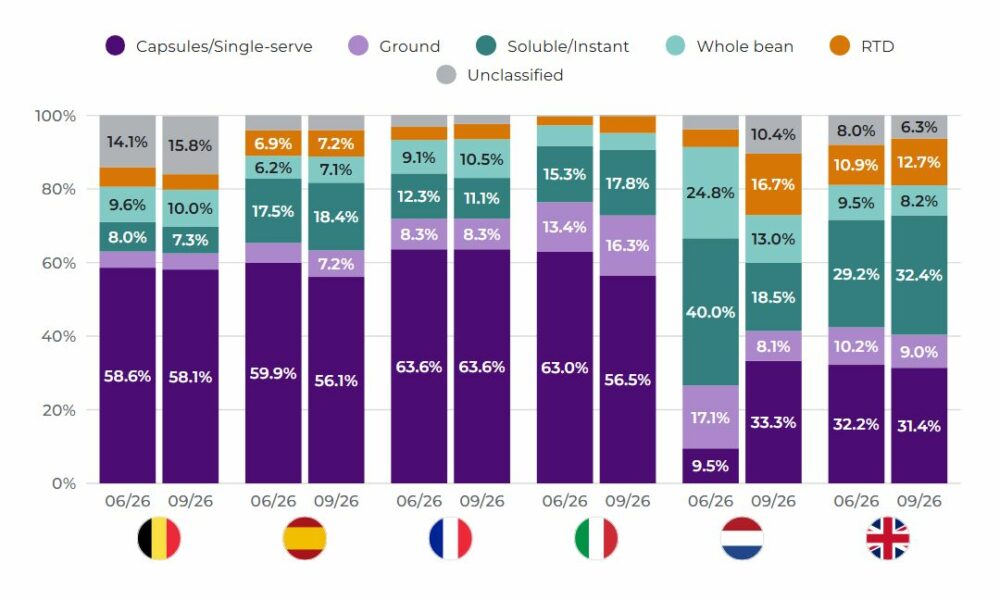
Capsules are the dominant format on the European shelf. In September they are the leading format in the national brand assortment in five of the six markets, with shares of between 56% and 64% in Belgium, Spain, France and Italy. France is the country most focused on capsules (63.6% in both periods).
The two exceptions are the United Kingdom, where instant coffee even overtakes capsules in September (32.4% compared with 31.4%) and RTD (ready to drink) reaches 12.7%, and the Netherlands, the most changeable market: capsules go from just 9.5% of the national brand assortment in June to 33.3% in September, while instant coffee falls from 40.0% to 18.5%.
Each brand has its speciality
- Nescafé dominates instant coffee (from 512 to 679 SKUs) and, together with L’Or, is the brand with the most capsules (884 and 799 SKUs in September).
- L’Or focuses mainly on capsules, around 70% of its assortment.
- Starbucks leads ready-to-drink coffee (from 136 to 215 RTD SKUs), ahead of Nescafé.
- Lavazza is the most traditional: its ground and bean assortment (from 308 to 411 SKUs) exceeds its capsule range.
- Illy maintains a shorter portfolio split between capsules, ground coffee and beans.
When price is normalised per unit, Illy sets the ceiling and Nescafé the floor. An Illy capsule costs between €0.48 and €0.50, compared with €0.33–0.38 for Nescafé, a price consistent with the latter’s broad coverage strategy.
In short, format redefines competition. In the United Kingdom and the Netherlands the battle is also fought in instant and RTD, not only in capsules, and replicating one market’s mix in another can leave a brand out of what consumers actually buy.
Conclusion: Nescafé, the brand with the strongest presence on the European coffee shelf
Of all the brands analysed, Nescafé takes up the most shelf space. It is the national brand with the largest assortment in four of the six countries (Belgium, Spain, the Netherlands and the United Kingdom), leads instant coffee with 679 SKUs and is the brand with the most capsules, with 884 SKUs in September.
Its case shows that presence does not depend on promotion: Nescafé is also the brand that relies least on discounts, with only 8.0% of its SKUs on promotion in September. Its strategy is based on being available in every format and every market, rather than competing on price.
Even so, its leadership is not absolute. L’Or leads in France and Lavazza in Italy, and at retailers such as Delhaize its assortment has been cut almost in half in a single quarter. On a shelf this fragmented and changeable, even the brand with the strongest presence needs to know at all times where it is gaining and losing space against its competitors and private label.
—————————————————————————————————