
Retail 2026: The 7 Unmissable Predictions that will Define the Coming Year
Retail is entering a decisive phase of transformation. Looking ahead to 2026, the sector will reach a tipping point where technological experimentation and consumer volatility will give way to a new competitive criterion: the ability to operate with efficiency without losing emotional relevance.
Why will 2026 be a Tipping Point?
The year 2026 will represent the moment when the technological promises of the current decade become established as everyday realities. The global economic context suggests moderate growth in consumption, marked by constant pressure on corporate profit margins. On one hand, operational and logistical costs remain a challenge; on the other, the consumer displays a complex duality.
Today’s shopper is extremely price-sensitive due to accumulated inflation, yet paradoxically they are willing to pay a premium if the service offers absolute convenience or an exceptional experience. This gap forces brands to be surgical in their strategy. There is no room for waste or generic value propositions.
In this environment, artificial intelligence, the explosion of Retail Media and advanced automation will act as filters. We are facing a year of “natural selection” in the sector. Those companies that fail to integrate technology to optimise their processes and truly know their customer will face critical difficulties in maintaining their competitiveness.
2026 will not be a year for observers. It will be a year for actors.
What will be the 7 Unmissable Predictions for Retail in 2026?
Below, we analyse the trends that will set the agenda for the sector’s executives and entrepreneurs during the coming year.
Prediction 1: Generative AI becomes the new brain of retail
Artificial intelligence will stop being a pilot experiment to become the backbone of commercial operations. It is expected that 80% of retailers will implement AI solutions by the end of 2025, and in 2026 we will see its maturation into truly transformative applications.
It is no longer about basic chat bots. In 2026, generative AI will operate end-to-end: it will personalise offers in real-time, adjust prices according to demand, optimise the assortment per store, generate marketing content tailored to each segment and manage customer service through natural conversations capable of resolving complex incidents.

For the customer, the effect is immediate: a fluid and precise experience. Whether in the physical store or on the app, they find exactly what they are looking for, at the right price and with recommendations that add value. In the background, AI systems process millions of signals in real-time to make this possible.
The critical point is this: 58% of shoppers already use generative AI tools instead of traditional search to discover products. And 67% allow themselves to be influenced by AI-driven adverts while browsing. The consumer is not waiting for retail to adopt the technology; they have already incorporated it into their purchasing process.
What will be crucial in 2026 is the transition from AI that supports human decisions to AI that makes autonomous decisions with human supervision. Those who manage to balance operational speed and strategic control will set the market pace.
Prediction 2: Retail Media moves from tactical channel to revenue empire
If 2025 was the year when retailers woke up to the potential of Retail Media, 2026 will be the year they capitalise on it as a main line of business.
Global investment in Retail Media will reach approximately $196.7 billion in 2026, representing 16% of all digital advertising spend. In the United States, advertisers will spend more than $69 billion in 2026 alone. To put it in context: this figure will exceed the combined investment in linear TV and connected TV in 2026.
The real value of Retail Media lies in its ability to close the advertising attribution loop. Unlike traditional media, where it is difficult to measure the direct impact on sales, Retail Media allows brands to know exactly how many units they sold thanks to a specific advert.

For retailers, this evolution represents a golden opportunity: converting their digital platforms and physical spaces into high-margin advertising revenue streams. Stores are no longer only places to sell own products. They have become media where brands compete for consumer attention.
The key to success in 2026 will be expanding beyond traditional sponsored search adverts towards visual formats, off-site advertising and immersive in-store experiences. The retailers that build full-funnel advertising offers, capable of generating both brand awareness and immediate conversion, will capture the bulk of this growth.
Prediction 3: Radical omnichannel retailing: the customer shops everywhere at once
The concept of shopping in a physical store or on a website separately has become obsolete. In 2026, we live in the era of radical omnichannel experiences. The shopping journey is a constant flow that seamlessly integrates the web, mobile applications, social media, and physical stores in a way that is invisible to the user.
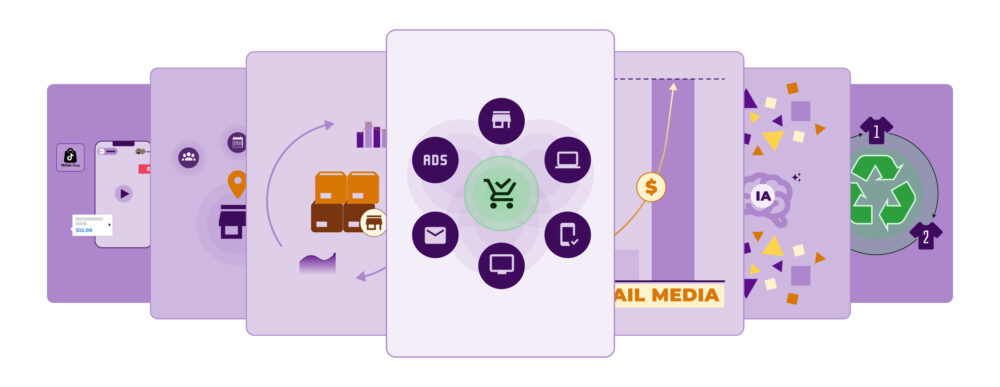
The majority of consumers combine channels and use various touchpoints before deciding on a product. A customer might discover an item in a short video on a social network, check reviews on the mobile app while walking to the store, and finally buy it there to have it delivered to their home two hours later.
To meet this demand, advanced logistics solutions have been standardised. In-store collection of online orders (BOPIS), the use of smart lockers at strategic points and ultra-fast deliveries from urban stores themselves are basic services. The physical store continues to concentrate a large part of total transactions, but its main function has changed: it now also acts as a local logistics hub and a multi-channel customer service point.
Prediction 4: Data-driven assortments and hyperlocal segmentation
The standardisation of stores is losing ground to personalisation by location. Thanks to the use of big data analytics, retailers are adjusting the assortment of each establishment according to the specific audience of its neighbourhood or area of influence.
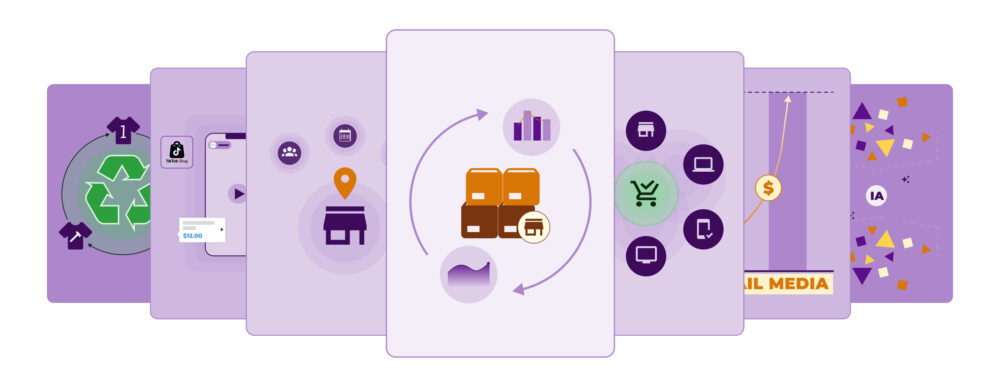
This hyperlocal assortment strategy allows a store from the same chain in a university neighbourhood to offer radically different products from those in a store located in a family residential area. Technology analyses local purchasing patterns, nearby events and even weather forecasts to decide which products should be on the shelf.
The importance of this approach lies in financial optimisation. By having exactly what the local customer is looking for, product turnover is improved and periods of out-of-stock are reduced. Likewise, the need to apply large discounts to clear products that do not fit the audience of a specific area decreases. The key metrics to evaluate success in your segmentation and assortment strategy in 2026 will be sales per square metre per segment and the reduction of forced markdowns due to excess inventory.
Prediction 5: The physical store as an experience and community centre (Retailtainment)
In 2026, the purpose of visiting a physical establishment will evolve. Consumers will not go to stores just to perform transactions that they could complete in seconds from their phone. Physical spaces will be transformed into centres for experiences, learning and community building, a concept known as retailtainment.
Brands will use their premises to host events, practical workshops and product demonstrations that provide added value. The fundamental metric for measuring the success of a location will move from being exclusively “sales per square metre” to considering “engagement per square metre”. The goal is for the time the customer spends in the store to strengthen their bond with the brand, which translates into long-term loyalty and sales across any channel.
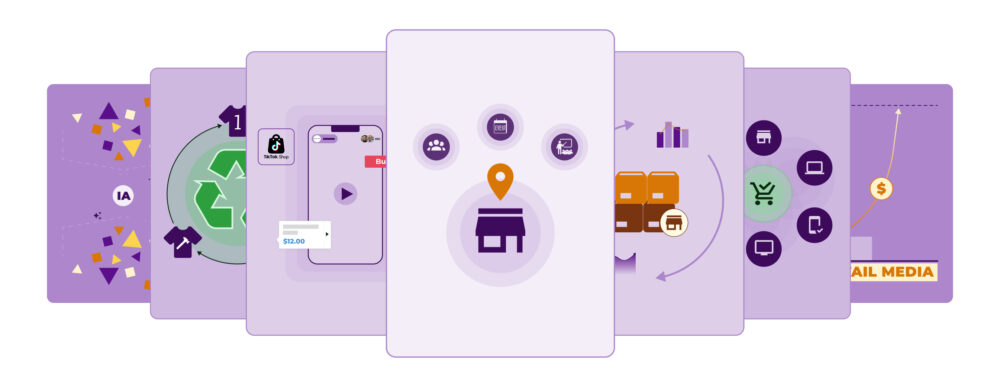
Technology will play a facilitating role: interactive screens that educate about products, augmented reality to visualise results, event booking systems integrated into apps and loyalty programmes that reward both purchases and participation in activities.
A practical example of this trend is a kitchenware store that devotes half of its surface area to an open kitchen where it offers classes at weekends. Customers do not just buy a knife or a pan; they learn a culinary technique, try the product in a real environment and share an experience with other enthusiasts. This emotional connection is something that pure e-commerce cannot replicate.
Prediction 6: Social Commerce 2.0 and Livestream Shopping
In 2026, livestream shopping will occupy the place in the digital ecosystem that home shopping had in the nineties: a legitimate, scalable sales channel fully integrated into consumption habits. Social buying will evolve towards increasingly deep native integrations on platforms such as TikTok, Instagram or YouTube, minimising the distance between discovery and conversion. Following the model already consolidated in Asia, livestreaming will become a commercial pillar in the West.
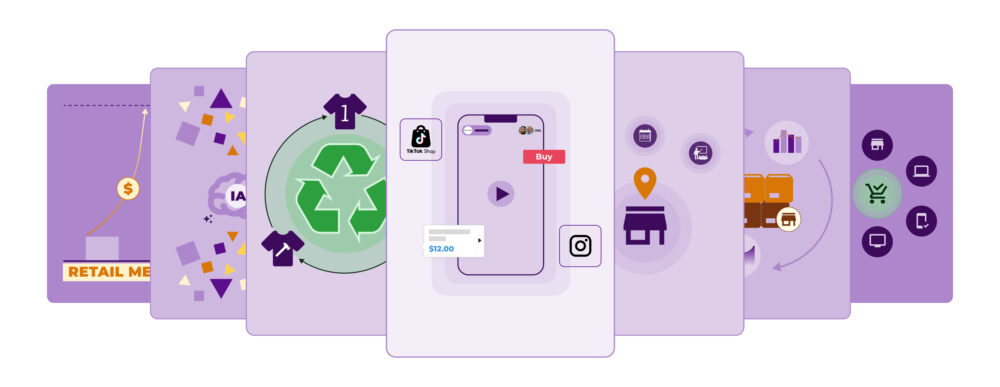
Leading brands will operate with dedicated social commerce teams, capable of producing specific content for each platform, collaborating with micro-influencers to activate niche audiences and relying on advanced analytics to optimise the timing, format and message of each broadcast. Performance supports this bet: various benchmarks indicate that TikTok Shop livestreams convert 3 to 5 times more than standard product videos, thanks to real-time interaction and exclusive offers. In terms of results, live shopping studies place typical conversion rates in a range of 10% to 30%, up to ten times more than traditional e-commerce, which usually moves between 2–3%
The key to its effectiveness is simple: the purchase occurs natively, without friction. The result is an experience that combines demonstration, interaction and immediate conversion.
Imagine a beauty brand launching a new facial serum. Instead of resorting to a static advert, it organises a live session with a professional makeup artist. Viewers observe the results in real-time, access exclusive discounts valid only during the broadcast and buy instantly. This combination of entertainment, urgency and ease of payment is redefining acquisition and market share, especially among younger generations.
Prediction 7: Sustainability stops being a plus to become a standard
Environmental awareness has moved from being a niche market concern to an indispensable requirement for commercial survival. In 2026, consumers are better informed than ever and actively penalise “greenwashing” or empty ecological promises.
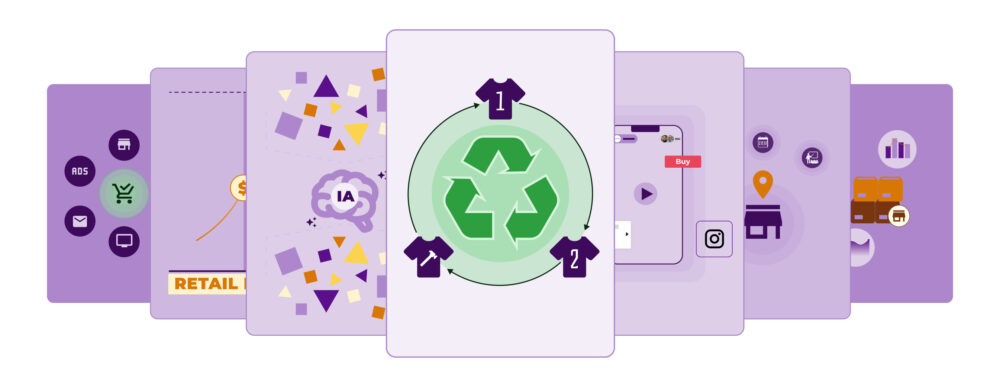
Sustainability is now demonstrated with data and transparency. Supply chain traceability, the use of truly eco-friendly packaging and the adoption of circular economy models are determining factors in the purchase decision. The customer wants to know where what they buy comes from, who manufactured it and what will happen to the product when its useful life ends.
A practical example of this trend is the implementation of the “product passport”. Using a QR code, the consumer can access all the information about the item’s life cycle: from the origin of raw materials to the options for resale, rental or repair. Companies that facilitate the second life of their products, whether through their own platforms for used items or maintenance services, are gaining the trust of a consumer who values durability and ethical responsibility.
Conclusion and actionable recommendations for 2026
The retail landscape in 2026 will be demanding, but will offer unprecedented opportunities for those who know how to combine technology with human empathy. The key will not lie in adopting all innovations at once, but in selecting those that truly solve problems for the customer and improve the company’s efficiency.
To successfully navigate this coming year, these are some strategic recommendations:
- Audit your data management: Before implementing advanced AI solutions, ensure that your customer and inventory data is clean and centralised. AI is only as good as the data that feeds it.
- Explore Retail Media: If you are a retailer with your own digital traffic, analyse how to monetise that space by offering value to your suppliers. If you are a brand, start diverting part of your advertising budget towards these Retail Media networks where conversion is higher.
- Humanise your physical store: Evaluate the purpose of your square footage. Are they designed only to store products or to generate memories? Introduce training or entertainment elements that give the customer a compelling reason to travel to your store.
- Invest in transparency: Prepare your infrastructure to offer total traceability. The implementation of smart tags or digital passports is not just an ethical measure, it is a powerful marketing tool to connect with the conscious consumer.
- Simplify social shopping: Do not ignore the power of live video and native selling on social networks. Start with Livestream Shopping pilot tests to understand what type of content resonates with your audience and how to streamline the payment process on these platforms.
The next stage of retail will reward clarity of purpose: less noise and more real impact on the life of the consumer, delivering tangible value, honesty and ease in their day-to-day life.