
Goodbye Rufus: Amazon Launches Alexa for Shopping, its New AI Shopping Assistant
TL;DR
Amazon has taken a decisive step in its commitment to artificial intelligence applied to e-commerce. On 13 May 2026, the company unveiled Alexa for Shopping, an agentic assistant that replaces Rufus and, for the first time, can complete purchases on the user’s behalf even outside the Amazon marketplace.
From Rufus to Alexa for Shopping: What has Changed and Why
Rufus arrived in 2024 as Amazon’s AI shopping assistant. In two years, the tool was used by more than 300 million customers and helped generate nearly $12 billion in annualised incremental sales. Usage data was more than solid: Rufus users were 60% more likely to complete a purchase than those who did not use it.
However, the competitive landscape had changed. ChatGPT, Gemini and Perplexity had begun to position themselves as alternatives for searching and comparing products, threatening to become intermediaries between the consumer and shops. Faced with this pressure, Amazon has decided to take a qualitative leap. It has unified Rufus with Alexa+, its generative AI voice assistant, to create a shopping experience that is more integrated, more personalised and, above all, harder for the competition to replicate.
Rajiv Mehta, Amazon’s Vice President of Conversational Shopping, stated that the company realised that customers were starting shopping “missions” in one place and resuming them in another, as Rufus and Alexa did not share memory or context. The idea is that «the customer doesn’t have to think about where they started a conversation with Amazon», explained Mehta in an interview with GeekWire.
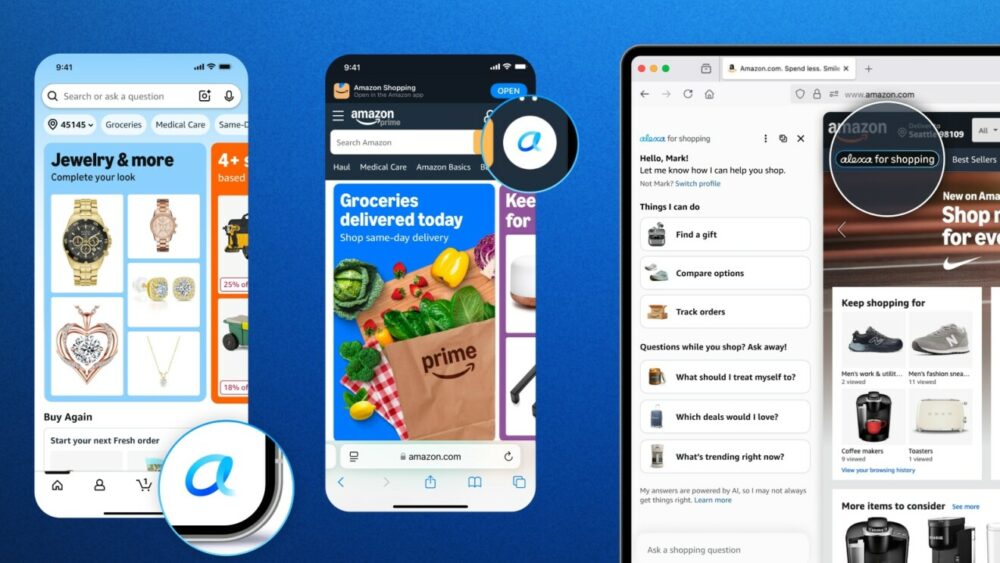
The result is Alexa for Shopping, available to US customers in the Amazon Shopping app, on the web and on Echo Show devices. Any user with an Amazon account can access it for free, without needing a Prime subscription or having any Alexa device.
Source: Meet Alexa for Shopping, your personalised, agentic AI assistant on Amazon – May 2026
How Alexa for Shopping Works: Key Capabilities
One of the first visible differences is the integration of the assistant directly into the Amazon search bar. Previously, users had to click on a chat bubble icon to open Rufus. Now, the icon with a cursive ‘A’ replaces Rufus across the entire app and website. And it allows questions to be asked in natural language without leaving the usual search flow.
These are the most relevant functionalities:
- Dynamic product comparisons: The assistant can select several items from search results and compare them side-by-side, analysing features, prices and ratings.
- Price history: Available for hundreds of millions of products, it allows users to check the price evolution over the last year directly from the product page.
- Alerts and automatic purchases: Users can ask the assistant to notify them when a product drops below a certain price or to buy it automatically at that moment, without needing to return to the app.
- Scheduled purchases: Through so-called Scheduled Actions, it is possible to set up recurring top-ups (detergent, pet food, vitamins) or ask the assistant to add items to the basket if certain conditions are met, such as the price falling below a threshold or at least two months having passed since the last order.
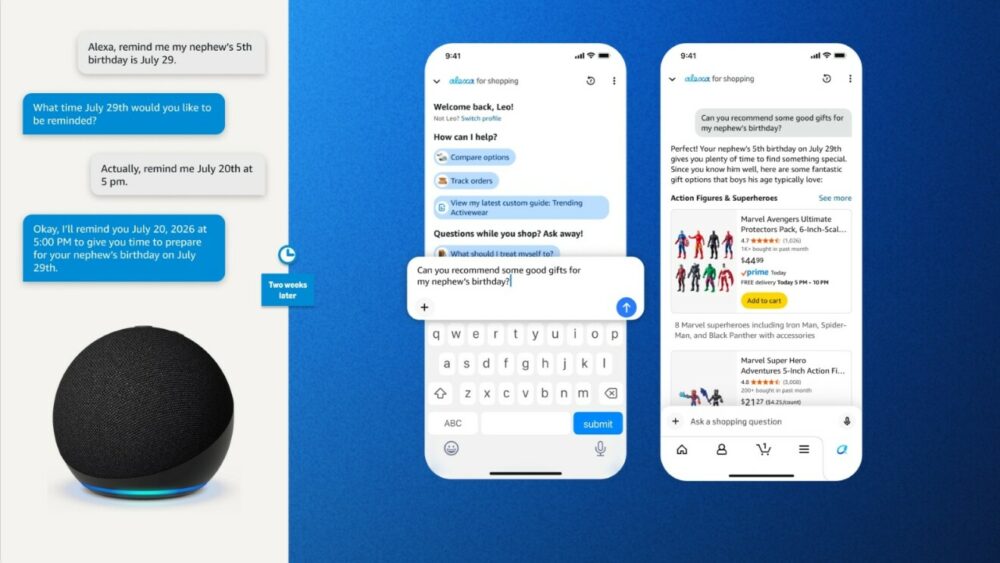
- Continuity between devices: What the user shares with Alexa on their Echo Show informs their shopping experience in the app, and vice versa. The assistant remembers previous conversations, preferences and habits, so there is no need to start from scratch in each session.
- Personalised shopping guides: For complex decisions such as buying a TV or preparing a gift, the assistant can generate a bespoke guide that compares options inside and outside Amazon.
Source: Meet Alexa for Shopping, your personalised, agentic AI assistant on Amazon – May 2026
Buy for Me: When the Assistant Completes the Purchase for You
The feature that has attracted the most attention, and also generated the most controversy, is Buy for Me. Thanks to this, Alexa for Shopping can locate a product on another retailer’s website and complete the purchase on the user’s behalf. To do this, it uses the payment and shipping details stored in the Amazon account.
Alongside Buy for Me, Amazon has enhanced Shop Direct, which allows products from third-party shops to be discovered from within the Amazon interface itself. This combination turns Alexa for Shopping into a shopping agent that operates beyond Amazon’s own catalogue, something unprecedented in the history of the platform.
The practical implication is significant. Users can ask the assistant to find a specific item, compare options from various retailers and authorise the purchase, all within the same conversation. For those who manage their regular shopping through Amazon, the time saving is evident.
The Competitive Context: Amazon vs the AI Giants
The launch of Alexa for Shopping responds to a clear dynamic: general AI assistants are entering the e-commerce field. OpenAI, Google and Perplexity have launched tools that allow products to be researched and, in some cases, purchases initiated through conversational interfaces.
Amazon has opted for a strategy different from that of its rivals. While OpenAI and Google work with open protocols that allow multiple brands to integrate with their agents, Amazon is building its own closed ecosystem, with its own data, catalogue and direct integration with its logistics infrastructure. CEO Andy Jassy summed it up clearly a few weeks ago in Amazon’s Q1 2026 Earnings Call:
At the same time, Amazon has actively blocked external agents from accessing its platform. In March 2026, a federal judge prevented Perplexity’s Comet browser from making purchases on Amazon on behalf of users, although the order was stayed pending appeal.
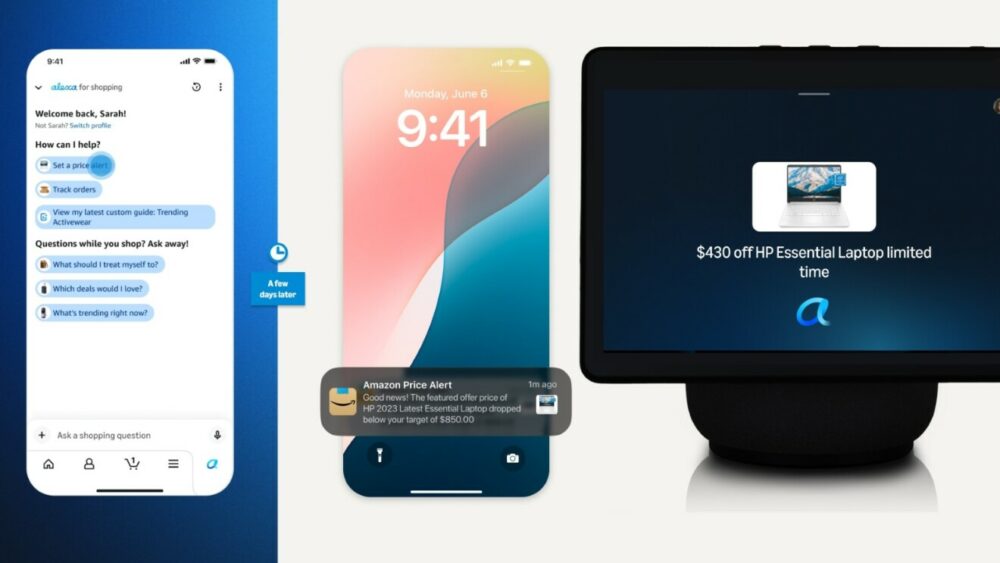
Source: Meet Alexa for Shopping, your personalised, agentic AI assistant on Amazon – May 2026
What this Means for Brands and Sellers
The impact of Alexa for Shopping on the Amazon seller ecosystem deserves attention. Amazon has integrated the assistant directly into the search bar. Furthermore, it shows AI-generated summaries at the top of results. All this alters the dynamics of one of the most valuable advertising spaces in digital commerce.
The sellers who invest in sponsored product advertising to appear in top positions may see those positions now competing with answers generated by the assistant. In parallel, the Buy for Me feature has generated tension with some external retailers. They point out they have not authorised Amazon to complete purchases on their websites on behalf of their customers. This raises certain questions about the ownership of the customer relationship.
E-commerce analyst Juozas Kaziukėnas has described the launch as “a graduation party for Rufus“: the beta label disappears and the assistant begins operating under the Alexa brand, with all the recognition that implies. According to the analyst himself, consumer familiarity with the Alexa name is far superior to that of Rufus. This should accelerate the assistant’s adoption.
Privacy and Control: What the User Needs to Know
Alexa for Shopping works because it accumulates context: purchase history, previous conversations with Alexa, stated preferences and browsing habits. This accumulation of data is what allows the assistant to be genuinely useful, but it also raises legitimate questions about privacy.
Amazon has enabled an Alexa privacy panel where users can review and manage what information the assistant holds. This includes stored voice recordings and preferences. Any user can check what the assistant knows about them with a simple question, and update or delete that information from the same panel.
Conclusion: E-commerce Enters the Era of the Agent
Alexa for Shopping represents a shift in model for how Amazon conceives the relationship between consumer and shop. For decades, the online shopping process has followed the same pattern: the user searches, filters, compares and decides. With an agentic assistant capable of tracking prices, remembering preferences and executing purchases autonomously, a growing part of that process passes into the hands of AI.
The challenge for Amazon lies in winning consumer trust for this level of delegation. For sellers and brands, it lies in understanding how to optimise their presence in an environment where the first point of contact could be a response generated by an assistant, rather than a traditional product page. E-commerce has been evolving for years. With shopping agents, that evolution has just entered a new phase.