
Prices and Discounts in Soy, Protein and Kefir Yogurts: An Analysis of the Spanish Market (2025)
TL;DR
Analysis data: trends in average price and average discount in Spain for kefir, protein yogurts and soy yogurts during September–December 2025, based on information from our SaaS (full details in the downloadable report).
The yogurt market is undergoing a period of readjustment in Spain: household consumption has been falling for two years, but the market value continues to grow due to the effect of inflation and the rise of higher value-added segments such as protein, kefir or plant-based alternatives. Yogurt accounts for around 13‑14% of spending on dairy products in the home, with nearly 9 kg per capita per year, and is impacted by cost pressure and the normalisation of farm-gate milk prices following the peaks of 2022.
In parallel, plant-based yogurts are accelerating: retail sales for this category reached approximately 93 million euros in 2024 in Spain, with cumulative growth exceeding 30% since 2022, driven by consumers looking for healthier and plant-based options. In this context of more selective consumption, greater price sensitivity and a search for functionality, understanding price trends and the role of promotions in soy, protein and kefir yogurts becomes key for dairy brands.
Price Trends by Type: Three Very Different Curves
Between September and December 2025, the three types analysed —kefir, protein and soy— sent mixed signals. There is no single trend in prices; instead, each segment responds to its own supply and demand dynamics.
This divergence forces manufacturers and retailers to make fine-tuned decisions: where they can defend margins, where adjustments are needed to sustain volume, and what role manufacturer brands and private brands play in each segment.
Kefir: upward trend with a final adjustment
The average price of kefir during the period moved upwards, with very pronounced behaviour in autumn.
- September: €2.30.
- October: €2.41 (+4.8% vs September).
- November: €2.55 (+5.8% vs October, +10.9% vs September).
- December: €2.48 (‑2.7% vs November, but still +7.8% vs September).
The dynamic is clear: kefir became progressively more expensive until November, when it peaked, and corrected slightly in December without losing the price level gained. This fits with a category where positioning revolves around added value, origin and “eco/artisan” attributes, providing room to pass on part of the cost pressures while maintaining willingness to pay.
Protein yogurts: downward adjustment and a new benchmark level
In protein yogurts, the movement was the opposite, with a price adjustment concentrated in the final stretch of the year.
- September: €2.33.
- October: €2.35 (+0.9% vs September, practically flat).
- November: €2.06 (‑12.3% vs October).
- December: €2.02 (‑1.9% vs November, ‑13.3% vs September).
The result is a downward “step”: the type entered December with an average price 13% lower than in September, suggesting a combination of higher promotional intensity, tactical repositioning by some brands and pressure from Private Brands as a lower-priced alternative.
Soy yogurts: one-off price increase and return to equilibrium
Soy exhibited a pattern of increases followed by a quick correction, with clear signs that the market does not support a structural price jump.
- September: €2.50.
- October: €2.69 (+7.6% vs September).
- November: €2.52 (‑6.3% vs October).
- December: €2.51 (‑0.4% vs November, +0.4% vs September).
The October price hike acted more as a “peak” than as a new stable level, and the category closed the year at practically the same price as the start. This suggests a delicate balance between the perceived value of plant-based yogurts and the price sensitivity of a consumer who, while willing to pay more for nutritional or sustainability attributes, continues to compare them with traditional dairy yogurts and Private Brands.
Brand Pricing Strategies: Private Brand Stability vs High-End Volatility
Behind these category averages are very different logics depending on the brand and the retailer. The report distinguishes clearly between the behaviour of Manufacturer Brands (MDF) compared to Private Brands (PB) in each type.
Kefir: volatility in the ultra‑premium segment
In Manufacturer Brand kefir, two blocks are observed: relatively stable brands and a very volatile ultra‑premium segment.
Among the stable brands, we find Activia (-1% between September and December) and Pastoret (-0.9% in the same period).
Volatility is concentrated in brands with ecological or artisan positioning (El Cantero de Letur and Granja Noé) and higher starting prices, pointing to active price management to avoid losing turnover in an environment of greater sensitivity to the final receipt. Both brands show very sharp drops from their peaks to December (‑15.3% and ‑30.4% respectively).
In Private Brands, the pattern is very different: restrained and practically flat prices. Hacendado sets the market floor, with almost entirely stable prices (‑1.8% September‑December). Dia is the exception, with a clear rise during the period (+8.2%). Carrefour plays the role of the “higher” Private Brands, with prices above €2.
Here, competition is defined more by positioning between retailers (Hacendado as the low-price reference, Carrefour as a premium Private Brand) than by inflation dynamics.
Protein: stable premium, one-off adjustments and “price-fighter” Private Brand
In protein yogurts, the segmentation between manufacturer and retailer is also highly visible.
In Manufacturer Brands, there is significant dispersion and movement, with a clear axis between stable premium brands and one-off adjustments. Pastoret maintains the highest price tier. YoPRO stands as a stable reference around €2.43 (‑1.2% in the period). Kaiku represents a distinct case: it rose sharply until November and fell notably in December (‑10.5% vs September), a pattern consistent with intense promotional actions.
In Private Brands, the picture is one of stability and a focus on price. Dia and Carrefour operate in the lowest band, with minimal price changes during the period. Alipende acts as a completely flat anchor. Hacendado is positioned as the highest Private Brand in the block, but with a gentle and controlled increase (+1.8%).
This confirms that, in protein, Private Brands function as “price fighters” and set the price floor, while Manufacturer Brands work more with brand value, innovation and highly tactical price management.
Soy: manufacturers at the top end and Private Brands as a stable lower step
In soy yogurts, the manufacturer price level is clearly above Private Brands and with very consistent positions.
Activia is the most premium brand and closed the period as the price ceiling. Alpro remains a stable “core”, with very contained variations. Sojasun provided the greatest variation: rising in October and correcting until December, with a fall of 3.9% compared to September.
In Private Brands, Hacendado set the minimum at €1.35, staying completely flat throughout the period. Consum cut slightly (‑1.9%) and Carrefour was the only one with a moderate increase (+3.1%).
Here, Private Brands do not seem to be the driver of average price fluctuations in the category, but rather a stable price base above which manufacturer brand adjustments move.
Discount Landscape: Moderate on Average, Uneven in Practice
If the average price explains “where the market is”, the discount explains “how it competes” week by week. The report shows a discount landscape where the average is restrained, but behaviour is very uneven across brands.
- Average discount for the set: ‑2.5% if non-promoted brands are included.
- Average discount only among discounting brands: ‑3.7%.
- Private Brands apply more aggressive discounts (average ‑5.1%) than Manufacturer Brands (average ‑1.3%).
This means that most brands use shallow tactical reductions, while a few push with strong promotions that end up moving the average and contributing to the perception of a “price war” on the shelves.
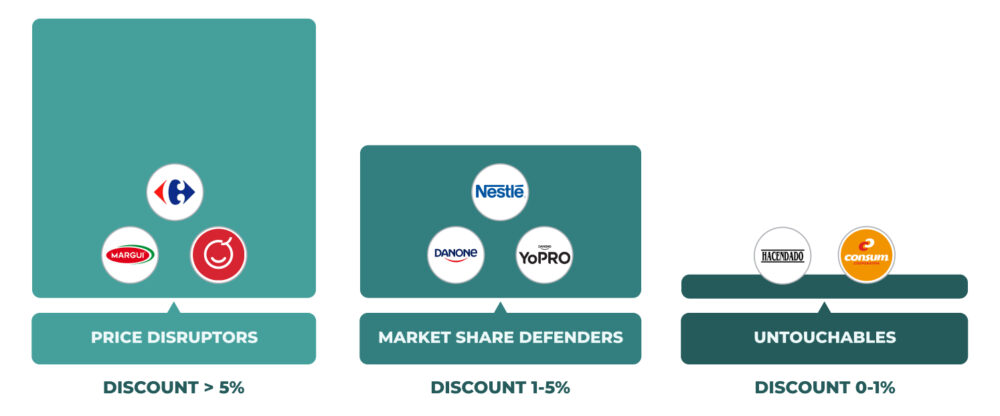
Price “agitator” brands: very aggressive promotions
A small group of retailers concentrated the deepest discounts (>5%). Carrefour (‑12.65%) was the most aggressive brand, with a strategy based not just on low base prices, but on intensive use of promotion.
MARGUI (‑9.95%) and Alipende (-7.92%) are niche brands that need to “shout offer” to capture attention compared to major manufacturers, or retailers that use promotion as a primary tool to reinforce their price positioning.
Brands with tactical discounts: defending volume without eroding too much margin
At a second level are the mainstream brands that combine shelf visibility with recurring promotions, but not as deep (discounts between 1% and 5%). At this level, we find brands such as Nestlé (-5.32%) or Danone (-4.42%).
These are traditional brands that are suffering pressure from Private Brands and are forced to sustain a high level of promotional activity to maintain volume, especially in types like protein, where Private Brands are gaining shelf space.
This group also includes cases like YoPRO, with a much more moderate average discount (‑1.60%), relying on brand value and a wide range without entering an aggressive promotional spiral.
“Untouchable” brands: stable prices and no promotions
At the opposite end are the brands that applied no discounts during the analysed period.
- Private Brands with an “everyday low price” strategy like Hacendado and Consum.
- Eco-artisan and premium brands like Pastoret, El Cantero de Letur or Casa Grande de Xanceda.
- Sojasun, which maintains its positioning without resorting to promotion.
In Private Brands , the logic is clear: prices already act as the category “floor” and temporary offers would lose meaning. In premium brands, foregoing discounts protects the perception of quality, origin and exclusivity, avoiding the dilution of positioning by entering the price conversation.
Key Points for Decision-Making: How to Use this Data in Pricing and Promotions
With these patterns, there are several lines of action that typically work well in categories like yogurt:
1) Separate strategy by type (do not apply a single recipe): Kefir tolerates high prices better when the value is clear; it is advisable to care for the premium architecture and avoid a constant promotional war. Protein yogurts require closer monitoring of price and promotions, because the market is more sensitive and Private Brands are pushing hard. Soy yogurts allow for working on a differential if there is a solid proposal; the gap relative to Private Brands is established, but it must be justified.
2) Review the role of promotion (frequency vs depth): The average discount is low, but the brands that “move” the market do so with depth. This forces a decision: Do you need to compete with one-off strikes? Or is it better to build stability and defend margins?
3) Control consistency between base price and promotion: Especially in protein, part of the drop in average price can be explained by adjustments and promotional dynamics. If your base price is high, the promotion can become a “crutch” and end up educating the consumer to expect a discount.
Roadmap for Commercial Management in the Yogurt Category
The analysis of the final months of 2025 reveals a yogurt market in Spain moving at two speeds. Value-added segments, such as kefir and protein, lead innovation and growth in value, but they do so under radically opposite pricing strategies: kefir bets on premiumisation and rising margins, while protein is immersed in a price war led by distribution.
Private Brands have ceased to be simply a cheap option and have become the market regulator. Their ability to maintain stable prices while simultaneously applying aggressive promotions at key moments forces manufacturer brands to be more creative in their commercial policy.
For companies in the dairy sector, the key to success in the coming months will not lie only in product quality, but in the ability to monitor competitor movements in real time. Understanding when an own-label brand lowers its price floor or when a direct competitor activates an aggressive discount campaign is fundamental to reacting in time and protecting both market share and profit margins.
The Spanish yogurt market is mature and highly competitive. In this scenario, data management and the precise analysis of price trends become the best tools for navigating a consumption environment that continues to evolve. And flipflow is here to help you achieve it.