
Decoding Assortment DNA: How Category Intelligence Transforms your Retail Strategy
TL;DR
Category Intelligence allows you to go beyond price and availability to understand how the competition builds their assortment and detect growth opportunities. Analysing formats, attributes, and segments transforms market analysis into more agile decisions with a greater business impact.
The End of the “Superficial View” of the Shelf
For decades, category management has operated under a two-dimensional view: availability and price. In the physical environment, category managers could walk the aisles, observe shelf space, and get a rough idea of their rival’s strategy. With the explosion of e-commerce and the fragmentation of sales channels, this visual observation has become impossible to scale manually.
The superficial view, which only looks at whether a product is present and at what price it is sold, is insufficient in a market saturated with options. Nowadays, consumers do not just choose a product because of its cost, but because of a series of intrinsic attributes that define its value proposition. Ignoring these details means losing sight of the real reasons why a customer chooses a competitor’s brand over ours.
Advanced data analysis allows for a complete dissection of every SKU in the market: Why has your competitor just launched that format? Which price segment are they strengthening and which are they abandoning? Which technical attributes are differentiating their products in the consumer’s mind?
Answering these questions requires a different approach: category intelligence. In this article, we explain what it is, how it is applied to competitor assortment analysis, and what specific advantages it offers to category management, trade marketing, and commercial strategy teams.
What is Category Intelligence?
Category Intelligence represents the highest level of maturity in product data analysis. It is defined as the process of gathering, processing, and analysing data within a specific segment to obtain a holistic view of the market.
Applied to retail, this discipline combines pricing analysis (Pricing Intelligence) with assortment analysis (Assortment Intelligence). According to specialised sources such as dunnhumby, smart category management integrates consumer behaviour science with operational execution. It is not simply about accumulating data, but about understanding how the structure of a category influences value perception and the final purchase decision.

Category Intelligence uses algorithms to group products not just by name, but by their shared characteristics. This allows analysts to observe cross-cutting trends affecting an entire group of products, enabling much more precise and well-founded decision-making.
The difference between analysing products and analysing categories
There is a fundamental distinction between tracking individual products and analysing an entire category:
- Product analysis: Focuses on the performance of a specific SKU, its price evolution, and its stock. It is a tactical view, necessary for day-to-day management.
- Category analysis: Observes the forest instead of the trees. It examines how visibility shares are distributed, how formats offered by different brands vary, and which segments are growing.
While product analysis answers the “what”, Category Intelligence answers the “why” and “where to”. It allows you to identify whether a competitor’s growth is due to a star product or a structural strategy of diversifying their catalogue.
A manufacturer that only analyses products knows that their competitor has twelve yoghurt references. One that applies category intelligence understands that those twelve references cover four price segments, prioritise single packs over family packs, and have incorporated three new functional attributes in the last six months. This reading completely changes portfolio, price, and launch decisions.
What does it Mean to Analyse the Competitor’s DNA?
The concept of “Assortment DNA” refers to the internal structure that defines how a competitor builds their catalog. Just as biological DNA contains the instructions that determine the development of an organism, Assortment DNA contains the strategic instructions that explain why a catalog takes the shape it does.
Decoding it requires working with at least three dimensions of analysis.
Formats and packaging
Format and packaging are strategic decisions, not aesthetic ones. They reveal which consumption occasions a competitor is aiming for, which channels they prioritise, and which buyer profile they are targeting. It is one of the clearest indicators of a rival’s logistics and segmentation strategy.
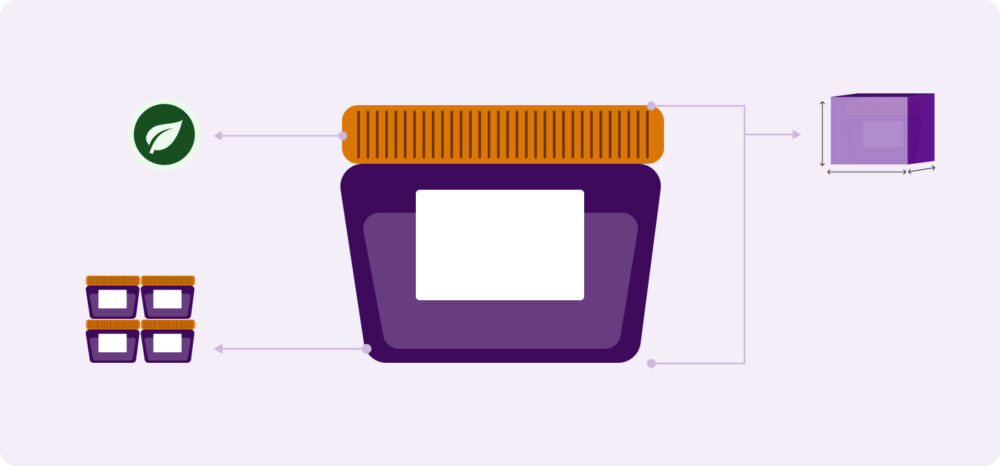
By analysing the packaging, we can extract crucial information:
- Sizes and volumes: Is the competitor opting for “value” formats to increase the average transaction value or “single-dose” formats to capture the convenience consumer?
- Sustainability: The type of material (recycled, compostable, plastic-free) has become a differentiating attribute that, in many cases, justifies a price increase.
- Multipacks and bundles: Product grouping strategy reveals attempts to improve inventory turnover or to protect margins against direct price comparisons.
Continuously monitoring these movements allows you to anticipate where the market is moving before sales data confirms it.
Ingredients and technical attributes
For FMCG brands or sectors like cosmetics and electronics, analysing internal components is vital.
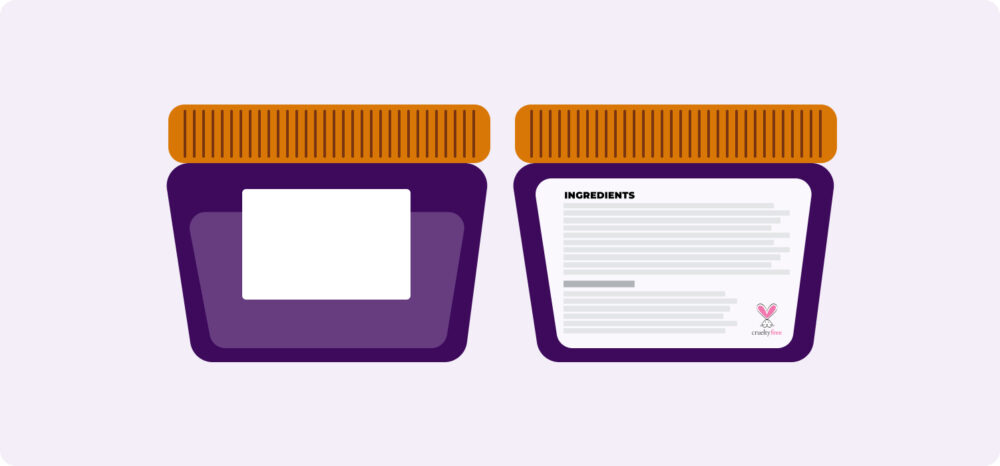
Category Intelligence allows you to track:
- Key ingredients: The presence of components such as “plant-based protein”, “hyaluronic acid”, or “biodegradable materials”.
- Certifications: Seals such as Organic, Vegan, Gluten-Free, or energy efficiency certifications.
- Technical specifications: In technology, attributes such as battery life, resolution, or software compatibility define real competition clusters.
Systematically analysing the ingredients and attributes of competitors’ new launches allows you to identify which positioning territory they are moving into and, consequently, where it is advisable to strengthen your own proposition.
Catalog segmentation
Assortment DNA also reveals how a competitor divides their offering to cover different customer profiles.
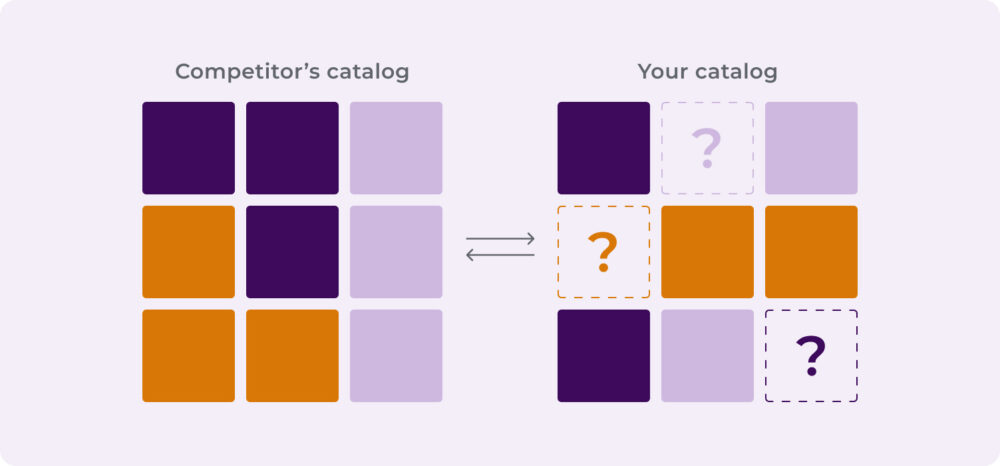
Segment analysis allows you to identify:
- Level of premiumisation: What percentage of the catalog is destined for the luxury or high-value segment.
- Private Label vs. Manufacturer Brands: How a retailer balances their own assortment against leading brands.
- Specialisation: Whether the competitor is focusing their efforts on specific niches (e.g. athletes, large families, or senior profiles).
Reading that segmentation allows you to identify areas free from direct competition and sectors where the market is saturated.
What Strategic Signals does this Analysis Reveal?
Access to this structured data acts as an early warning system for any retail company. The signals emanating from the competitor’s Assortment DNA have a direct impact on the bottom line.
1. Gap detection
An assortment gap is a demand space not covered by your own catalogue or insufficiently covered by the market in general. Identifying them accurately is one of the most direct returns of Category Intelligence.
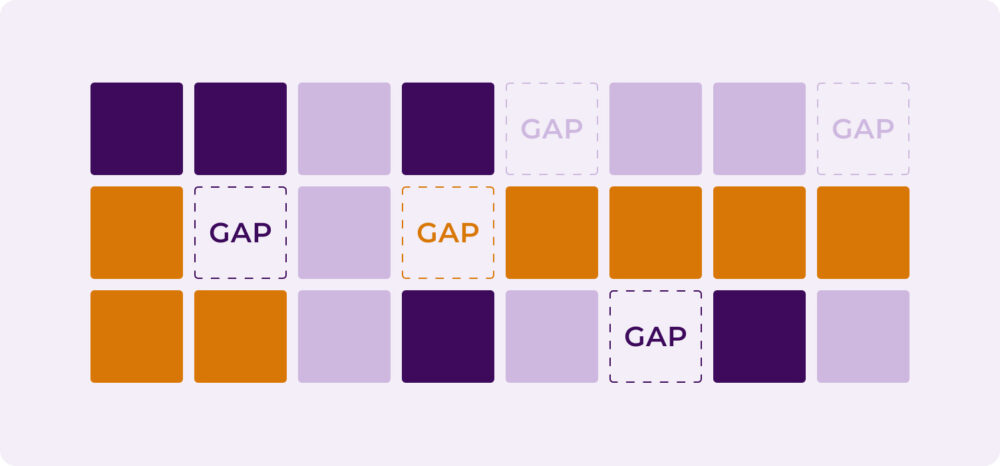
These gaps can be of various natures: price segments without coverage, technical attributes with growing demand but scarce supply, formats that no operator has developed for a specific channel, or combinations of function and price that the consumer seeks but cannot find. Early detection of gaps opens up the possibility of launching under favourable conditions: without price wars, with a higher probability of establishing a benchmark, and with enough time to develop the value proposition.
2. Margin optimisation
Assortment also influences margins, because each format, ingredient, or segment can have different price elasticity and a different weight in profitability. A well-structured assortment allows you to balance high-traffic references with higher-margin products, reducing cannibalisation and improving category efficiency.
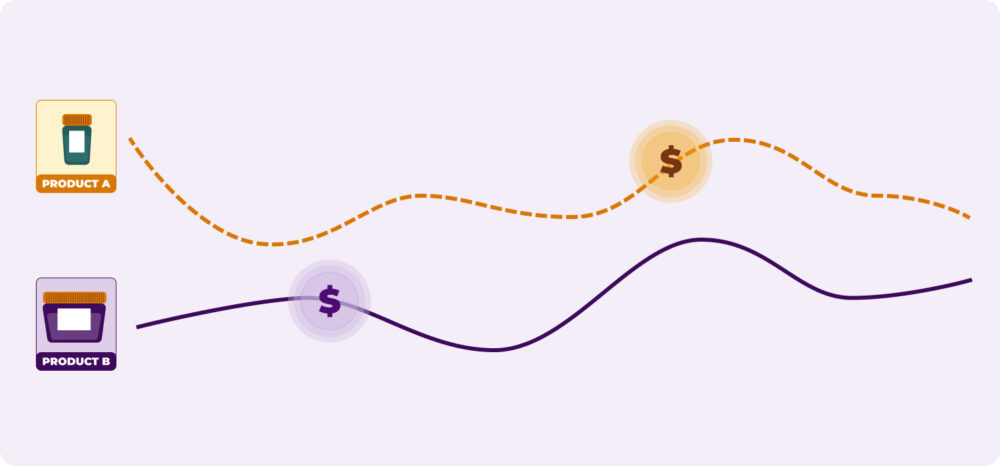
By using Category Intelligence, companies can normalise prices (for example, price per wash or price per gram of active ingredient). This makes it easier to identify products that are “undervalued” or “overvalued” in the market, allowing profit margins to be adjusted without losing competitiveness against products with a similar DNA. This granular adjustment capability transforms margin management from a global decision into a structured one.
3. Agility in time-to-market
Time-to-market is one of the metrics where Category Intelligence generates the greatest return. Detecting in advance where the market is moving (which attributes are gaining relevance, which formats are emerging, which segments are opening) allows you to prepare for launch before the window of opportunity closes.

This agility allows R&D and purchasing teams to react quickly, whether by matching the offer, improving it, or pivoting towards a defensive strategy before the competitor consolidates their advantage.
Useful KPIs for Measuring Competitor Assortment
Establishing clear metrics for competitive assortment analysis turns Category Intelligence into a measurable and repeatable process. Some of the most commonly used indicators are as follows:
- Assortment Overlap: Measures what percentage of products are identical between your catalogue and your competitor’s. Low overlap indicates a clear differentiation strategy.
- Share of Attributes: Indicates what percentage of the market you dominate in a specific attribute (for example, how many “sugar-free” products in the category are yours).
- Price competitiveness index by segment: Your own price position compared to the market price distribution, segmented by range and attribute. Helps detect weak price positions before they translate into loss of share.
- Active gap ratio: Number of assortment opportunities detected that have not yet been covered, segmented by revenue potential. Prioritises action on gaps with the highest expected impact.
- Average Assortment Depth: Measures how many variants (sizes, colours, flavours) the competitor offers for each product line.
- Innovation speed: Number of new references launched by a competitor in a given period, by category or segment. Allows you to anticipate in which categories they are investing development resources.
- Time-to-detect new launches: Average time from when a competitor introduces a new reference until the internal team has access to the information. The lower this indicator, the greater the available reaction window.
How Flipflow Automates Assortment DNA Analysis
Applying category intelligence manually by tracking websites, capturing product sheets, and updating Excel spreadsheets is unfeasible at the scale required by today’s retail. The volume of references, the speed of changes, and the need for comparability across categories, channels, and territories mean that automation is not an advantage, but a requirement.
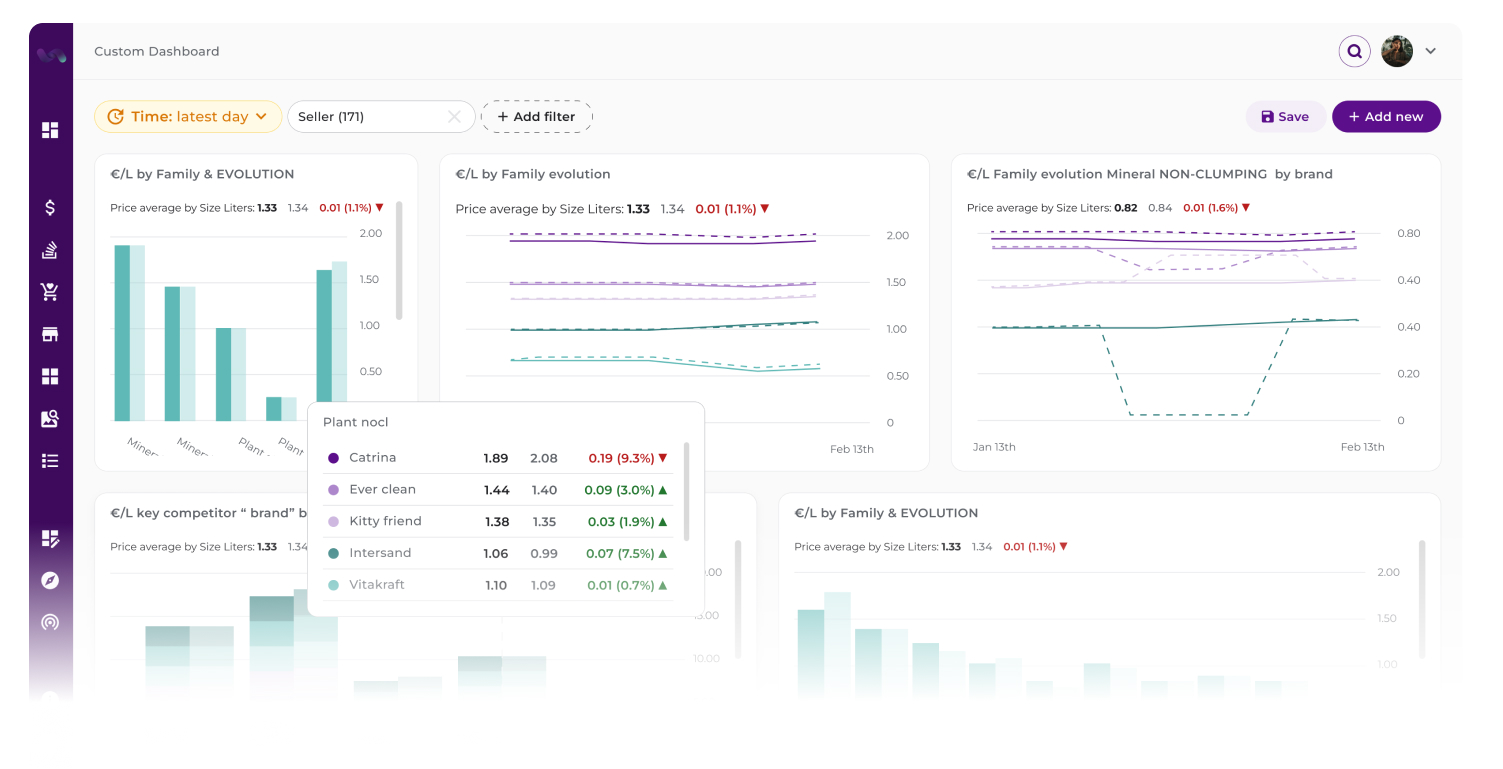
Flipflow continuously captures and structures the complete digital market assortment: retailer by retailer, category by category, postcode by postcode. This coverage turns assortment data into a permanently updated intelligence layer, rather than a periodic snapshot.
On this basis, the platform allows you to:
- Automatically detect gaps and delistings: Identifies in real-time where a competitor’s product appears or disappears from the assortment, which territories are left without coverage, and which references are occupying that space.
- Map the competitor catalog DNA: The platform structures the attributes of each product so that category analysis goes beyond SKU counts and allows the strategic logic behind each catalog to be read.
- Prioritise territories by revenue impact: Flipflow assigns an estimated revenue potential to each gap and crosses that data with territorial distribution, so commercial teams can prioritise action where the expected return is highest.
- Monitor competitor innovation speed: New launches are detected the moment they appear in the digital channel, allowing time-to-detect to be shortened and the strategic response window to be expanded.
The result is a Category Intelligence process that does not depend on the periodicity of audits or a team’s ability to process data manually. It depends on a data infrastructure that works continuously and returns actionable signals at the moment they are relevant.
Conclusion: From Observation to Decision
Competitor assortment contains high-value strategic information. The difference between organisations that leverage it and those that do not lies in their ability to move from observation to decision systematically and quickly.
Understanding competitors’ formats, technical attributes, and price segmentation generates a specific roadmap: where to launch, when to adjust prices, which gaps to prioritise, and in which territories to concentrate commercial resources. Organisations that have incorporated this approach into their category management processes have reduced their reaction time, improved their success rate in launches, and managed their margins with greater precision.
Those still operating with periodic market snapshots run the risk of arriving too late to the windows of opportunity that Category Intelligence allows you to see sooner. In an environment where assortments change week by week and pressure on margins is relentless, this difference in speed has a direct cost in revenue.
The most important transition for any retail intelligence team is not technological: it is moving from observing the category to managing it with data, judgement, and speed.