
Connecting Retail Media with Content, Reviews and Catalogue: How to Multiply E-commerce Conversion
TL;DR
Retail Media performs much better when backed by a well-structured catalogue, useful product content and reviews that build trust. Connecting these 4 pieces helps improve relevance, boost conversion and get more out of e-commerce ad spend.
Introduction: From Isolated Banners to the Retail Media Ecosystem
For years, Retail Media has been understood as advertising space within the retailer: a banner here, a sponsored product there. This model worked in low-competition digital environments. Today, with thousands of references competing in the same category and increasingly demanding shoppers, this approach falls short.
Market data is telling. According to the “The Future of Commerce Media 2025” report by WARC, global Retail Media spend will reach $200 billion by 2027, with annual growth rates clearly outpacing the digital advertising market as a whole. But budget growth does not guarantee results if the shopper experience fails before or after the click.
The most widespread problem in current Retail Media strategies is disconnection. Brands invest in visibility —featured positions, sponsored search, home page display— but that visibility leads to incomplete product pages, lacking sufficient reviews or with content that doesn’t answer the shopper’s real questions. The result is a reasonable CTR with disappointing conversion.
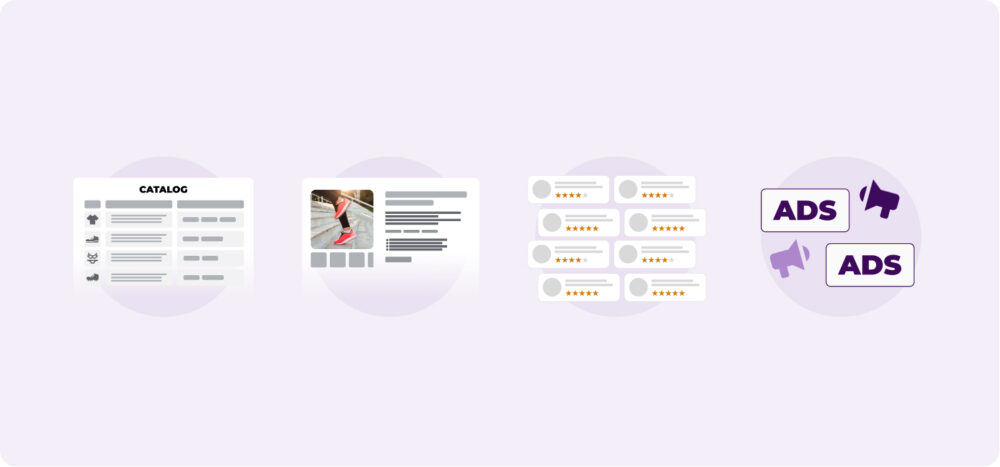
Building an effective Retail Media ecosystem requires aligning 4 levers: advertising investment, the catalogue (structured product data), product content (text, images, video) and user reviews and ratings. When these four dimensions work together, the effects on conversion are multiplicative, not additive.
The Catalogue: The Invisible Foundation of Performance
The product catalogue is the foundation upon which everything else is built. A common mistake in Retail Media strategies is treating the catalogue as an operational requirement (the bare minimum for the product to appear on the platform) when it is actually a determining factor in advertising performance.
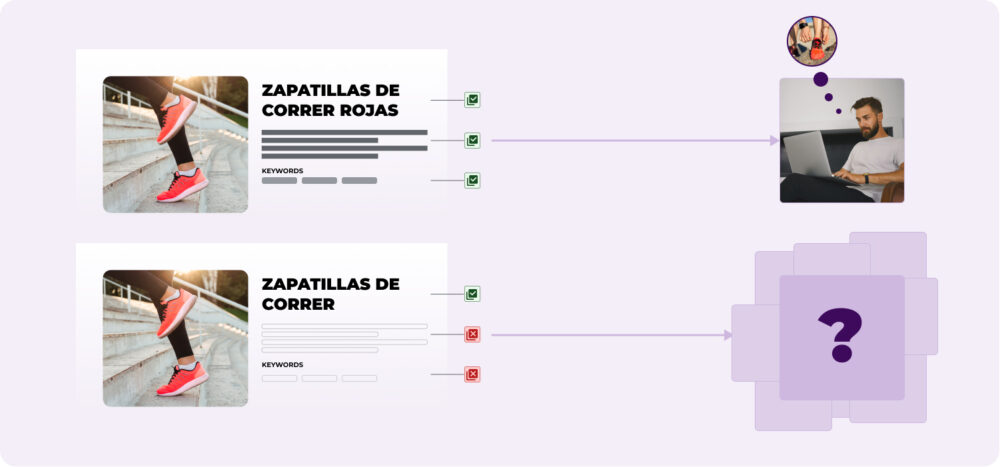
Retailer algorithms use catalogue data to determine the relevance of each product for every search. The logic is simple: if the product data fails, activation loses precision and the shopping experience suffers.
In Retail Media, the catalogue is involved at several key moments:
- Defining how each SKU is classified
- It facilitates matching with searches and categories
- Helping to decide which products are eligible for promotion
- It affects actual availability, price and the commercial promise
A messy catalogue generates visible problems very quickly: miscategorised products, ads triggered with incomplete information, stock errors or unhelpful pages. All of this reduces the likelihood of conversion and can drive up the cost per sale.
Which catalogue elements impact Retail Media?
There are critical components within the catalogue that determine whether a Retail Media campaign will have a positive return on investment:
- Stock management and availability: Most Retail Media platforms automatically suspend ads for out-of-stock products, but a lag in catalogue updates can lead to paid clicks ending on a “product unavailable” page, damaging consumer trust and brand score.
- Titles and categorisation: Titles must contain the main keywords that users use in their searches. Incorrect categorisation in the catalogue will prevent the ad from appearing in the relevant digital aisles.
- Technical attributes: Dimensions, materials, colours and technical specifications must be standardised. This data allows retailers’ search filters to work correctly, making it easier for the ad to reach someone looking for a specific feature.
- SKU variants: A well-connected catalogue allows the ad to direct the user to a page where they can choose between different sizes or colours, increasing the chances of conversion without needing to create separate ads for each variant.
- Identifiers: Having correct GTINs / EANs, and other key data for inventory consistency, allows the retailer to cross-reference sales data, history and enriched content from providers like Syndigo or Salsify.
Product Content Turns Traffic into Purchases
If the catalogue determines if the product appears, product content determines if the shopper clicks and, above all, if they buy. The distinction is important: the catalogue is structured data; content is persuasive communication.
In the context of Retail Media, content plays a dual role. On one hand, it improves the Quality Score of paid campaigns. Platform algorithms like Amazon Advertising or Criteo value the completeness of the product page when calculating cost per click. On the other hand, it reduces the page abandonment rate once the user has arrived there thanks to the campaign.
What type of content matters?
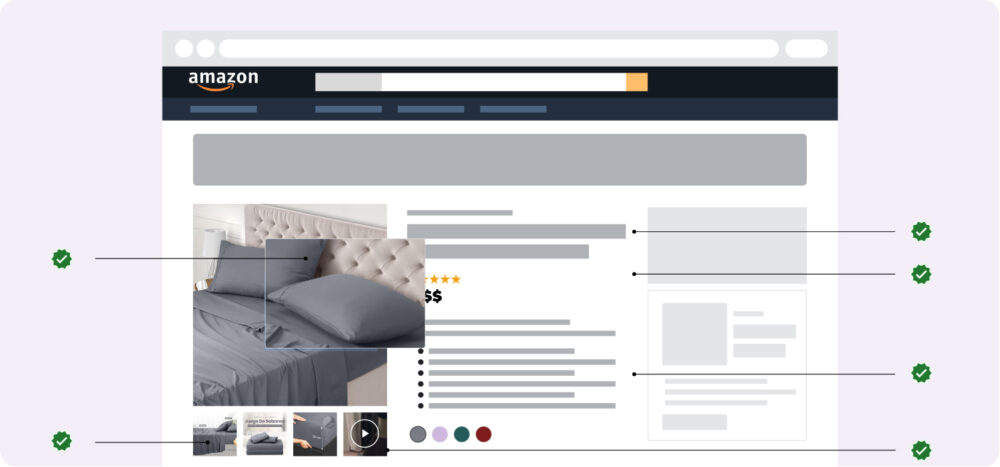
The product content that works best usually combines clarity, utility and persuasiveness. Brands that achieve the best results in Retail Media pay special attention to these elements:
- Optimised main description: between 150 and 300 words, benefit-oriented (not just features), with main keywords integrated naturally. Descriptions that answer the question ‘why this product and not another?’ have significantly higher conversion rates.
- Bullet points: scannable format. Digital shoppers don’t read, they scan. Five concise points covering benefit, use, differentiator, key technical specification and warranty or after-sales service.
- Enriched content (A+ Content, Brand Stores, Enhanced Content): visual modules with comparisons, usage infographics, lifestyle image galleries. According to Amazon data, A+ Content can increase sales by 8% to 20% depending on the content type, with higher peaks in high-involvement categories like electronics, cosmetics or premium food.
- Product video: short video on the product page reduces returns and increases pre-purchase trust.
The best content is not necessarily the longest. What works best is content that reduces friction and answers shoppers’ real questions.
Relationship between content and performance
The relationship between content quality and advertising performance is direct and quantifiable. Well-crafted content improves several funnel metrics:
- Increases product understanding
- Helps differentiate similar options
- Improves dwell time and interaction with the page
- Boosts the rate of products added to cart
- Reduces returns caused by incorrect expectations
Retail Media platforms have incentives to show products with high-quality pages because it improves the shopper experience and increases their own conversion. Consequently, brands with well-crafted product content pay less for each relevant impression and convert more with the same budget.
Reviews and Ratings: The Trust Layer that Accelerates Conversion
Reviews are the digital equivalent of a recommendation from an acquaintance. In an environment where the shopper cannot touch the product, social proof is one of the most powerful uncertainty reduction mechanisms that exist.
In the context of Retail Media, reviews have an impact that goes beyond direct conversion. They influence retailers’ organic ranking algorithms, affect campaign Quality Scores and determine whether a page maintains its position after receiving paid traffic.
Why do they matter so much in Retail Media?
Algorithms of major retailers —Amazon, El Corte Inglés, Carrefour— use ratings as a signal of quality. Reviews help to:
- Confirm perceived quality
- Reduce purchase risk
- Validate specific product uses
- Answer objections that the brand doesn’t always anticipate
- Differentiate products with similar features
A product with more than 50 ratings and an average score above 4.2 stars has significant advantages in organic visibility. When that product also receives Retail Media traffic, the algorithm interprets the combination as a positive signal and can improve its natural position.
According to a report by Spiegel Research Center, products with at least 5 reviews have a conversion rate 270% higher than products without reviews. The effect is especially pronounced for medium-to-high priced products, where the shopper perceives greater risk in the decision.
From a ROAS (Return on Ad Spend) perspective, investing in Retail Media with a page lacking reviews is equivalent to filling a funnel that has a leak at the bottom. Traffic arrives, but the absence of social proof causes the shopper to abandon at the last moment.

Types of UGC that can enrich the product page
User-Generated Content (UGC) adds authenticity to the brand:
- Detailed Reviews: Opinions describing long-term use of the product help build a solid reputation for the brand.
- Community FAQs: Answering these questions demonstrates that the brand is committed to customer service, which is a deciding factor for many shoppers.
- Unboxing and real-use videos: Seeing the product in a real environment rather than a professional photo studio adds a layer of realism that consumers value positively. Additionally, they reduce return rates and increase post-sales satisfaction.
This content also offers very valuable signals for internal teams. It allows for the detection of repeated objections, poorly explained attributes, gaps between expectations and real experience, and opportunities for page improvement.
How to Connect Retail Media, Content, Reviews and Catalogue in Practice
Effectively connecting these layers requires processes and technology, but can be described as a continuous flow of data and optimisation. The key is ensuring that the catalogue is well-structured, that product pages are enriched, and that reviews and purchase behaviour are integrated into the Retail Media platform and decision models.
In parallel, campaigns must be configured to take advantage of these signals: using segments based on behaviour, product rules that consider ratings, stock and margin, and creatives that reuse content and social proof from the PDP. More advanced experiences also connect this logic with in‑store media, ensuring messages are consistent across web, app and physical stores.
Conceptual flow
The ideal connection process follows a logical sequence:
- Retail Readiness Audit: Before allocating budget to Retail Media, verify that the catalogue is accurate and the product is in stock.
- Content Optimisation: Create visual assets and optimised descriptions to ensure the landing page is persuasive.
- Activating Social Proof: Implement strategies to incentivise organic reviews or through specific retailer programmes.
- Campaign Launch: Activate Retail Media ads targeting products that meet the above requirements.
- Analysis and Adjustment: Use sales and behaviour data to adjust both ad bids and page content.
This approach ensures that changes in the catalogue or product perception (e.g., an improvement in reviews) are quickly reflected in Retail Media activation.
Use cases
Concrete use cases illustrating this connection:
- New product launch: in the first weeks, the lack of sales history and reviews means organic visibility is low. Retail Media investment generates the initial traffic needed to accumulate the first reviews and verified sales. This improves organic ranking and progressively reduces dependence on paid investment.
- Category defence: when a competitor enters with aggressive advertising, brands with a full catalogue, quality content and solid ratings resist better because the retailer’s algorithm continues to prioritise them in organic results, even if they temporarily lose paid positions.
- Reviving stagnant references: products with good historical sales but outdated reviews or ageing content can recover their position with an A+ content update and a review generation campaign combined with sponsored search investment.
These cases allow the shopper to perceive a consistent and reliable experience at all touchpoints.
KPIs to monitor
To evaluate the impact of this integration, it’s advisable to track metrics at each layer:
- Catalogue: Content Score or page completeness (% of fields covered), correct indexing rate by category.
- Content: CTR in listing (before and after updating content), time on page, bounce rate from the page.
- Reviews: number of reviews, average rating, verified review ratio, accumulation speed of new ratings.
- Retail Media: ROAS per campaign, Share of Voice in category, cost per click on brand search vs. generic search.
- Integrated Conversion: revenue per visit, total conversion rate (organic + paid), return ratio.
The Role of AI and Automation in this Connection
Manual management of catalogues, content, reviews and campaigns at the scale required by today’s retailers is unfeasible for most brands. This is where artificial intelligence and automation transition from being a competitive advantage to an operational necessity.
In the area of cataloguing, Product Information Management (PIM) tools with AI capabilities allow for detecting missing attributes, correcting categorisation errors and enriching product data at scale. Platforms like Akeneo, Salsify or Contentserv incorporate generative AI modules to suggest optimised titles, complete attributes and translate content while maintaining brand consistency.
In product content, large language models (LLMs) allow for generating variants of descriptions tailored to each retailer, significantly reducing content production times and maintaining consistency in tone and key messages across catalogues of thousands of references.
In reviews, AI allows for analysing large volumes of ratings to identify patterns of satisfaction and dissatisfaction, extract actionable insights for the product team and detect fraudulent or low-quality reviews. Additionally, sentiment analysis tools allow for prioritising which pages need urgent intervention due to deteriorating average ratings.

In Retail Media, bidding automation (Smart Bidding, Target ROAS) combined with personalised business rules allows for real-time advertising investment optimisation, adjusting budget based on stock availability, seasonality and historical performance of each reference.
The combination of these capabilities allows brands to scale their Retail Media presence without linearly scaling their teams, and to do so with greater consistency and speed than manual management.
Conclusion and Actionable Checklist for Brands and Retailers
Retail Media has matured. Brands that continue to treat it as an isolated advertising channel are missing a golden opportunity. Those who understand that conversion depends on 4 elements working in sync (catalogue, content, reviews and advertising investment) are building advantages that are difficult to replicate.
The good news is that most problems are correctable. They don’t require massive technology investments if they don’t exist; they require, above all, a shift in thinking about Retail Media: moving from managing campaigns to managing conversion ecosystems.
Taking this into consideration, you can use this checklist to prioritise actions:
Actionable checklist
Catalogue and data
- Your catalogue has a clear taxonomy, rich attributes and accessible stock and margin data for marketing and Retail Media teams.
- You have defined rules to prioritise or exclude products in campaigns based on rating, stock, margin or incidents.
Product content
- Key pages have quality images, benefit-oriented descriptions and, where applicable, video and enriched content.
- PDP content is reused in Retail Media creatives and systematically tested.
Reviews and UGC
- You have an active process for generating, moderating and responding to reviews, reaching a minimum volume to be representative.
- Rating and review volume are integrated into your ads, sponsored modules and recommendation logic.
Orchestration and measurement
- Catalogue, content, behaviour and reviews are integrated into your Retail Media platform or central data platform.
- You measure KPIs beyond ROAS: PDP conversion, incremental uplift, incremental margin, LTV, rating evolution and returns.
AI and automation
- You use advanced models or rules to decide which product to show to each audience and in each location, considering inventory, margin and trust signals.
- You are moving towards dynamic audiences and creatives that are continuously optimised based on real results.
E-commerce conversion is not won at the moment of the click. It is built beforehand, with a well-prepared product ecosystem. Retail Media is the accelerator. The catalogue, content and reviews are the fuel.