
Price Is No Longer in Your Hands: How Third-Party Sellers are Undermining your Brand Positioning
TL;DR
Marketplaces have shifted price control from brands to third-party sellers competing for visibility and the Buy Box. This price dispersion erodes margins, creates channel conflict, and weakens brand positioning. The solution lies in monitoring sellers, detecting deviations, and managing pricing with real-time data and alerts.
Imagine you have been working on your brand strategy for months. You have defined the positioning, calibrated the recommended price to fit the perception of value you are looking for, and built a consistent narrative across all your channels. Then you go onto Amazon or any other marketplace and see your product listed at three different prices, by three different sellers, none of whom you have directly chosen.
That is exactly what happens to thousands of brands every day.
The rise of marketplaces has democratised access to the final consumer. But it has also decentralised control over something fundamental: the price at which your product appears to that consumer. And price, in the digital environment, communicates much more than a number. It communicates who you are as a brand. According to Wiser, price positioning directly influences consumer behaviour because it determines how the buyer perceives a brand’s value compared to its alternatives. If that perception changes because of sellers competing with each other without coordination, the positioning built by the brand begins to weaken.
This article analyses why pricing has stopped being an internal lever for brands and has become a disputed territory, what consequences this loss of control over positioning has, and what brands can do to regain the initiative without falling into the most common channel management errors.
What Has Changed: From Brand Control to a Multi-Seller Ecosystem
For decades, price control was an almost exclusive prerogative of the brand or the authorised retailer. The structure was relatively simple: brand → distributor → point of sale → consumer. Each link had clear rules, agreed margins and, in many cases, minimum price agreements that protected commercial consistency.
Marketplaces broke that logic.
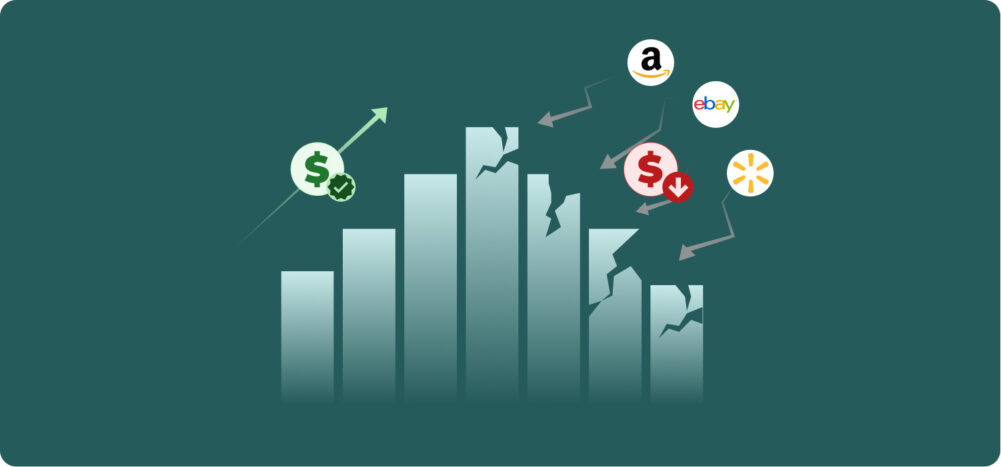
Platforms like Amazon, Miravia, or large retailers with an open marketplace allow any seller —authorised or not— to list a product and compete for the sale. The result is a multi-seller ecosystem in which the brand coexists with authorised distributors, parallel resellers, stock liquidators, and arbitrage operators, all under the same listing.
This model has obvious advantages: a wide catalogue, greater availability, and price competition that can benefit the consumer. But for brands that have invested in building value positioning, this ecosystem represents a structural threat. The price is no longer set by those who know the brand strategy. It is set by whoever wins the Buy Box.
Why the Price Is No Longer “Yours”
There are several reasons why the price has stopped being “yours” and has come to depend on others. We explain the main ones:
1. Because the final price is shown by a seller, not your brand book
Your brand book may define a premium, aspirational, or volume positioning. But the consumer does not buy an internal document: they buy what they see on the screen. In marketplaces, that visible price usually comes from a specific seller, and can also include shipping, availability, or conditions that modify the final perception of value.
BigCommerce highlights that on Amazon, the Buy Box is decided based on criteria such as total price, fulfilment, shipping speed, and account health, not just the listed price. The brand, in many cases, does not control any of those factors when the seller is a third party. The practical result is that your price identity is left in the hands of an external actor whose sole priority is winning the sale, not protecting your positioning.
2. Because visibility also depends on the seller
The problem goes beyond the price itself. On platforms like Amazon, the Buy Box can account for more than 80% of sales. Therefore, losing that position directly alters the distribution of demand. If the dominant seller is not the one that best fits your strategy, the customer’s perception of your offer is built from a context that you do not fully control.
There is an additional consequence. If your brand also sells directly and an external seller has the Buy Box with a lower price, your own visibility on the listing is relegated. In practice, your direct channel loses effectiveness against a third party that is using your own products to compete against you.
3. Because pricing is no longer static, it is dynamic
Marketplaces operate with dynamic logic. Prices change frequently due to human decisions, repricing tools, overstock or lack of stock, tactical campaigns, or competitor moves.
Furthermore, external sellers —especially the more sophisticated ones— use automatic repricing tools that adjust their prices in real-time based on the competition. This means that the price of your product can change several times a day, in response to the moves of other sellers, stock changes, or variations in demand.
For a brand with a positioning strategy based on price-value, this dynamism is especially problematic. Price positioning is not just a number: it is a consistent signal that builds perception over time. When that signal fluctuates unpredictably, the perception of value is eroded. The consumer who saw your product at €49.99 yesterday and finds it at €34.99 today does not interpret that as a one-off offer; they may interpret it as the “real” price always having been €34.99.

How Sellers are Redefining your Positioning
A brand’s price positioning is not a static asset. It is the cumulative result of the price signals that the market receives over time. When those signals are emitted by external actors without strategic coordination, the positioning becomes distorted.
A seller with a price that is too low can “reposition” your brand downwards
A seller liquidating stock at prices far below the recommended RRP does not just lose margin on that transaction. They redefine, in the eyes of the buyer, the real value of the product. If an item that usually costs €80 repeatedly appears at €45 through a seller with a poor reputation, the buyer updates their price reference. When the brand tries to return to the €80 price, it has to overcome resistance that it did not generate itself but must now manage.
This phenomenon is especially destructive in categories where price is an indicator of quality or exclusivity. In these categories, a low price does not necessarily generate more sales; it can generate distrust.
A seller with a price that is too high can make you appear uncompetitive
The problem also exists at the opposite extreme. If a seller publishes excessive prices, the product may seem expensive compared to equivalent alternatives and lose conversion, even when the brand has solid value arguments.
The risk is not just losing a one-off sale. An inflated price can reinforce the idea that the brand is not aligned with the market or that its channel is disorganised. This is especially sensitive in categories where consumers compare quickly.
Price dispersion destroys consistency
When the same product appears at very different prices depending on the seller, which can happen even within the same platform, the buyer enters a state of uncertainty about what the “correct” price is. This uncertainty can lead to a purchase stall, a search for alternatives, or the conclusion that the product has an inherently volatile and unpredictable price.
Price dispersion does not only affect immediate conversion. It affects long-term trust in the brand. A consumer who has bought at €60 and later discovers that another person bought the same thing for €40 through another seller on the same platform experiences a sense of grievance that is difficult to resolve with a discount on the next purchase.
Price consistency matters because it sustains trust. If that consistency disappears, the purchase decision becomes more uncertain and the perceived value is eroded.
The seller who gains visibility conditions market perception
In marketplaces, the visible seller is not always the one most aligned with the brand’s strategy, but the one who best combines price, stock, and service. That makes that seller the real spokesperson for the offer to the user.
When that role is occupied by a reseller, a parallel distributor, or a seller with an opportunistic strategy, the brand is represented by a logic that may not reflect its desired proposal. In terms of positioning, whoever dominates visibility ultimately dominates the price narrative as well. And your own sales teams, your physical retailers, and your strategic partners see that price as a reference. The effect is systemic.

Risks of Losing Control of the Channel
The consequences of not actively managing the ecosystem of sellers accumulate silently until they become difficult to reverse. Among the most relevant risks are:
- Structural margin erosion: When external sellers compete with each other downwards, the market reference price falls progressively. The brand is pressured to adjust its own price to avoid being priced out of the market, with the consequent impact on profitability.
- Channel conflict: Physical retailers working with a brand under minimum price agreements have well-founded reasons for complaint when they see the same product at lower prices in marketplaces managed by third parties. This tension can lead to a loss of distribution in strategic channels.
- Brand damage difficult to quantify: The impact on perception is not immediately reflected in the company’s profitability, but it materialises in lower conversion rates, greater price sensitivity on the part of the buyer, and a loss of differentiation from competitors.
- Entry of unauthorised sellers: The lack of visibility over who is selling your products can hide the presence of resellers operating outside distribution agreements, with stock of dubious origin or failing to comply with warranty conditions, generating claims that directly impact the brand’s reputation.
What can a Brand Do to Regain Control without Making Channel-Related Mistakes?
Regaining control does not mean imposing the final price on all sellers. The useful path involves commercial intelligence, monitoring, and active management of the seller ecosystem. These are some recommended actions:
- Establish and communicate a clear pricing policy: Defining a recommended RRP and, where legally viable, a minimum advertised price (MAP) is the starting point. Without that documented reference, it is impossible to identify deviations or start conversations with distributors about compliance.
- Regularly audit the seller ecosystem: Knowing who is selling your products, on which platforms, at what price, and under what conditions is basic information that many brands do not have systematically. Manual auditing is possible for small catalogues but becomes unfeasible beyond a certain volume of SKUs and markets.
- Prioritise direct sales in the Buy Box: On platforms like Amazon, a brand’s best defence against the proliferation of sellers is to have a competitive presence in the Buy Box itself or through a trusted distributor. This requires continuous attention to prices, stock, and seller metrics.
- Review agreements with distributors: Distribution contracts should include explicit clauses on the channels in which distributors can operate and under what price conditions. Without this contractual framework, brands have few tools to act against disruptive behaviour.
- Establish alerts and protocols: When a seller drops the price significantly or a new seller appears on a sensitive listing, the team needs a quick signal and a clear protocol to act as quickly as possible.
- Act with data, not assumptions: The most common mistake brands make when addressing this problem is doing so reactively, when the damage is already visible. Proactive management requires continuous and structured data on the behaviour of the seller ecosystem.
What a Retail Intelligence Solution like Flipflow Provides
For brands with a presence in multiple marketplaces, multiple countries, and catalogues of a certain breadth, manual management of the seller ecosystem is unfeasible. Growing in marketplaces, online retailers, and D2C without control is not scaling. It is opening the door to margin erosion, parallel resale, and inter-channel conflicts. It is in this context where our Pricing & Seller Control module provides differential value.

On that basis, we articulate our solution around several axes:
- Complete mapping of sellers and distribution
- Structural control of pricing and deviations.
- Actionable alerts in real-time.
- Integrated vision by market and channel.
In short, we turn what has historically been a problem of late reaction —”we find out when there is already tension with the retailer“— into a system of continuous governance of the digital channel. This ability to anticipate is, in an environment as dynamic as today’s, the difference between protecting brand positioning and yielding it to whoever has the lowest price at that moment.