
From Sentiment to Action: How to Leverage Reviews to Improve Product and Sales
TL;DR
Reviews contain key data on what your customers value and what they reject, but they only generate impact when analysed systematically. By applying sentiment analysis, you can turn thousands of opinions into structured insights to prioritise product improvements, optimise product listings and marketing messages, reduce purchase friction, and increase conversion.
Customer reviews are one of the most valuable sources for understanding what works, what fails, and what is expected of a product. More than 90% of consumers read online reviews before choosing a product or service, showing the extent to which they influence trust and conversion. Even so, many brands treat them as a simple “reputation thermometer”: they look at the average rating, reply to two or three comments, and carry on with their plan.
Reviews as a “Gold Mine” (and Why Almost Nobody Exploits them Well)
The problem is that the average rating almost never explains the real reason for satisfaction or anger. Two products can have 4.4 stars and be suffering for opposite reasons: one for quality, another for logistics. If you stick to the number, you miss the story.
Furthermore, reviews have three advantages that few data sources can match:
- Reviews are spontaneous: the customer speaks in their own words, without a script.
- They are also specific: they usually mention concrete details (size, battery, smell, texture, assembly, delivery).
- They accumulate over time: they allow you to see patterns, changes, and trends.
The majority do not exploit them well for very down-to-earth reasons:
- Lack of time: reading hundreds of reviews seems impossible.
- Biases: more attention is paid to a flashy criticism than to a repeated pattern.
- Lack of method: “impressions” are extracted without a system to convert them into actions.
- Poor internal connection: product, marketing, and customer service work with different priorities.
But there is a systematic way to take advantage of this gold mine. Sentiment analysis allows you to transform scattered opinions into structured data that drives tangible improvements. It doesn’t require a team of data scientists or multi-million pound budgets. With a tool like flipflow and our sentiment analysis solution for reviews, any company can start extracting real value from its reviews.
In this article, you will discover what techniques exist for applying sentiment analysis and how to turn the findings into concrete actions that improve your product and boost your sales.
What Sentiment Analysis Is (and What It Isn’t)
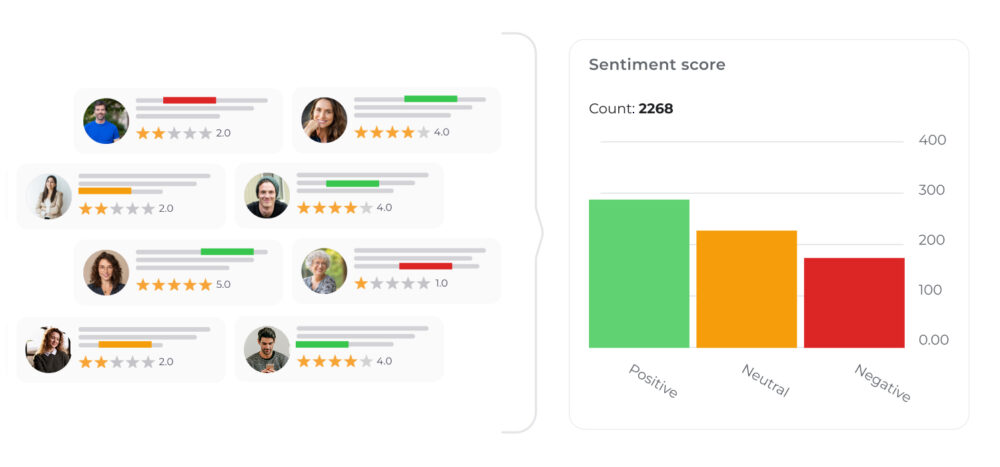
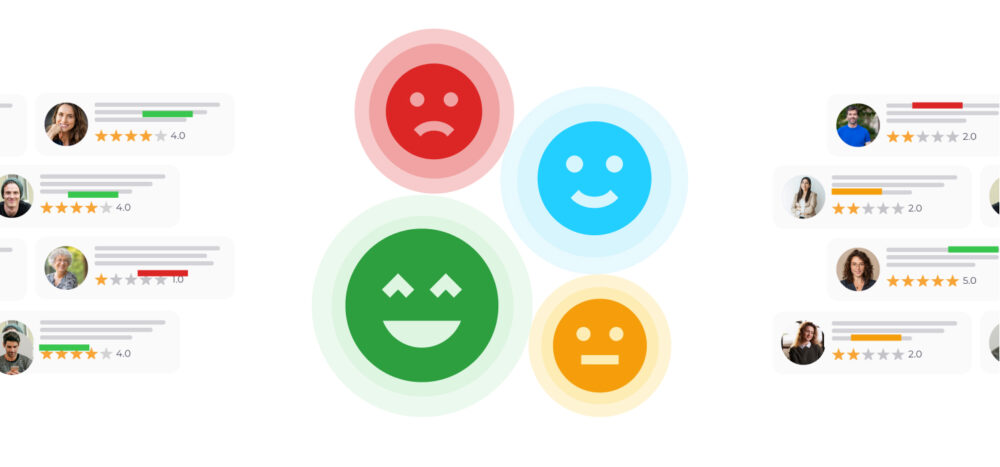
Sentiment analysis is a process that identifies and classifies the emotions expressed in a text. In the context of reviews, it seeks to determine whether an opinion is positive, negative, or neutral, and to understand which specific aspects of the product generate each emotion. In this way, feedback stops being an untidy collection of texts and becomes data that can be grouped, compared, and tracked over time.
It is worth clarifying what it is not, to avoid frustration. It does not replace reading reviews, because there are nuances that a system might interpret incorrectly: sarcasm, ambiguous phrases, or comments with both highlights and shadows. Nor does it fix poorly organised data. If you mix reviews from different variants (sizes, models, batches), the result may confuse you and lead to wrong decisions. And, on its own, sentiment does not explain the cause: knowing that a review is negative doesn’t tell you if the problem was the material, the instructions, or the expectation.
What it does do is process large volumes of text quickly, identify patterns that would be invisible to the naked eye, and quantify perceptions that were previously purely qualitative. It turns “I think customers like X” into “73% of reviews mention X positively”.
Sentiment analysis works like a microscope for your reviews. It allows you to see details that exist but that the human eye cannot catch when observing thousands of opinions at once. And it works best when combined with another layer: understanding which part of the product or experience the customer is talking about. That is where the information becomes actionable.
3 Techniques for Analysing Sentiment (from Manual to Automatic)
There is no single way to analyse sentiment. The choice depends on your volume of reviews, available time, and how fine-tuned you want your results to be. The sensible approach is to think of it as a ladder: start with something manageable and move up when the business justifies it.
1. Rule-based analysis
The rule-based approach is the most direct and, if well-designed, can yield surprising results. This technique works with dictionaries of words previously classified as positive, negative, or neutral. The system searches for these words in the reviews and assigns a score based on what it finds.
For example, words like “excellent”, “perfect”, or “fast” add positive points. Terms like “horrible”, “defective”, or “slow” subtract points. In the end, if the total sum is positive, the review is classified as favourable; if it is negative, as unfavourable.
Rules can also include modifiers. “Very good” carries more weight than just “good”. “Not bad” inverts the polarity. These rules can be refined over time by adding specific words from your sector.
- Advantages: easy to implement, transparent (you know exactly why the system classified something a certain way), and doesn’t require large volumes of data to start.
- Limitations: requires constant maintenance of the dictionary, doesn’t understand complex context, and can fail with expressions unique to your niche or nuances of language.
2. Machine Learning-based analysis
When volume grows and language becomes more varied, many companies move to Machine Learning models. The idea is for a system to learn classification patterns from previous examples. You show it thousands of already labelled reviews (positive, negative, neutral) and the system identifies patterns that characterise each category.
Once trained, the model can classify new reviews automatically without the need for predefined dictionaries. These systems capture subtle relationships between words and detect contexts that rule-based analysis would overlook.
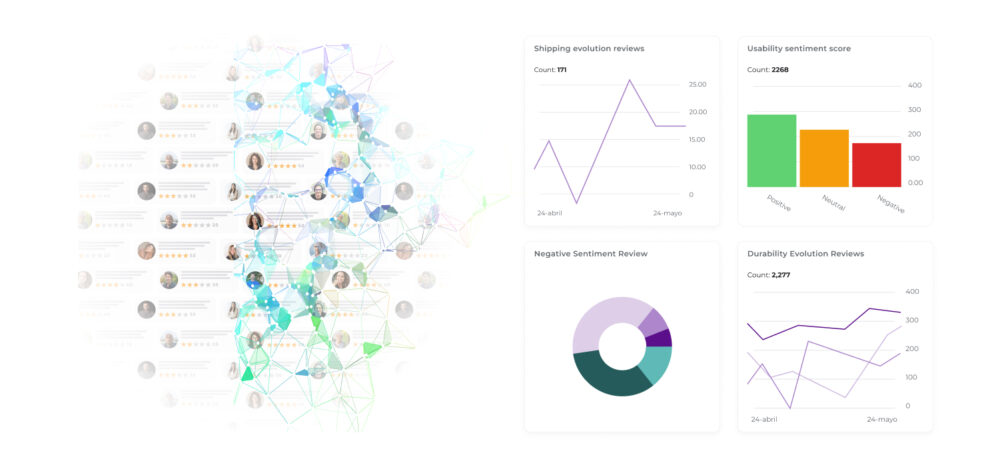
This type of analysis is especially useful when handling large volumes of reviews in several languages, as the model can adapt and improve with more data. Furthermore, some systems (such as flipflow) incorporate sentiment analysis in near real-time, allowing for early detection of emerging trends and problems.
- Advantages: high precision, ability to learn complex nuances, continuous improvement with more data, and less need for manual intervention.
- Limitations: requires quality training data, can be a “black box” (hard to understand why it classified something a certain way), and requires some technical knowledge to implement correctly.
If you don’t want to start training from scratch, you can use existing tools to classify sentiment and then validate with a sample. In many companies, this hybrid approach accelerates internal learning: first the value is demonstrated, then investment is made in fine-tuning.
3. Aspect-based analysis
If your goal is to improve the product and increase conversion, aspect-based analysis is usually the turning point. Instead of just “positive” or “negative”, you identify what the customer is giving an opinion on. The sentiment becomes specific: “positive for comfort”, “negative for battery”, “negative for size”, “positive for service”.
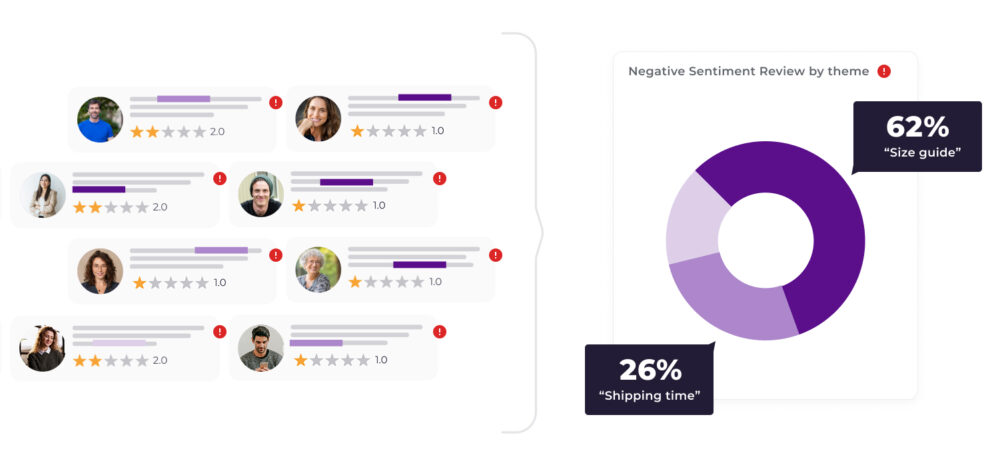
In business terms, this changes the internal conversation. “There are negative reviews” is a phrase that paralyses. “Most negative reviews mention the size guide” opens a clear door: adjust the product listing, photos, table, post-purchase messages, or even the patterns.
Advantages: provides extremely actionable information, allows prioritisation of improvements according to the emotional impact of each aspect, and facilitates very specific marketing communication.
Limitations: it is the most complex technique to implement, requires greater processing capacity, and may need adjustments for each product category.
The best strategy usually combines several techniques. You can start with basic rules for obvious cases, apply machine learning models for the bulk of the reviews, and reserve aspect-based analysis for strategic products or when you need very detailed insights.
How to Turn Insights into Product Improvements (Actionable Framework)
Many brands make the effort to analyse reviews and stop halfway. They obtain interesting conclusions, but they don’t turn into real changes. To avoid this, you need a framework that forces the cycle to close. Here is one in 4 steps that works well due to its simplicity:
Step 1: group by themes and aspects
- Classify and tag reviews by categories relevant to your business: product quality, usability, price, after-sales service, shipping, etc.
- Within each category, analyse which subthemes appear most frequently, such as “battery”, “size”, “documentation”, or “phone support”.
Step 2: prioritise according to impact
- Combine three dimensions: volume of comments, intensity of negative or positive sentiment, and relevance to your value proposition.
- A theme with many negative reviews in a key aspect of the product becomes a priority candidate for the roadmap.
Step 3: decide on actions for the product
- For each prioritised theme, define a concrete action: improve a material, simplify the sign-up process, add a feature, change a logistics provider, etc.
- Assign responsibilities and deadlines, and include these actions in the usual product decision cycle.
Step 4: measure the effect on reviews
- After launching the improvement, observe the evolution of sentiment and the volume of comments related to that aspect in the following weeks or months.
- If sentiment improves and complaints decrease, the change is moving in the right direction; if not, it’s a sign that the solution doesn’t address the root cause.
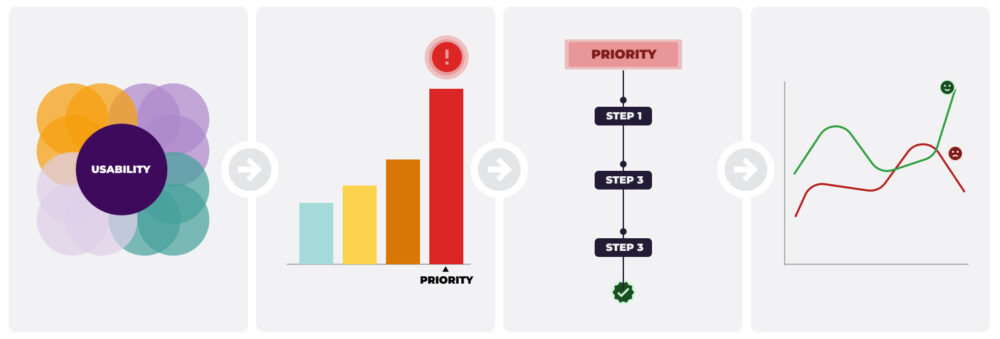
This framework transforms sentiment analysis from an academic exercise into an engine for continuous improvement. Each analysis-action-measurement cycle strengthens your product and your reputation.
How to Turn Insights into Sales (Marketing and Conversion)
Review analysis isn’t just for “fixing things”. It also feeds marketing and conversion with material that is already validated: the voice of the customer. When you use real words, the message fits better and reduces friction.
An immediate first use is to improve the product listing. If many reviews repeat “easy to assemble”, “lightweight”, “quick to clean”, or “looks elegant”, there you have benefits that people understand. You don’t need to invent angles: you need to organise what is already appearing. Those phrases work especially well in subheadings, short bullets, or blocks near the buy button.
The second use is to address objections. Negative reviews are often a map of doubts. If many say “smaller than expected”, there is a lack of visual context and highlighted measurements. If there are complaints about “don’t know how to use it”, clear instructions or a short video are missing. When content answers those doubts, conversion goes up and returns go down.
The third use is to segment messages. Not everyone buys for the same reason. In the same product, you can detect two or three dominant positive aspects. With that, you can create campaigns and creatives that connect with different audiences: those who prioritise durability, those looking for design, those who want speed or ease of use.
Finally, there is a less visible but very powerful effect: reputation management. Responding to reviews accurately, without generic phrases, conveys control. And if you monitor spikes in negativity by aspect (delivery, packaging, service), you can act before the problem snowballs.
Use Case (mini-example) to Make it Tangible
Let’s see how this would work in practice with a simplified example with invented data:
Context: A company sells technical hiking backpacks. They have 800 accumulated reviews with an average score of 4.2 stars. Sales are stable but not growing.
Initial Analysis: They apply aspect-based sentiment analysis to all their reviews. They discover interesting patterns:
- Strap distribution (68% positive): “The straps adjust perfectly” / “Excellent weight distribution”
- Waterproofing (45% negative): “Everything got wet in the rain” / “Not as waterproof as promised”
- Compartments (72% positive): “Perfect organisation” / “Everything in its place”
- Price (mixed sentiment): “Expensive but worth it” vs “Too costly”
Actions taken:
- Product improvement: They invest in improving the waterproof coating for the next production batch. Additional cost: £4/unit.
- Communication adjustment: They rewrite the product description highlighting “ergonomic weight distribution system” and “smart organisation with 7 compartments” (the most valued aspects). They reduce the prominence of “waterproof” to “splash protection”.
- New content: They create a video showing how to organise the backpack efficiently (capitalising on the positive aspect) and a waterproofing maintenance guide (addressing the negative one constructively).
- Segmented campaign: They launch ads targeted at experienced hikers using phrases extracted from the positive reviews.
Results measured in 3 months:
- The new backpacks receive 81% positive mentions about waterproofing (vs 45% previously)
- The conversion rate on the product page rises from 2.8% to 3.9%
- Sales grow by 34% without changing the price
- The cost of returns for “not meeting expectations” falls by 60%
This example shows how systematic sentiment analysis generates measurable improvements in both product and sales. The key lies in moving from vague intuitions to precise data that guides concrete decisions.
Applied Sentiment Analysis: From Customer Feedback to Measurable Business Decisions
Reviews are, at heart, conversations that continue to happen after the sale has ended. Each comment is a clue about how the product is used in real life, what expectations people have, and where friction appears that no one was able to detect in a meeting room. Ignoring them is leaving those conversations in the air. Listening to them methodically is turning them into a competitive advantage that is hard to copy.
When feedback is translated into concrete decisions (design adjustments, listing changes, clearer messages), the business starts to move with fewer assumptions and more evidence. The product team stops debating hypotheses, marketing speaks the consumer’s language, and customer service anticipates problems before they escalate. Everything aligns around real signals, not intuitions.
Ultimately, working well with reviews is more like a process of continuous improvement than a one-off task: collect, interpret, act, and measure again. Whoever adopts that cycle systematically learns faster than the market. And in e-commerce and retail, learning faster almost always means selling better.