
Advertising on ChatGPT: Key Points to Understand the New Generative AI Monetisation Model
OpenAI has confirmed that ChatGPT will start showing ads in free accounts and in the new Go plan. This move marks a turning point in how generative AI assistants are monetised on a massive scale. This change opens a new front for digital marketing. However, it also amplifies doubts about privacy, biases and the impact of advertising on how people think and make decisions.
What Exactly Has OpenAI Announced?
OpenAI will start testing ads “in the coming weeks” in the United States for users over the age of 18 who use ChatGPT on the Free and ChatGPT Go plans.
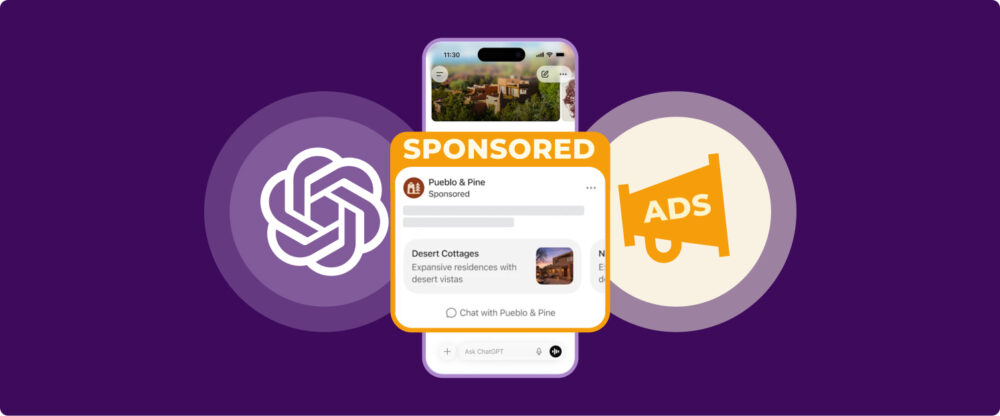
Ads will appear when there is a relevant product or service related to the conversation. They will be shown at the end of responses, in separate modules and clearly labelled as sponsored content.
ChatGPT Plus, Pro, Business and Enterprise plans will remain ad-free. ChatGPT Go is positioned as an intermediate subscription (around $8 in the US and €9.99 in Spain) with more usage limits, but with advertising.
OpenAI frames this decision as a way to “expand access” to AI while maintaining a free level and a low-cost level, partly funded by advertising revenue.
How Will Ads Work within ChatGPT?
The first ad formats will appear as sponsored blocks at the foot of the response. They will not be mixed with the “organic” text of the model. And there will be options to see why that ad is being shown and to dismiss it if it does not interest us.
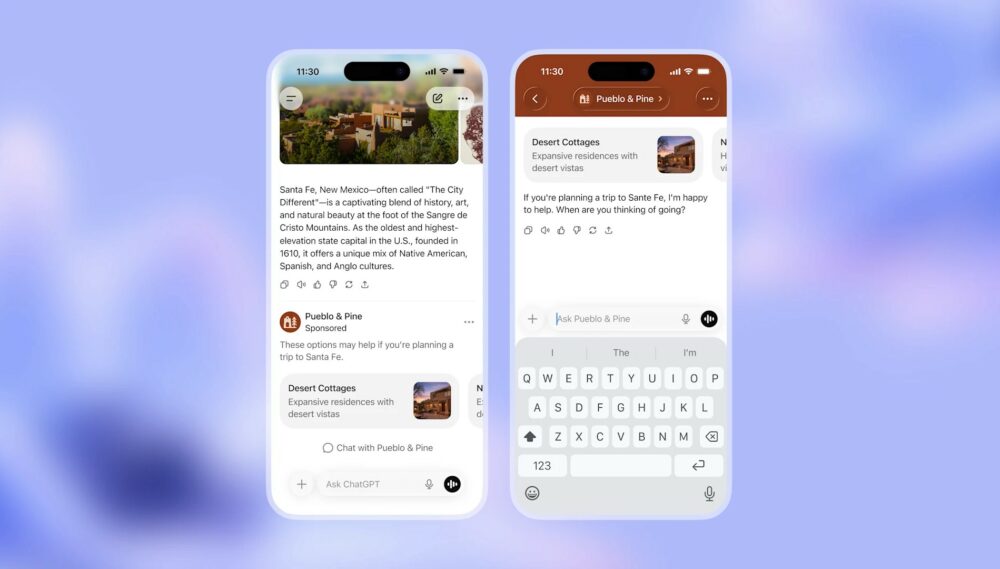
Source: Our approach to ads and expanding access to ChatGPT – OpenAI, January 2026
Targeting will be based on the context of the conversation (e.g., planning a trip, searching for marketing tools, etc.). And it will be combined with some personalisation data that the user can deactivate for advertising.
OpenAI promises that advertisers will not be able to access conversations or identifiable personal data. It also states that chats will not be sold to third parties, something the company itself emphasises to differentiate itself from the logic of traditional social networks.
Furthermore, the company ensures that ads on sensitive or regulated topics (health, mental health, politics) will be avoided. And that ads will not be served to users under 18 or those who indicate they do not want to see advertising in the tests.
OpenAI’s Promises: Access, Privacy and “Non-Intrusiveness”
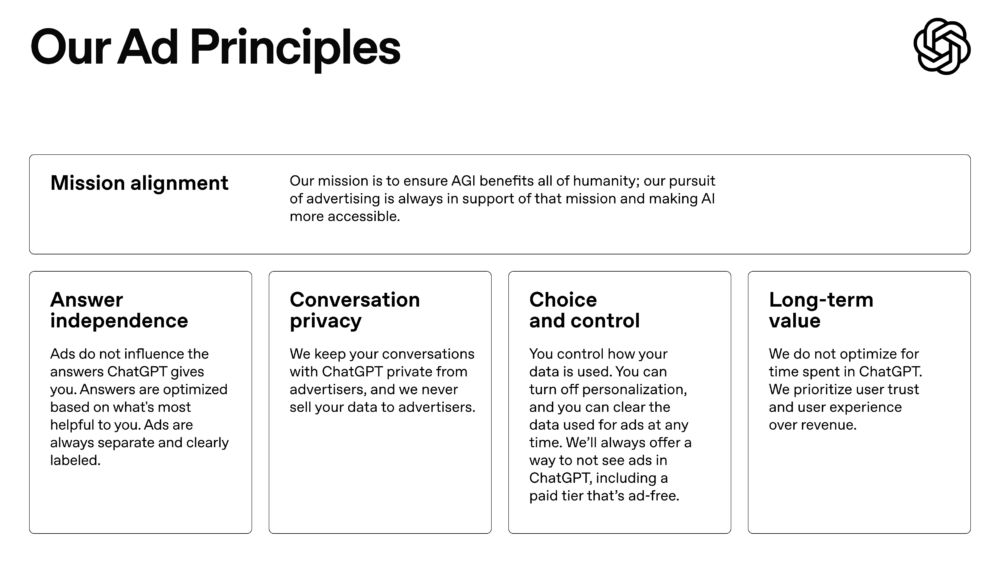
In its official note, OpenAI articulates 5 key principles for its advertising strategy: mission, independence of responses, privacy, user control and long-term vision.
Source: @OpenAI on X – OpenAI, January 2026
- Independence: ads will not influence the content of the response. The stated priority is for the model to respond based on what is “objectively useful”. Advertising will remain separate at a visual and functional level.
- Privacy: the company insists that conversations will remain private from advertisers and that it will not sell data. It also says that specific personalisation for advertising can be deactivated and data used for that purpose can be deleted.
- Control: OpenAI promises to always maintain at least one paid level without ads. This way, anyone who wants a completely ad-free experience can continue to access it via subscription.
Sharing our principles for how we will approach ads in ChatGPT before we start testing in the U.S. in the coming weeks. Most importantly: ads will not influence the answers ChatGPT gives you. https://t.co/EM8IctXsaM
— Fidji Simo (@fidjissimo) January 16, 2026
As Fidji Simo, CEO of OpenAI applications, writes in the press release published to announce the introduction of advertising in ChatGPT:
Expert Concerns: Manipulation and Bias
For part of the academic community and security experts, the combination of conversational AI and advertising is not a simple evolution of the business model, but a risk qualitatively different from that of social networks.
Researchers such as Bruce Schneier and Nathan Sanders warn that conversational AI can influence ways of thinking, spending patterns and even personal beliefs in a more subtle way. This would be because it answers specific questions and accompanies decision-making processes that are much more intimate than a static content feed.
The problem, they point out, is not the technology itself, but corporate priorities: when the dominant incentive is to maximise advertising revenue, the risk is that the experience design is optimised to capture data, attention and influence, reproducing – and probably amplifying – the dynamics already seen on social networks.
Innovation experts like Enrique Dans warn that a chatbot one talks to daily can become “a data-capturing machine” much more powerful than any social platform, if the monetisation model pushes in that direction.
Why Is OpenAI Betting on Advertising Now?
Sam Altman, CEO of OpenAI, has been saying for years that he saw ads on ChatGPT as a last resort:
This is how he expressed it during an event held at Harvard University in May 2024. What has happened since then?
The shift towards advertising occurs in a context of strong economic pressure. OpenAI has committed to an estimated expenditure of €1.2 trillion (1.4 trillion of dollars) on AI infrastructure up to 2033. On the other hand, it has not yet achieved profit and does not expect to do so until at least the next decade.
ChatGPT already has around 800 million weekly active users, most of them free—a scale that has historically triggered advertising-based models in other major internet services.
The magnitude of the investment and the competitive pressure from Google Gemini, Microsoft Copilot and other players make the advertising route difficult to avoid.
In parallel, the company is launching and reinforcing a range of subscriptions (Go, Plus, Pro, Business, Enterprise) with different functionalities and no ads, seeking a diversified revenue model where advertising is one more pillar, but not the only one.
What Does this Imply for Users and Brands?
For end users, the impact will depend on two factors: how ads are integrated into the conversational experience and to what extent privacy and neutrality of responses are truly respected. If advertising remains clearly separate from the content generated by the model and the user retains control over their data and preferences, the perception will be very different from that of an opaque system that prioritises advertising performance.
For brands, the entry of ads into ChatGPT opens a new channel with a level of intent and context difficult to find in other digital formats. It is not just about “impacting” a user, but about appearing as a relevant option precisely when they are formulating a doubt, comparing alternatives or moving forward with a purchase decision within the conversation.
In this first phase, the main lever for optimisation will be contextual relevance:
- Working thoroughly on conversational SEO (what prompts your buyer personas actually use, how they formulate problems and objections) to align messages, content and creatives with that real language.
- Connecting inventory and product listings with clear, structured and updated descriptions, which make it easier for AI systems to understand when it makes sense to show your brand as a sponsored option.
- Ensuring consistency between the ad and the destination experience (landing page, demo, free trial, etc.). In an environment as immediate as a chat, any subsequent friction is perceived as a breach of the initial promise.
As OpenAI develops more interactive formats, brands will be able to experiment with full journeys within the chat itself, which will require creatives designed for dialogue and not just for the click. In this scenario, those who best understand how to “converse” with their audiences, and not just how to impact them, will have an advantage in gaining visibility and performance in ChatGPT ads.