
How Meta Wants to Turn Facebook and Instagram into the Off-Site Extension of Retail Media Networks
TL;DR
Meta is testing retail media tools on Facebook and Instagram that allow for campaign optimisation and product-level sales measurement. The initiative aims for brands to integrate social media into their retail media strategies and capitalise on the growth of this channel.
Introduction: When Social didn’t Speak the Language of Retail Media
For years, social media advertising and retail media have evolved along parallel paths. Facebook and Instagram established themselves as channels for discovery and consideration, while retailers and marketplaces dominated the conversion landscape thanks to their purchase data.
The main difference lay in measurement. Retail media networks —especially those of marketplaces— can connect an ad with a specific sale within the same environment. In contrast, social platforms usually optimise campaigns based on more general signals such as clicks, aggregate conversions, or user behaviour.
This difference has influenced the distribution of advertising budgets in e-commerce. In recent years, a growing portion of digital investment has shifted towards retail media, a market that already moves tens of billions of dollars annually in the United States.
Meta wants to take a more active share of that budget. To do so, it needs to speak the same language as retail media networks: products, SKUs, and attributable sales.
In this context, the company is testing new advertising tools that aim to connect Facebook and Instagram ads with the commercial performance of specific products.
Meta Tests New Retail Media Tools on Facebook and Instagram
Meta is experimenting with two new features designed to improve the execution of retail media campaigns within its advertising ecosystem, according to an ADWEEK exclusive. These tools would allow ads to be optimised at the product level and their impact on sales to be measured with greater precision.
The tests focus on two key capabilities:
- Product Set Optimisation
- Product Insights
Both are integrated into Meta’s advertising infrastructure, based on automatic optimisation systems such as Advantage+. Their objective is to facilitate collaboration between social platforms, retailers, and brands managing retail media campaigns.
One of the problems these tools attempt to resolve is the way Meta historically optimised ads linked to product catalogues. When a retailer promoted products from different brands, the algorithm could optimise the campaign around the retailer launching the ad, rather than around the specific product or brand.
This behaviour limited the ability to run campaigns oriented towards specific SKUs, something that is common within retail media networks.
With the new features being tested, Meta aims to introduce a logic closer to that of digital commerce.
The 2 Key Features: Product Set Optimisation and Product Insights
The new tools focus on two fundamental dimensions of retail media: product optimisation and measurement of commercial results.
Campaign optimisation by product sets
The Product Set Optimisation feature allows advertising catalogues to be organised around sets of SKUs and campaigns to be optimised based on those product groups.
This means that Meta’s algorithms could decide which products to show, to which audiences, and in what context, taking into account the individual performance of each SKU.
In the past, some retailers tried to resolve this limitation by creating independent catalogues for each brand or manufacturer. The process involved complex operational management and a heavy maintenance burden.
The new tool simplifies that approach. Those participating in the trials for this tool have been recommended to work with broad catalogues, even exceeding 100 SKUs. This would allow the system to optimise ad delivery based on more performance signals.
From a retail media perspective, social advertising is moving closer to an optimisation model that is already standard in marketplaces: campaigns managed at the product level.
SKU-level sales measurement
The second tool under testing is Product Insights, designed to improve sales attribution.
Its function is to connect ads with specific products and analyse whether advertising exposure has generated sales for that specific item.
In previous versions of Meta’s reporting systems, it was possible to see if an ad had generated sales within a retailer, but it was difficult to link those conversions to the specific product or brand promoted.
Product Insights attempts to close that gap. The tool seeks to provide more granular information on the commercial performance of each SKU, which is especially relevant for:
- Brands selling through multiple retailers
- Campaigns oriented towards specific products
- Retail media strategies requiring measurement of incremental sales
For many advertisers, this capability is key to justifying investment in retail media.
Why does Meta Want to Enter the Retail Media Budget?
Retailers and marketplaces have developed their own advertising networks that allow brands to promote products directly within the shopping environment. These networks have a structural advantage: direct access to transactional data.
This facilitates metrics such as:
- Attributable sales
- Return on advertising investment
- Impact per SKU
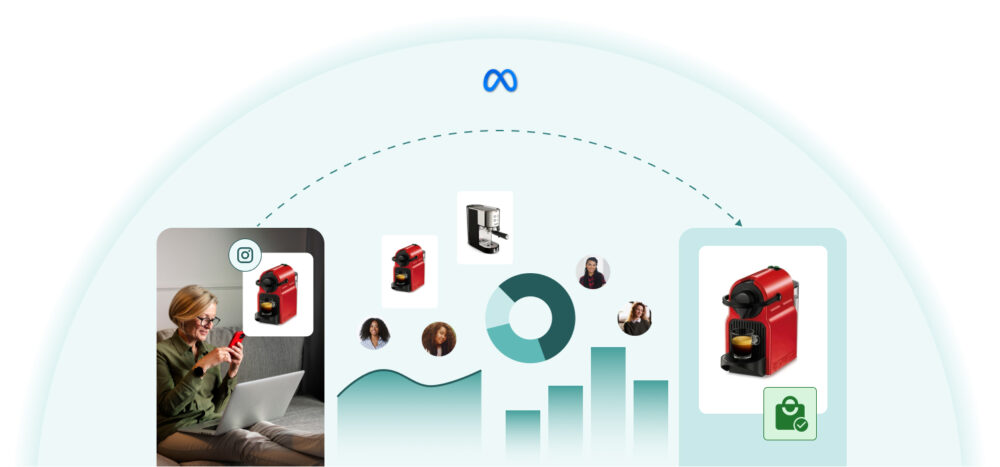
Social platforms do not have that same level of visibility of the final transaction. Meta’s new tools aim to reduce that gap and position Facebook and Instagram as channels that can participate in retail media strategies.
The logic behind this move is clear: if brands can measure the commercial impact of their social media ads with greater precision, part of the budget allocated to retail media could flow towards these platforms, especially in a context where this channel continues to grow. According to EMARKETER estimates, retail media investment in the United States will increase by nearly 18% in 2026, outstripping the growth rate of both social media and search engine advertising.
Furthermore, Meta is strengthening its advertising ecosystem with artificial intelligence and automation to optimise ad delivery and improve e-commerce campaign performance.
The objective is to integrate discovery, consideration, and conversion within a single advertising flow.
What do Retailers, Brands, and Agencies Gain?
If these tools are consolidated, the impact could extend to different actors within the retail media ecosystem.
For retailers and retail media networks
Retailers operating retail media networks could use Facebook and Instagram as off-site channels within their advertising offering.
This would allow the reach of campaigns to be expanded beyond the retailer’s environment, while maintaining a level of measurement and product-level optimisation.
In practice, retail media networks could incorporate social inventory as an extension of their advertising activation.
For FMCG brands
FMCG brands work with extensive catalogues and sell through multiple retailers.
In this context, campaigns oriented towards specific SKUs are a common practice to drive:
- Product launches
- Promotions
- Visibility in competitive categories
The ability to measure the impact of social ads on specific products facilitates the integration of Facebook and Instagram into broader retail media strategies.
It also allows results to be compared between on-site and off-site channels.
For agencies and technology partners
Media agencies and technology platforms working with retail media could benefit from greater integration between e-commerce data and advertising activation.
This opens the door to new campaign planning models where:
- Segmentation is based on products
- Optimisation is supported by sales data
- Reporting incorporates more precise commercial metrics
In this scenario, social platforms can become a natural complement to retail media networks.
The Next Step: Social Commerce + Retail Media
The evolution of retail media points towards an increasingly integrated advertising ecosystem. Boundaries between social media, e-commerce, and digital advertising are becoming less clear. Social platforms are incorporating shopping features, while retailers are developing their own advertising solutions.
The new tools that Meta is testing are located at this point of convergence.
If the model works, Facebook and Instagram could establish themselves as off-site channels within retail media strategies, connecting social discovery capabilities with commercial e-commerce measurement.
For brands, the result would be an advertising environment where investment decisions are increasingly based on the performance of specific products. And where SKUs —not just audiences— begin to become the central unit of advertising optimisation.