
From Desktop to Smartphone: The Dominance of Mobile-First Commerce in the 2025 Christmas Campaign
Introduction: a Christmas Experienced on Mobile
The Christmas campaign is once again the great annual test for retail. In a few weeks, traffic peaks, promotional pressure, high-speed stock changes and fierce competition for consumer attention are concentrated. For many brands, what happens between late November and early January determines a decisive part of the close of the year.
In 2025, this peak is being experienced with an increasingly clear pattern: the mobile phone has become the remote control of daily life. The consumer uses it to discover gift ideas, compare prices, read reviews, find store availability, buy with a couple of taps and, afterwards, follow the shipment minute by minute. Even when the final purchase is completed in another channel, the decision is usually made on the smartphone.

The thesis is simple: brands that have adopted a mobile-first approach will arrive better prepared for Christmas 2025 and capture a larger share of sales. It is not just about “looking good on mobile”. It is about designing experience, marketing and operations thinking first about how people buy from a small screen, in a hurry, with distractions and very high expectations.
From “Mobile Also” to “Mobile First”: What has Changed in 2025
Mobile as the gateway to the customer journey
The smartphone has ceased to be a complementary device to become the starting point for most shopping experiences. Data shows that mobile currently accounts for the majority of visits to e-commerce websites, and during Christmas campaigns this trend is accentuated even more, widely surpassing the desktop computer.
The interesting thing about the mobile-first phenomenon goes far beyond web traffic figures. Mobile phones accompany consumers in multiple shopping contexts. At home, it serves to research products and read reviews from the sofa. In the physical store, buyers use it to practice showrooming: they scan barcodes, compare prices with other retailers and consult opinions from other users before deciding on a purchase. This practice, which worried physical shops enormously a few years ago, has become completely normalised.
The customer journey no longer follows a linear pattern nor is it limited to a single device. However, mobile has emerged as the common thread connecting all stages: from initial product discovery to final purchase and after-sales tracking.
Key data: the weight of mobile in Christmas sales
The figures projected by the sector’s main analysts for the 2025 Christmas campaign confirm the absolute dominance of mobile commerce. According to eMarketer forecasts, commerce through mobile devices will represent more than half of the total online sales during this Christmas, also capturing more than 90% of net e-commerce growth.
Reports from Adobe and Salesforce on recent Christmas campaigns show how the percentage of orders made from mobile is already approaching or exceeding 70% on the busiest days, such as Black Friday, Cyber Monday or the final days before Christmas. Although the exact figure varies by country, category and digital maturity, the pattern is consistent: mobile dominates volume and drives growth.
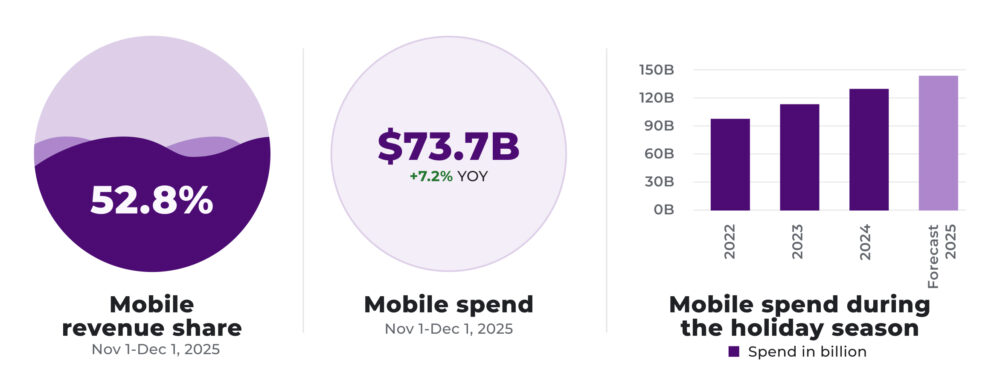
Source: 2025 Holiday Shopping Trends – Adobe 2025
With this split, it is not enough to optimise for desktop and “adapt” for mobile. At Christmas, mobile is the main channel to capture demand, defend margin and avoid leaks to competitors.
How Mobile-First Commerce is Redefining Christmas Sales
Massive mobile traffic… and more demanding
During the 2025 Christmas season, approximately 7 out of every 10 visits to retail websites will come from mobile devices. This figure translates to mean that the share of revenue generated from mobile will approach 56%, consolidating the smartphone as the main sales generator for most retailers.
What is relevant is not just the volume. It is the level of demand. The mobile user decides with less patience: if a page lags, if the buy button remains hidden, if the form asks for too much data, the probability of abandonment rises. And at Christmas, the cost of that friction multiplies, because the consumer is in a hurry and has alternatives one click away.
A mobile-first approach results in three clear expectations:
- Real speed: fast and stable loading, even with variable networks.
- Simple navigation designed for the thumb: clear menus, usable filters, large touch elements.
- Frictionless checkout : few steps, few doubts, quick payments and transparent confirmation.
When a brand does not meet these minimums, the user does not think twice; they leave. And in high season, that leak becomes a direct loss of sales and return on advertising investment.
Mobile conversion: from weak point to growth engine
Historically, mobile commerce faced a persistent challenge: although it generated a lot of traffic, its conversion rates were notably lower than those of desktop. Users browsed and explored from mobile, but completed their purchases on the computer. This gap has been the Achilles’ heel of mobile commerce for years.
But this has changed. Mobile is no longer just a discovery channel: it is a closing channel, capable of generating mass orders without the user needing to “wait to be in front of the computer”.
What is behind this improvement? Three factors stand out:
- Experience improvements: clearer product pages, better adapted photos, more visible returns, and shorter processes.
- More mobile-friendly payment methods: digital wallets , one-touch payment, biometrics and deferred payment options (BNPL – Buy Now Pay Later).
- Specific campaign optimisation: landings created for mobile, fewer distracting elements and more direct messages for small screens.
At Christmas, converting from mobile implies eliminating doubts quickly. Stock, estimated delivery, shipping costs, return policy and customer service must be one click away.
Apps, social commerce and mobile wallets as accelerators
The mobile ecosystem in 2025 has two clear accelerators: apps and shopping from social networks. Retail mobile applications have experienced a notable resurgence, especially among frequent shoppers who value the convenience of saved purchases, personalised notifications and integrated loyalty programmes.
In parallel, social commerce has consolidated as a dominant force, particularly among Generation Z and millennials. Platforms like Instagram or TikTok have transformed their interfaces to allow direct purchases without leaving the application. During the 2025 Christmas campaign, it is estimated that purchases made directly from social networks will represent a significant portion of mobile sales, especially in categories like fashion, beauty and consumer electronics.
Payment methods have also evolved to adapt to the mobile consumer. Digital wallets like Apple Pay, Google Pay and other local alternatives have radically simplified mobile checkout , eliminating the need to manually enter card details or shipping address. Christmas comes accompanied by large baskets, multiple purchases and pressure to meet deadlines. Offering convenient and flexible payment methods reduces abandonment, especially when the user buys from mobile in moments of limited time.
3 Key Levers to Win Christmas 2025 in Mobile-First
1. Performance and UX in mobile: speed, design and checkout
The first lever is the foundation: performance and mobile experience. In the Christmas campaign, every second counts, and every extra step in the payment process is noticed.

Practical actions that usually have impact:
- Prioritise speed: image optimisation, reduction of unnecessary scripts , progressive loading and control of third-party elements that slow down.
- Design navigation for small screens: simple menus, visible search bar, filters that are understood and can be used with one hand.
- Improve product pages: price, promotions, availability, variants, delivery and returns at first glance.
- Simplify checkout: guest purchase, autocomplete, fewer fields, clear validation of errors and fast payment methods.
- Visible trust messages: secure payment seals, customer service, returns and deadlines without small print.
A good test before starting the campaign consists of making a “gift journey”: entering from mobile, searching for a typical Christmas product, comparing variants, adding two items and paying. If something bothers an internal team, it bothers the customer double.
2. Mobile-first marketing: from the campaign to the moment of truth
The second lever is marketing designed for mobile consumption. In 2025, a good part of attention occurs in vertical formats, in short sessions and in contexts where the user can be distracted.

To adapt:
- Adjust creatives to mobile: short video, vertical format, large text, clear product demonstrations.
- Bring the value proposition to the beginning: delivery, price, availability and clear benefits in a few seconds.
- Build landings consistent with the ad: if the ad is mobile, the landing must also be mobile, without excess modules or waits.
- Activate communications at key moments: push notifications (if there is an app), SMS with moderation, email adapted to mobile and specific retargeting for mobile users.
At Christmas, the “moment of truth” is usually a quick decision. Mobile-first marketing reduces the leap between inspiration and purchase, and prevents the user from getting lost along the way.
3. Data and personalisation in real time
The third lever is the use of real-time data to refine messages and offers during the campaign. Mobile generates valuable signals: browsing behaviour, interaction with categories, response to notifications, saved products, cart abandonments and visit frequency.

Taking advantage of these signals allows:
- Personalise product recommendations in the mobile session according to recent navigation.
- Adjust messages according to intent: “gift ideas”, “last minute”, “store pickup”, “guaranteed delivery”.
- Activate useful reminders (not invasive): price drop, back in stock, delivery deadline for Christmas.
- Use AI and automation to optimise promotions, product order and content shown at segment or user level, with the aim of improving mobile conversion.
In the Christmas campaign, effective personalisation does not consist of being “creative”, but of being timely: showing what the user needs to decide without friction.
Challenges and Risks of Mobile-First Commerce
Despite the enormous potential of mobile commerce, implementing a mobile-first strategy presents significant challenges that retailers must anticipate and actively manage during the Christmas campaign.
- Ad saturation and fatigue: too many impacts in a short time lower performance. Controlling frequency, varying creatives and prioritising useful messages helps sustain results.
- Limited attention on small screen: there is less space to explain. Critical information (delivery, returns, availability) must be very visible and simple.
- Measurement difficulties: the environment without cookies and iOS/Android restrictions complicate customer tracking. It is advisable to reinforce own measurement, create well-defined events and use more realistic attribution models.
- Dependence on third-party platforms and marketplaces : changes in algorithms or advertising costs can affect sales. Diversifying traffic (SEO, CRM, app, affiliation) reduces exposure.
- Security risks: phishing, the use of fake apps, misleading ads and payment fraud usually increase at Christmas. Mitigating all these risks implies verifying domains, brand protection in ads, monitoring impersonations and educating the customer with clear communications.
The key is not to improvise. On mobile, a small incident is amplified: more users, less patience and more competition one click away.
Conclusions: Mobile as the Epicentre of the Christmas Campaign
Mobile is no longer an extension of the shopping journey, but its authentic epicentre. Christmas 2025 will consolidate this reality: the smartphone concentrates discovery, guides comparison, accompanies in store and closes a growing volume of transactions. In this context, winning the campaign does not depend on having a responsive site or just another app on the market, but on redesigning the entire experience from mobile logic: interfaces designed for small screens, fluid navigation for users who buy with their thumb, immediate payments, natively mobile messages and metrics that capture real consumer behaviour.
With more than half of Christmas sales already originating on mobile, the logic is inverted: it is not about anticipating a transition, but about optimising a fully consolidated standard. Brands that put speed, clarity and real-time personalisation at the centre of their mobile operations not only capture more demand, but elevate their commercial efficiency and strengthen the relationship with the customer. The smartphone dominates the moment of truth in this campaign, and those who have aligned their commercial experience to this reality compete today with a clear advantage that is difficult to replicate.