
Price Wars in Marketplaces: Why your MAP and RRP Strategy Needs Governance, Not More Excels
TL;DR
In today’s e-commerce, manually controlling prices is not viable: the volume of SKUs, countries and channels exceeds the capacity of any ad-hoc review. This article explains the difference between RRP and MAP, the legal limits of their application and why only a structural governance system allows for protecting margins and brand positioning on an international scale.
The Myth of Monday Morning Manual Control
Monday, 8:30 am. An e-commerce analyst opens his laptop with a cup of coffee. His first task consists of opening an Excel file with hundreds of rows and manually checking product listings on Amazon or Miravia to identify if any external seller is selling below the suggested price.
This ritual stems from an obsolete premise: believing that the digital market operates at human speed. While the brand’s team was resting over the weekend, dozens of dynamic pricing algorithms were competing in an automated way. Amazon modifies prices on its platform millions of times a day, and in the most competitive listings, the Buy Box can rotate between sellers dozens of times in a single day. No human team, however dedicated, can keep up with that pace through ad-hoc reviews.
The result is that manual RRP and MAP control detects deviations only after the damage has been occurring for days: eroded margins, disgruntled distributors and a Buy Box that has changed hands without anyone noticing. This article explains why this model has reached its limit and what it means to move from manual surveillance to a system of structural governance for the digital channel.
What are RRP and MAP, and Where Are they Confused?
The RRP (Recommended Retail Price) is the reference price that the brand recommends for its product at the point of sale. It is also known as MSRP (Manufacturer’s Suggested Retail Price). It is a guideline: it helps distributors understand what margin and positioning the brand expects, but it cannot be imposed as the final selling price.
The MAP (Minimum Advertised Price) is a commercial policy typical of the United States, with a different and more restrictive concept. It defines the lowest price at which a distributor can publicly advertise a product, whether on their website, in a marketplace or in a paid advert. An important nuance: MAP regulates what is shown to the public, not what happens inside the shopping basket. That is why many sellers resort to tactics like “see price in basket” to show discounts without technically infringing the policy.
This is one of the points where both concepts are most often confused. The RRP guides the final price; the MAP limits only the advertised price. A brand may have an RRP of 80€ and a MAP of 65€, leaving room for distributors to compete on price without that discount becoming a public draw that damages positioning.
The confusion worsens when attempting to import the MAP concept directly into the European Union. In Europe, any mechanism that acts coercively to force minimum prices or limit discounts in the digital channel violates free competition and is pursued by regulatory bodies.
Legal Limits: What Can and Cannot Be Demanded
In the United States, a unilateral MAP policy is generally legal: the brand can set a minimum advertised price as long as it communicates it unilaterally, without negotiating it with distributors, and applies the same consequence to everyone equally (usually, ceasing to supply products to those who breach it). In the European Union, the framework is much more restrictive. European Union competition law, regulated by Article 101 of the Treaty on the Functioning of the European Union (TFEU) and the Vertical Block Exemption Regulation (VBER), considers Resale Price Maintenance (RPM) as a hardcore restriction.
What brands can do within the legal framework includes:
- Establishing recommended RRPs as a non-binding reference guideline.
- Implementing MAP policies that limit the advertised price in advertising and online channels, provided it does not extend to the final transaction price in a coercive manner.
- Including clauses in distribution contracts regarding authorised channels, assigned territories and marketing conditions, without imposing minimum sales prices.
- Taking action against unauthorised sellers operating outside contractual agreements, using documentary evidence of infringements.
What brands cannot do includes:
- Imposing minimum sales prices vertically on distributors or retailers.
- Commercially sanctioning distributors who set prices lower than the recommended RRP, provided they operate within the contractual terms.
- Coordinating prices between competitors or distributors, which would constitute a prohibited horizontal agreement.
Recent case law shows that authorities pursue these infringements with severity. In October 2025, the European Commission sanctioned luxury firms such as Gucci, Chloé and Loewe with more than 157 million euros for RPM practices. In Spain, the CNMC fined ICON Europe in December 2025 1.19 million euros, also imposing a 5-month ban on contracting with the public sector. The resolution determined that ICON controlled online discounts and blocked marketplaces to neutralise price competition.
Despite this, brands have lawful alternatives. They can implement selective distribution systems based on objective technical and qualitative criteria. Likewise, it is perfectly legal to demand guidelines to preserve brand image or restrict certain marketplaces, provided it responds to qualitative brand reasons and does not serve as an indirect pretext for controlling prices. Furthermore, monitoring compliance with that policy is perfectly legitimate, and necessary in most situations.

Margin Erosion in Digital Retail: Causes and Symptoms
The erosion of margin rarely appears as a single, isolated problem. It is usually the sum of several dynamics that feed off each other in the marketplace environment.
The most common cause is the proliferation of unauthorised sellers or distributors reselling outside their assigned territory. When the same product is listed by several sellers, each one competes to capture the Buy Box, and the fastest way to achieve this is usually to lower the price. This triggers a downward spiral that no individual actor fully controls.
Added to this dynamic is the widespread use of automatic repricing tools, which adjust prices in real time according to the competition’s behaviour. This means that a price drop by a single actor can spread to dozens of listings in a matter of minutes, without negotiation or control by the brand.
The symptoms of this erosion are recognisable:
- Prices that fluctuate several times a day for the same SKU
- Official distributors complaining about unfair competition from other channels
- A Buy Box that changes hands more frequently than can be explained by normal stock or service variations.
When these symptoms accumulate, the problem is no longer occasional. It is structural and, in the medium term, a serious channel conflict may arise. Traditional distributors with physical shops protest as they cannot compete with internet rates, eroding the commercial relationship. At the same time, the brand suffers reputational damage because the end consumer associates price instability with a loss of product value.

3 Reasons Why Manual Control No Longer Scales
Even with a well-defined and legally sound pricing policy, manual control hits three barriers that do not depend on how much effort or how many hours are dedicated to the process.
1. Matrix volume (SKUs x Channels x Countries)
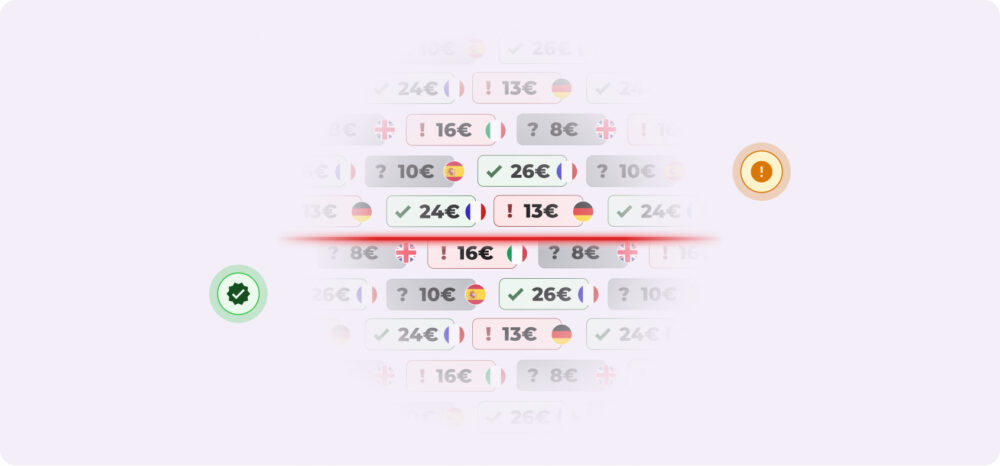
Any brand with an international presence faces a control matrix that grows multiplicatively, not linearly. A catalogue of 500 SKUs distributed across 8 marketplaces and 6 countries potentially generates 24,000 price-channel-country combinations that should be reviewed recurringly. Adding a single country or a single new channel does not add one unit of work: it multiplies the entire existing set. No team can sustain that volume with manual reviews, unless it grows proportionally to the catalogue.
2. Opacity of the 3P ecosystem
The 3P (Third Party Sellers) ecosystem is, by design, opaque from the brand’s perspective. The same product may be sold by authorised distributors, parallel resellers and stock liquidators, all under the same listing, without there being a centralised and real-time record of who controls the Buy Box at any given moment.
Manual analysis lacks the resources to break that opacity. The human eye sees the discounted rate on the screen, but cannot trace the physical source of the stock. Without an integrated system that records historical Buy Box variations, brands are limited to observing the symptoms of price deviation without the ability to act on the root cause.
3. The cross-border environment
Electronic commerce has definitively blurred the physical boundaries of retail distribution. Today, an official distributor established in Poland facing excess inventory can position their goods on sales platforms in the UK in a matter of clicks. Exchange rate imbalances, regional pricing policies and tax differentials become a source of constant arbitrage.
Localised manual audits completely ignore these geographical dynamics. While the national branch protects the premium positioning of its new releases, the digital grey market introduces batches from other EU countries with lower costs, undermining local margins without raising suspicion during routine checks.
Only a consolidated and automated view of all markets at once allows for identifying these patterns before they turn into a channel conflict with an official distributor.

From Reactive Monitoring to Structural Governance
Reactive price monitoring —reviewing prices when something has already happened, or when a distributor complains— answers the question of what is happening at a given time. Structural digital channel governance answers a different and more useful question: what systemic dynamic is behind that deviation and what specific action needs to be taken to protect it.
Flipflow articulates this governance around four key capabilities:
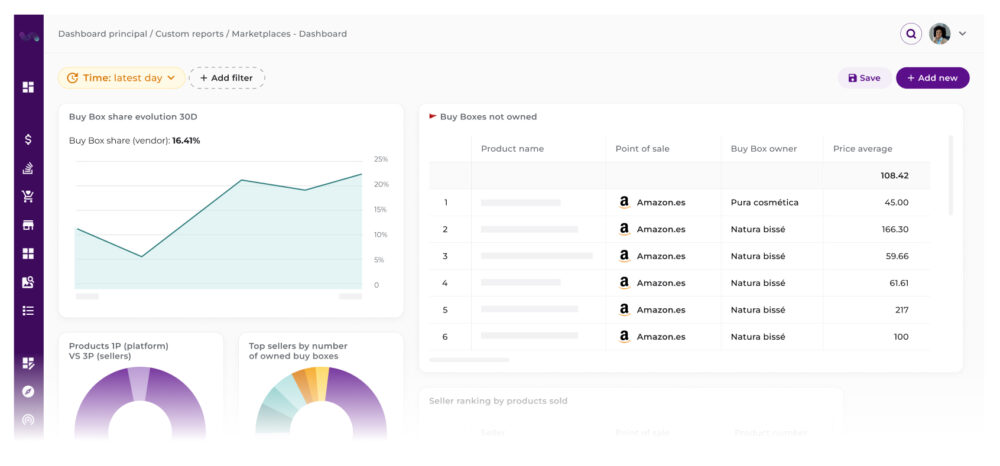
- Full mapping of sellers and distribution: Construction of a real map of the digital ecosystem by SKU, identifying who sells, where, in which country, with what availability and who controls the Buy Box.
- Structural pricing and deviation control: Automatic detection of deviations vs RRP/MAP, identification of inconsistent pricing between countries, systematic erosion alerts and tracking of price wars.
- Stability in the Buy Box and conversions: Continuous tracking of Buy Box loss, identification of dominant sellers, relationship between availability, price and visibility, and potential impact on conversion.
- Prevention of international channel conflicts: Detection of early signals of parallel reselling, cross-border inconsistencies and conflict flashpoints, with evidence ready for negotiation and enforcement.
The economic impact of this approach is direct. We see it in the Havaianas case study, the iconic Brazilian fashion brand. Aiming to expand its presence in European marketplaces, the firm implemented a pricing and seller governance model that allowed it to reduce unauthorised sales by 50%, decrease channel conflicts by 25% and increase DTC sales to marketplaces by 31%. Preventing a single parallel resale dynamic can justify the cost of the entire module in organisations with scale like Havaianas.
Fewer Excels, More Continuous Visibility
RRP and MAP control in marketplaces is not solved with more manual hours or more sophisticated spreadsheets. It is a problem of scale, of opacity in the seller ecosystem and of speed: the market moves in minutes, not in weekly reviews.
The brands that best protect their margin and positioning in the digital channel are not those that devote more resources to watching prices, but those that have replaced occasional surveillance with a system of continuous visibility over who sells, where, at what price and under what conditions. This visibility, sustained by country and by channel, allows for anticipating conflicts instead of managing them when the damage is already done.
If your organisation recognises several of the signs described in this article, it is probably time to evaluate how to move from reactive monitoring to a structural digital channel governance model, adapted to your matrix of SKUs, countries and marketplaces.
Do you want to see how the digital channel governance model works applied to your organisation? Discover the Pricing & Seller Control module from Flipflow and request a personalised demo.