

Sentiment Score and Conversion: At What Point does your E-commerce Start Losing Sales?
TL;DR
Conversion does not drop proportionally to the score: there are sentiment thresholds after which buying behaviour changes abruptly, due to both excess perfection and sustained deterioration. Monitoring the aggregate rating is not enough: attribute analysis allows you to detect the problem before it impacts conversion, and act on the cause rather than chasing a 5.0 score.
Almost all e-commerce teams monitor their sentiment score or average rating as if it were an isolated reputation indicator, something reviewed during a crisis and archived the rest of the year. However, the relationship between that score and conversion is much more direct than it seems. More than 90% of consumers read reviews before buying, and this directly influences whether the visitor adds the product to the basket or leaves the page.
What few teams identify in time is that this relationship is not a straight line. Conversion does not improve proportionally as the rating rises, nor does it drop proportionally as it falls. There are thresholds, specific turning points, after which buying behaviour changes abruptly. Detecting where those thresholds are, and above all, detecting when your brand is approaching them, is the difference between managing customer perception reactively or strategically.
This article reviews what the evidence says about those turning points and why the average score can hide a real problem. We will also tell you what to do when sentiment starts to deteriorate and what each channel measures (and doesn’t) when we talk about sentiment and positioning.
The Critical Trust Threshold: Why is the Drop in Conversion Non-Linear?
Intuition says that the higher the score, the higher the conversion. Evidence notes this intuition significantly. The Spiegel Research Center at Northwestern University, in collaboration with PowerReviews, analysed millions of purchase interactions and found that products with ratings between 4.0 and 4.7 stars consistently convert better than those with a perfect 5.0 score. In fact, a 5-star product can have a conversion rate comparable to one situated between 3.0 and 3.49.
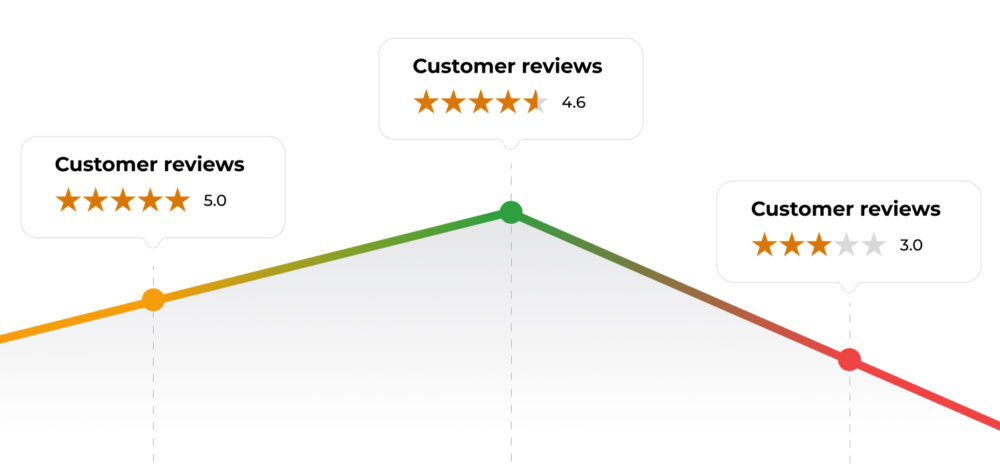
The explanation has a psychological basis. Nearly half of buyers (46%, and up to 53% among Gen Z) distrust perfect scores, because they associate them with manipulated or filtered reviews. A sentiment score that is too clean stops conveying trust and starts generating suspicion. That is why the 4.2 to 4.5 range has established itself as the zone where the perception of authenticity and the conversion rate best coincide. Meanwhile, the 4.75–4.9 segment tends to maximise pure conversion in the short term.
That same threshold principle, but in reverse, applies to the deterioration of sentiment. The Amazon analysis conducted by Pattern found that every additional point in rating translates into an approximate 4-5% increase in conversion, and that the jump from 3.5 to 4.5 stars can raise the conversion rate from 24% to 29%. When sentiment falls below certain ranges, the buyer doesn’t just slightly reduce their purchase intent. They also start to interpret the product as a risky option, and this change in interpretation is what causes sharp, non-gradual drops in conversion. Monitoring only the average score prevents anticipating when that boundary is crossed.
From Global Rating to Attribute Analysis: The Mistake of “Word Clouds”
The underlying problem is that the average score almost never explains the real reason for satisfaction or dissatisfaction. Two products can share a 4.2-star rating and be going through completely different problems: one due to packaging, another due to delivery times. If the analysis stays at the aggregate number, that difference disappears.
This is where the traditional “word cloud” approach falls short. Grouping frequent terms offers a visual snapshot, but it doesn’t answer the questions that actually drive business decisions: in which attribute am I winning? Where am I losing? What pattern is repeated across markets or SKUs? Without this breakdown, the deterioration of a specific attribute can go unnoticed for weeks while the global rating remains stable, precisely because other attributes compensate for the drop in the visible average.

Aspect analysis solves this limitation by turning “there are negative reviews” into actionable data such as “62% of negative reviews mention the size guide” or “45% of mentions about waterproofness are negative”. This granularity is what allows for prioritisation. Not all negative attributes carry equal weight in the purchase decision. And sentiment analysis only becomes strategic when it distinguishes this hierarchy instead of treating each comment as an equivalent unit.
What to Do When the Score Drops
Detecting the deterioration is only the first step. The second is acting without making the most common mistake, which is trying to polish the score instead of correcting the cause.
- Audit before reacting: Before launching any action, it is advisable to isolate whether the drop stems from a specific attribute (a faulty batch, a change in logistics provider) or from a structural pattern affecting several SKUs or markets. Confusing both scenarios leads to disproportionate or insufficient solutions.
- Prioritise by volume, intensity and relevance: Not all sources of negativity require the same urgency. An attribute with many negative mentions and high relevance to the product’s value proposition must immediately move up the product or logistics roadmap. An isolated, low-intensity complaint can wait for the next review cycle.
- Respond quickly and without generic templates: The speed of response to a negative review influences perception as much as the content of the response. Many consumers value brands that respond within the first 24-48 hours, compared to those who take days or do not respond at all.
- Do not chase a 5 as the goal: Given what was explained in the previous point about the trust threshold, a reasonable goal is not to maximise the score at all costs, but to stabilise it in the range that combines perceived authenticity and conversion. This avoids both sustained deterioration and suspicion of manipulation.
- Measure the effect of each correction. After implementing a change, you must observe the evolution of sentiment associated with that specific attribute in the following weeks, not just the aggregate rating. This is the only way to confirm if the correction addresses the root cause or if the problem will keep reappearing.
Sentiment and Ranking: What Each Channel Really Measures
It is worth being precise about which channels reward or penalise sentiment, because they do not all work the same way. In Google Search, review sentiment is not confirmed as an organic ranking factor. Google has explicitly stated that reviews help assess a site’s reputation, but they are not part of the general positioning algorithm. Confusion often stems from the relationship between reviews and local SEO, where there is evidence that the recency, volume, and polarity of reviews influence the positioning of local listings and the Google Business Profile.
In marketplaces and retail platforms, the mechanism is different but equally relevant. Sentiment doesn’t directly determine the internal search algorithm, but it does influence the buyer’s behaviour once they reach the product page. This, in turn, feeds back into the conversion and engagement metrics that those same algorithms use to prioritise products.
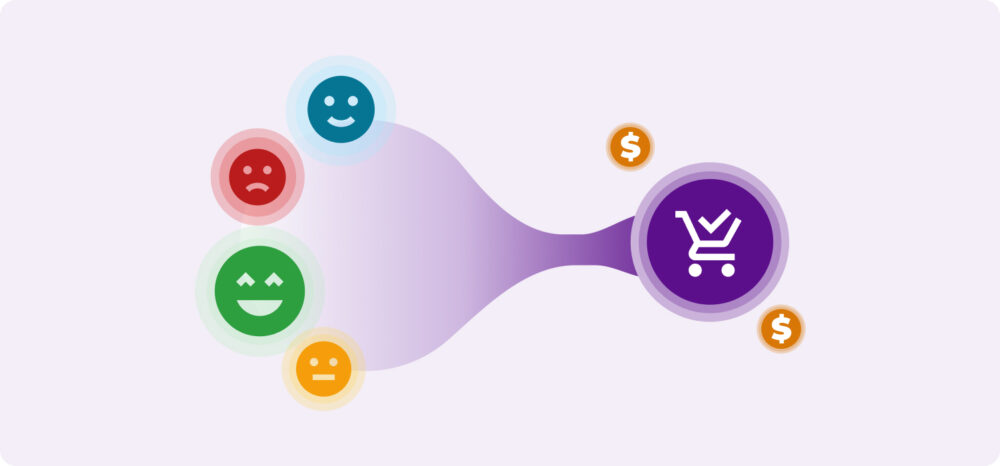
The most measurable impact, in fact, lies in the direct interaction with reviews within the product listing. According to user-generated content analysis conducted by PowerReviews on 1,500,000 product pages, interacting with reviews raises conversion by 120.3% compared to those who do not. And simple actions such as marking a review as helpful can generate an increase of 314.7%. Even filtering by one-star reviews (something more than 60% of users who interact with the filter do) is associated with a conversion 108.8% higher than average, confirming that the goal is not to hide negative sentiment, but to structure it in a way that reinforces the overall credibility.
The Sentiment Score as a Conversion Lever, Not a Crisis Thermometer
The sentiment score stops being a defensive indicator the moment it is understood as a conversion variable with specific thresholds, not just an average score that only matters when it plummets. Chasing perfection is as risky as ignoring deterioration. Both extremes erode buyer trust, albeit for opposite reasons.
Effective management involves monitoring sentiment at the attribute level, not just in an aggregate way, and acting on the cause before the critical threshold translates into lost sales. With our Customer Sentiment Intelligence module, we work precisely on that layer of detail. Connecting customer perception with real business performance, so that deterioration is detected before it impacts conversion, not after.