
Who has the most visibility in the serum category among the leading European brands?
TL;DR
La Roche-Posay is the brand with the most visibility on the serum digital shelf: it accounts for 53.5% of the five brands’ appearances in the Top 10 of searches. That visibility is concentrated in Germany, with 62.6% of appearances, although its stock ratio there falls from 90.4% in May to 69.5% in July. Visibility is mostly organic, but advertising is gaining ground: Vichy’s paid share goes from 2.2% in July to 27.1% in September, double that of La Roche-Posay (13.6%). In addition, La Roche-Posay is the brand with the highest average price (€36.07 on average across the six markets). At flipflow, we analysed La Roche-Posay, Vichy, Eucerin, CeraVe and Bioderma at two leading retailers in Spain, France, Germany, Italy, Portugal and the US between May and September 2026.
Serums have become one of the star products in facial skincare. Vitamin C, hyaluronic acid, retinol or depigmenting actives: consumers are no longer looking for “a cream”, but for a specific treatment for a specific need. And that search increasingly starts in the search bar of a marketplace or an online pharmacy.
According to Straits Research’s Facial Serum Market report, the global facial serum market reached $7.22 billion in 2025 and could reach $13.8 billion by 2034, with a compound annual growth rate of 7.46%. Europe leads this market, with 34.2% of the global share in 2025, and anti-aging serums are the type that generates the most revenue. The same study attributes this growth to consumers who are increasingly informed about their skincare routine and its active ingredients.
In this context, the serum digital shelf is where the decision is made about which serum goes into the basket: the price the consumer sees, whether the product is available and whether the brand appears in the top search positions.
Which brands are positioned in the highest average price range? Where does stock break down? Who gains visibility organically and who buys it?
At flipflow, we analysed La Roche-Posay, Vichy, Eucerin, CeraVe and Bioderma at two leading retailers in each country, including marketplaces, online pharmacies and e-retailers specialising in dermocosmetics, between May and September 2026. The result: a category with one brand leading in almost everything, but where leadership in price, assortment and visibility varies greatly from one market to another.
What our serum digital shelf study analyses
The report tracks the monthly evolution of the serum category between May and September 2026 in six markets: Spain, France, Germany, Italy, Portugal and the US. In each country, we compare two leading retailers: a marketplace or beauty e-retailer and an online pharmacy or store specialising in dermocosmetics.
| Country | Retailer 1 | Retailer 2 |
| Spain | Amazon.es (marketplace) | Atida (online pharmacy) |
| France | Amazon.fr (marketplace) | Atida.fr (online pharmacy) |
| Germany | Amazon.de (marketplace) | Shop Apotheke (online pharmacy) |
| Italy | Amazon.it (marketplace) | Farmacia Loreto (online pharmacy) |
| Portugal | Skin (beauty e-retailer) | SweetCare (online pharmacy and dermocosmetics) |
| US | Amazon.com (marketplace) | Dermstore (dermocosmetics e-retailer) |
The analysis is organised into four blocks:
- Average price: by brand, country, retailer and serum type.
- Assortment and stock: how many products each brand lists and what share is available to buy. The stock ratio is the percentage of times a product appeared as available out of the total number of times it was checked during the month.
- Digital shelf: how many times each brand appears in the Top 10 of serum searches and what share of the Top 3 it holds by search type.
- Retail media: what share of that visibility is organic and what share is paid.
Each format variant counts as one product, and packs have been excluded to analyse individual products only.
Average price: La Roche-Posay, the brand with the highest average price (€36.07); CeraVe, the lowest in all six countries
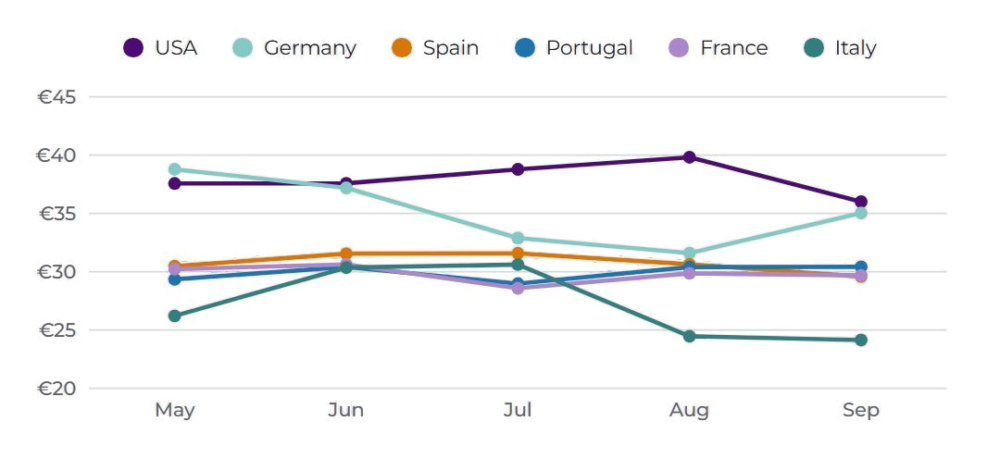
The average price of a serum varies greatly by country. The US is the market with the highest average price in four of the five months, peaking at €39.81 in August.
Germany, the country with the highest average price in May (€38.78), is where the average price falls the most: 19% up to August (€31.59), before rebounding to €35.03 in September.
Spain, France and Portugal barely move: between €28.58 and €31.57 throughout the period. At the opposite end is Italy, with the lowest average price in four of the five months: it rises to €30.61 in July and falls to €24.14 in September.
Eucerin, the highest average price in Germany, and Vichy, in France
Comparing brands country by country, La Roche-Posay has the highest average price in Spain, Italy, Portugal and the US. Its highest figure is in the US, with an average price of €44.88. In Germany, the brand with the highest average price is Eucerin (€40.56), and in France, Vichy (€33.81).
At the opposite end, CeraVe has the lowest average price in all six markets, without exception, between €20.30 and €24.17. This positioning is consistent with its value proposition within dermocosmetics.
Eucerin’s case shows how much price depends on the market: its average price in Germany (€40.56) is 58% higher than in the US (€25.62). For a brand, this suggests that a global pricing policy does not translate into a uniform price on the shelf: the assortment and formats each retailer lists change the outcome.
Stability versus adjustments: two pricing strategies
Over the five months, La Roche-Posay (between €36.17 and €36.96) and CeraVe (between €22.18 and €22.92) barely change their average price. Eucerin and Vichy, on the other hand, reduce it from June onwards: Eucerin by 18% (from €37.65 to €30.81) and Vichy by 12% (from €37.52 to €33.08).
Bioderma breaks the pattern. After falling to €25.70 in August, its average price rises 24% in September, to €31.81, its highest value of the period.
Dermstore, in the upper range; Farmacia Loreto, the most volatile
By retailer, Dermstore records the highest average price in all five months (between €40.05 and €41.39). Farmacia Loreto closes September with the lowest (€20.99) after a 44% drop since July, when it was among the highest.
At Amazon Germany, the average price falls 21% from May to September (from €39.82 to €31.28). At Amazon US, it rises 28% from June to August and falls back to €27.91 in September. Skin, SweetCare and Dermstore are the most stable retailers.
Depigmenting and vitamin C, the serums with the highest average price
By product type, depigmenting serums have the highest average price (€38.22 on average), followed by vitamin C (€35.08). Hyaluronic acid falls 11% from May to September, to €31.49. Retinol, the type with the lowest average price over the period (€30.08), closes September at €32.71, 18% higher than in August and above anti-acne in September (€30.44).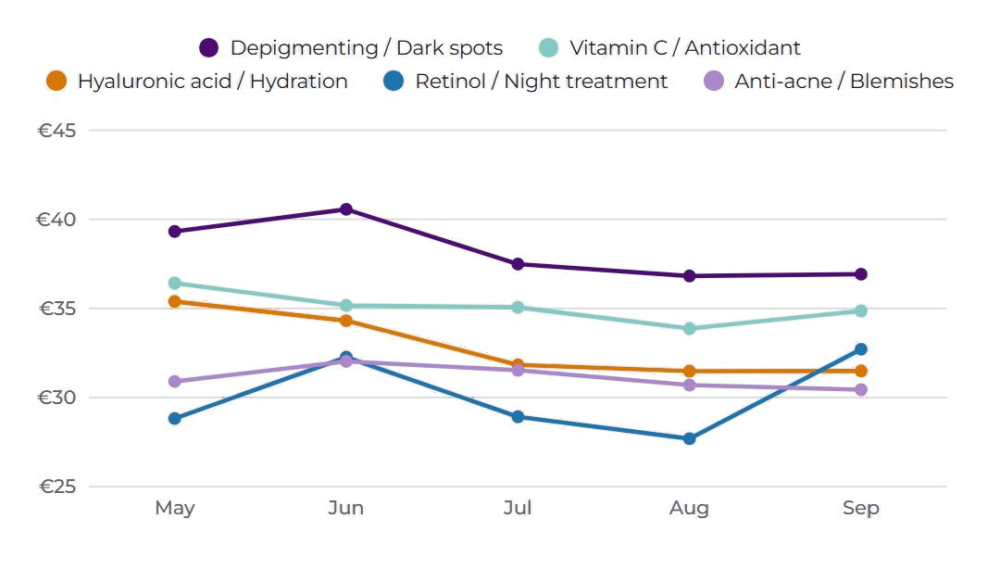
Assortment and stock: stock breaks down in Germany, where Shop Apotheke drops from 88.5% to 49.0% in one month
Spain is the country with the most serum products listed: 90 on average between May and September, peaking at 100 in August. It is followed by Portugal, with an average of 75 products, and Germany, with an average of 72.
At the other end are the US and Italy, with the smallest assortments. In the US, the number of products ranges between 26 and 31 depending on the month, and in Italy, between 14 and 24.
The most striking figure is Germany’s: its assortment plunges from 119 products in June to 53 in September, 55% fewer. France moves in the opposite direction, growing 48% from May to July, from 50 to 74 products.
La Roche-Posay, the brand with the most products listed; CeraVe, the one expanding its assortment the most
La Roche-Posay is the brand with the largest assortment in all five months (110 products on average), ahead of Vichy (78), Eucerin (68), CeraVe (48) and Bioderma (42). All of them peak in June, except CeraVe, which peaks in August (55 products).
CeraVe is the brand that expands its assortment the most over the period: from 40 products in May to 53 in September, 32.5% more, although with ups and downs, such as the drop to 45 in July.
The retailers with the widest shelves are Amazon Germany, with 53 products on average; Shop Apotheke, the German online pharmacy, with 49; and Amazon Spain, with 48.
Between May and September, Amazon Spain expands its assortment by 39% (from 38 to 53 products) and Amazon France by 78% (from 18 to 32). By contrast, Atida, the leading online pharmacy in Spain, closes September with the same 39 products it had in May.
At the other extreme is Farmacia Loreto, the online pharmacy analysed in Italy. It is the retailer with the fewest serums from these five brands, 4 on average: in June and July it listed 6 products and in August and September, only 2.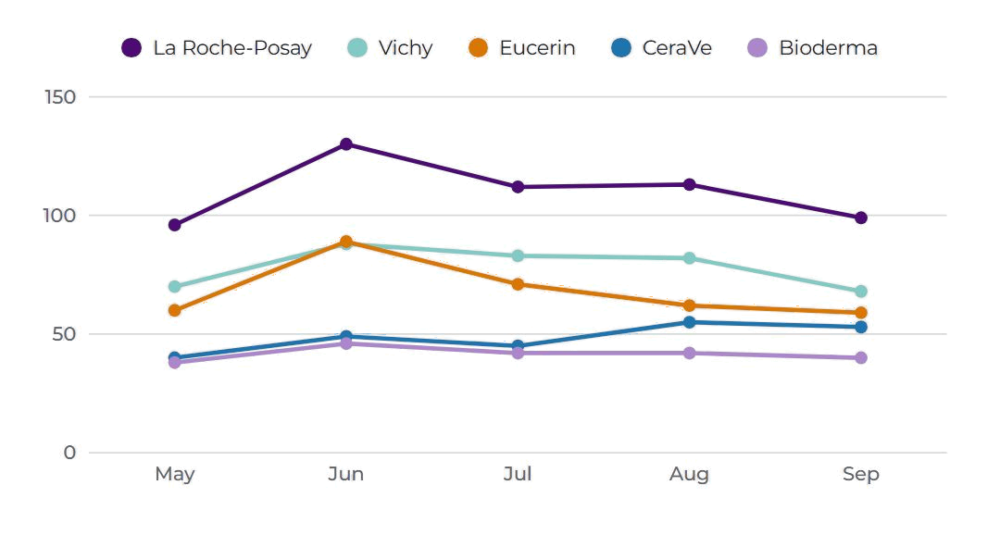
Germany, the exception in availability
Having a product listed does not guarantee being able to sell it. Portugal is the market with the highest and most stable availability, with a stock ratio of between 93.8% and 94.3% every month. It is followed by Spain, with a ratio of between 89.8% and 94.3%, and France, with one of between 89.4% and 92.5%.
Germany is once again the exception in the report: its stock ratio goes from 90.4% in May to 69.5% in July, with the drop concentrated between June and July, and only recovers to 77.1% in September. Two retailers explain this drop, although in very different ways. On the one hand, Shop Apotheke plunges suddenly: from 88.5% in June to 49.0% in July. On the other, Amazon Germany declines gradually throughout the period, from 92.5% in May to 79.0% in September.
Italy, for its part, closes September with the lowest stock ratio of the six countries (75.6%). Farmacia Loreto influences this figure: with only 2 products from these brands listed in September, its stock ratio was 61.1%, the lowest of the period, compared with 68.1% in June, its highest value.
For sales and key account teams, the takeaway is clear: a stock-out at a key retailer can wipe out the work on assortment and visibility within weeks. Monitoring availability retailer by retailer is as important as monitoring price.
Serum digital shelf: La Roche-Posay takes 53.5% of Top 10 visibility
The top positions of a search are the ones consumers see the most. That is why how often a brand appears in the Top 10 is a direct reflection of its weight on the serum digital shelf.
La Roche-Posay, the brand with the highest average price in the category, is also by far the most visible: between 20 and 27 appearances per month in the Top 10, 53.5% of the five brands’ total. CeraVe ranks second, with between 7 and 9. Eucerin is the brand that gains the most visibility over the period: from 2 appearances in May to 9 in August. Vichy and Bioderma close the ranking, tied in September with 4.
By country, visibility is highly concentrated. Germany accounts for 62.6% of the five brands’ Top 10 appearances over the period: between 17 appearances in May and 34 in August, its best month. The other countries reach a maximum of 7 appearances per month.
But being the most visible market does not guarantee that consumers can buy. Germany is where these brands appear most in searches and, at the same time, where their availability falls the most: the stock ratio drops from 90.4% in May to 69.5% in July.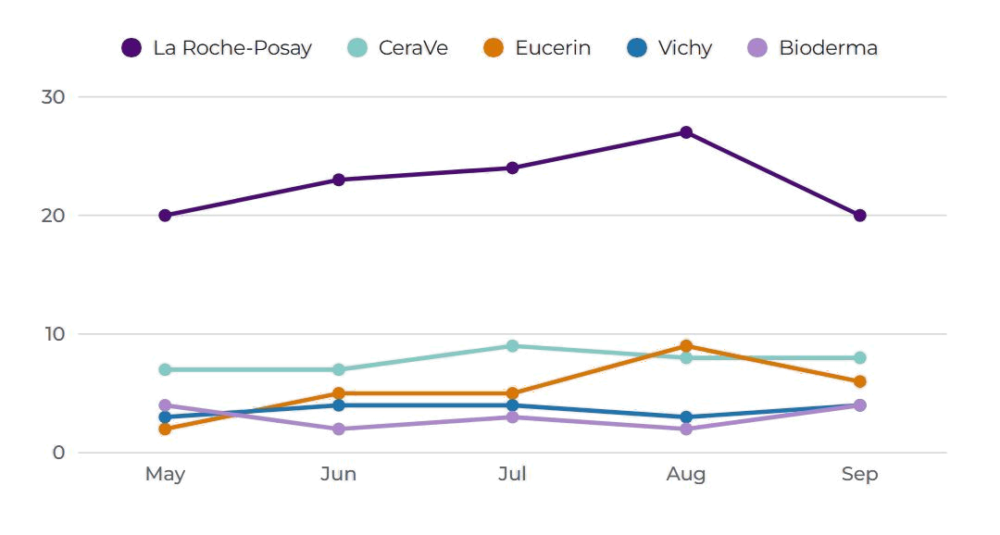
Vitamin C, the most contested search
Vitamin C is the search where these five brands have the strongest presence in the Top 3, the three most visible positions of each search. They hold an average of 32.4% of those positions between May and September: 35.0% in May, their highest value, 30.6% in June, the lowest, and 31.6% in September.
They are followed by anti-aging (19.8% on average) and hyaluronic acid (15.7%), with very stable values throughout the period. The generic term “serum” stands at 13.6% on average: it falls from 15.4% in May to 12.2% in July, rises to 13.4% in August and closes September at 13.1%.
The search for facial serum in German is the exception. These brands hold 25.7% of the Top 3 in May and 25.1% in June, fall to 10.9% in July and 10.5% in August, and recover to 26.2% in September.
By brand, La Roche-Posay holds the most Top 3 positions across all five search types, with its best result in vitamin C: 18.2% on average between May and September. Eucerin is the second brand in vitamin C (8.5%), anti-aging (5.4%) and the German search (6.4%). CeraVe ranks second in hyaluronic acid (3.9%) and Vichy achieves its best result in anti-aging (4.2%). Bioderma reaches a maximum of 1.3%, in the German search, with a still limited presence in the most visible positions.
Retail media: Vichy buys visibility while CeraVe and Bioderma earn it organically
Across the five brands, visibility is mostly organic (over 87%). But not all of them compete equally for sponsored positions.
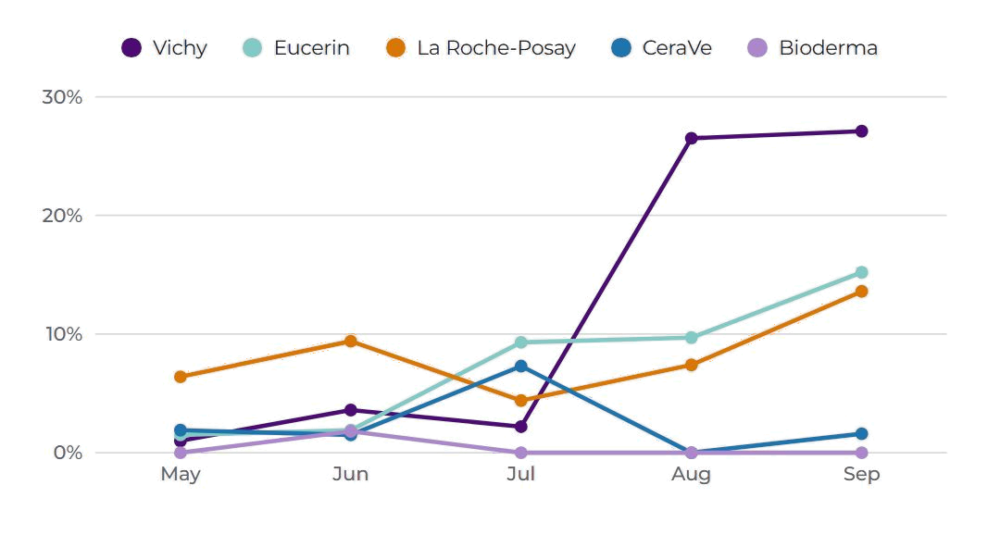
From May to September, Vichy is the brand that relies most on advertising (12.7% of its visibility), followed by La Roche-Posay (8.5%) and Eucerin (7.0%). CeraVe (2.3%) and Bioderma (0.5%) barely pay for their position: their visibility depends almost entirely on their organic ranking.
The most significant movement in the report takes place between July and September. Vichy’s paid share goes from 2.2% in July to 26.5% in August and 27.1% in September. Eucerin also grows steadily from July, up to 15.2%. La Roche-Posay, for its part, follows an irregular trend: it rises from 6.4% in May to 9.4% in June, falls to 4.4% in July, its lowest value, and from there rebounds to reach its peak for the period in September (13.6%), half of Vichy’s.
Overall, La Roche-Posay (40.1%) and Vichy (39.5%) account for most of the sponsored appearances, well ahead of Eucerin (15.6%). CeraVe (4.2%) and Bioderma (0.6%) are practically out of the bidding.
Amazon and the top banner concentrate the investment
Five of the six retailers with the highest sponsored share are Amazon, with Amazon US (24.6%) and Amazon Germany (18.9%) well above the rest. In third place is the online pharmacy Atida Spain (5.9%), ahead of Amazon Italy, Amazon Spain and Amazon France.
In terms of formats, the top banner accounts for 83.2% of advertising, compared with the sponsored listing ad (9.5%) and the sponsored module (7.3%). The battle for paid visibility is fought at the very top of the page, even before the consumer reaches the results.
Conclusion: La Roche-Posay leads the serum digital shelf, but each market plays its own game
Of all the brands analysed, La Roche-Posay takes up the most space on the serum digital shelf. It has the highest average price of the five brands (€36.07 on average across the six markets analysed), the widest assortment (110 products on average) and more than half of the appearances in the Top 10. Its case shows that positioning in the higher average price range is not at odds with leading visibility, as long as it is backed by assortment and a good organic ranking.
Even so, the serum digital shelf is far from static. CeraVe keeps the lowest average price in all six countries and is the brand that expands its assortment the most over the period, from 40 products in May to 53 in September. Vichy multiplies its paid share by 12 in just two months. And Germany, the market that concentrates visibility, is also the one with the biggest drop in stock.
In such a fragmented category, knowing the average price, availability and position of each brand at each retailer in real time is what makes it possible to react in time: adjust prices, prioritise markets and decide where to invest in retail media and where organic visibility is enough.
—————————————————————————————————