
Spain Leads Discount Growth in Europe: What is Happening and Why it Matters
TL;DR
Spain leads the discount channel growth in Europe with an 8.4% increase in sales, driven by a pragmatic consumer and a private label share that already reaches 59%. This trend consolidates the Spanish market as a benchmark for efficiency and savings in Europe.
Spain has placed itself at the centre of the European FMCG discount map. The growth of the channel in 2025 confirms a clear trend: Spanish consumers are increasingly buying in formats that combine competitive prices, a streamlined assortment, and a strong private label presence. This progress, moreover, occurs in a context where the European market is evolving at more moderate rates and with very different dynamics between countries.
A Change that Goes Beyond the Data
Spain’s leadership in the discount channel
The latest industry data places Spain as the fastest-growing market for discount in Europe, with an 8.4% increase in value sales during 2025 and a 7.5% advance in retail space. This evolution reinforces the position of this format within Spanish grocery retail and shows that its growth responds to a sustained trend, rather than a temporary peak.
The interest in the data lies not only in the growth figure but in what it represents for the sector. Discount is gaining ground in a highly competitive market, where consumers increasingly value the balance between price, convenience, and trust in their purchase.
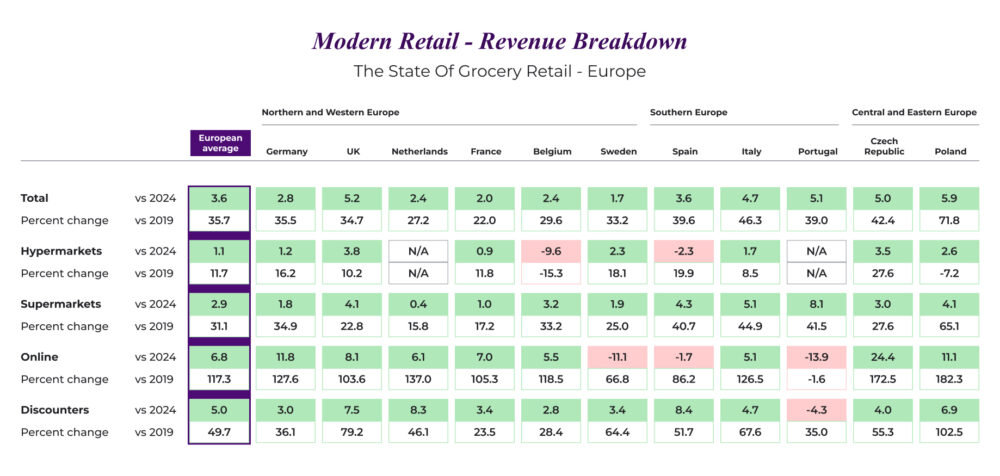
Source: The State of Grocery Retail Europe 2026 – McKinsey & Company – April 2026
Why is this growth attracting attention?
Spain’s relevance in this phenomenon is better understood when compared with Europe as a whole. According to the report The State of Grocery Retail Europe 2026 by McKinsey and EuroCommerce, FMCG behaviour in Europe remains marked by pressure on margins, the search for efficiency, and the transformation of the business model. In this context, Spain stands out for the speed with which discount and private labels are consolidating.
Furthermore, other sector coverage confirms that the advance of the discounter channel in Spain is not isolated, but part of a broader evolution of the FMCG market. Journalistic analysis agrees that Spanish consumers are favouring formats more oriented towards savings and functional shopping.
Key Market Data
Sales, space, and the weight of private labels
One of the great drivers of this change is private label. In Spain, private label sales reach 59%, according to recent data published by Circana. This figure is significantly higher than the European average and helps explain why discount finds particularly favourable ground here.
The combination of own-brand, concentrated assortment, and a tight pricing policy allows these banners to gain share in an inflationary environment or one of cautious consumption. Added to this is the physical expansion of the channel, which continues to open up space in the market and reinforce its presence in urban and peripheral areas.
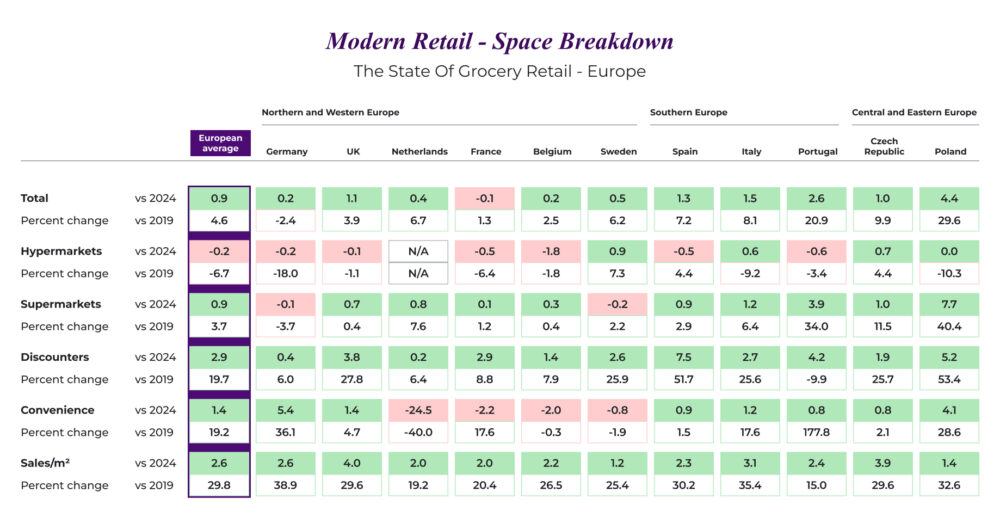
Source: The State of Grocery Retail Europe 2026 – McKinsey & Company – April 2026
Comparison with the European average
Compared to Spain, the European average shows more contained growth and a commercial structure less inclined towards discount. In many markets on the continent, promotions still carry greater weight and private label penetration does not reach such high levels as in Spain.
This difference helps explain why the country has become a benchmark for analysing the evolution of the channel. Spain meets several favourable conditions: greater acceptance of own-brands, price sensitivity, and a rapid adaptation of operators to more efficient shopping models.
What Explains the Rise of Discount?
Price, savings, and private label
The most evident factor is price. In an environment of monitored household spending, consumers look for ways to maintain control over their shopping bills without giving up an adequate basket. Discount responds precisely to this need through low prices, more contained promotions, and a simpler offering.
Private labels also play a decisive role. Spanish consumers have lost part of the historical prejudice towards own-brands and increasingly perceive them as a reliable, practical option with good value for money. This change in perception has boosted both discount and the FMCG sector as a whole regarding private label.
A more pragmatic consumer
The shopping profile has also changed. Today, the logic of smart saving carries more weight than the search for excessive variety. Consumers compare, prioritise, and select with greater attention, and this favours formats that simplify the decision-making process.
This behaviour fits with a more rational basket and a growing interest in completing the shop quickly and efficiently. In this scenario, discount offers a proposal very much aligned with what a significant part of the Spanish market is looking for today.
Impact on the Sector
For manufacturers and retailers, this evolution has several implications. The first is pressure on margins, as competing in a channel with tight prices forces a refinement of costs, assortment, and logistics. As Daniel Läubli, global head of Grocery Retail at McKinsey, summarises:
The second is the need to differentiate clearly, whether through brand, innovation, service, or operational efficiency.
Also, commercial strategy is changing. The growth of discount forces a review of the relationship between manufacturer brands and private labels, as well as the role of promotions in customer acquisition and loyalty. In parallel, the sector must read this trend as a long-term signal: discount does not only compete on price, but also on format, convenience, and trust.
Spain as a Benchmark for the New European FMCG Market
Spain is establishing itself as one of the most interesting markets in Europe for understanding where FMCG is heading. The leadership of discount and the progress of private labels show that Spanish consumers are adopting shopping patterns that are very demanding on price and very open to efficient models.
This position makes the country a benchmark for the European food sector. What happens here in the coming months will be key to interpreting the evolution of the discount channel, private labels, and the response of manufacturers and retailers to an increasingly pragmatic consumer.
In short, discount growth in Spain reflects a profound market transformation. The data serves as a starting point, but the real story lies in the change in shopping habits, the consolidation of private labels, and the new competitive logic of European FMCG.