
Inconsistent Product Content: The Hidden Cost of Failing to Standardise Listings Across Retailers
TL;DR
Data inconsistency in product listings across different retailers reduces conversion rates and causes returns to skyrocket. Standardising information through a single source of truth and Digital Shelf Intelligence tools like flipflow is essential for protecting profitability and brand consistency.
Introduction: When Every Retailer Tells a Different Version of your Product
In today’s e-commerce ecosystem, a brand’s presence is fragmented across dozens of platforms. The same product might be on sale on the brand’s official website, on Amazon, on digital department store sites like El Corte Inglés, or on specialised marketplaces. This ubiquity is a sales opportunity, but it also represents a logistical and communicative challenge of great proportions.
Imagine a consumer looking for a specific coffee machine. First, they check the price on a comparison site, then they visit the product listing on a major retailer’s site and, finally, they go to the manufacturer’s official website to confirm the exact measurements because they have limited space in their kitchen. If they read on the retailer’s site that the coffee machine is 30 cm high, but the official website states it is 35 cm, immediate doubt is created.
Doubt is the primary enemy of conversion in the digital environment. Faced with uncertainty, users often choose not to buy or to look for another brand that offers them consistent information. The problem lies in the fact that brands often send different data files to each seller, or the retailers themselves edit the information to fit their internal templates, losing the original accuracy along the way.
Inconsistent product content has measurable consequences. It affects conversion, organic positioning, return rates, and team efficiency. However, few organisations treat it as what it truly is: a structural problem that requires a proactive solution.

What Do we Mean by Inconsistent Product Content?
Product content is all the information that accompanies an item in its digital presentation: title, short and long descriptions, images, videos, technical specifications, categories, keywords, barcodes (EAN/GTIN), weight, dimensions, instructions for use, legal warnings, and any other attribute that the retailer or platform requires to list the product.
Inconsistent product content occurs when the attributes of the same item vary across different digital points of sale. This is not simply a typo in a description, but a structural discrepancy in the information that defines the product.
According to the standards of Google Merchant Center and the guides from Amazon Product Listings, high-quality content must be accurate, complete, and uniform. Inconsistency manifests in several ways:
- Contradictory technical attributes: Differences in dimensions, weight, manufacturing materials, or technical compatibilities.
- Disparate visual content: Using old photographs on some channels and modern renders on others. The absence of videos or 360º images on certain retailers while others have them also creates a sense of neglect.
- Misaligned titles and keywords: A product called “A1 Running Shoes” on one site and “Professional A1 Sports Footwear” on another makes rapid identification difficult for the user.
- Outdated stock and price information: Although pricing is often dynamic, a listing showing features that no longer exist in the current model generates false expectations.
In essence, inconsistency is the result of not having a “Single Source of Truth” for product data.
Why does this Problem Usually Go Unnoticed?
Many companies operate under a siloed structure. The marketing department creates the content, the sales team distributes it to retailers, and the IT department manages the databases. In this chain of command, the supervision of how the final product appears on each Digital Shelf often falls into a no-man’s-land.
There is also a scale factor. Manually reviewing 20 products across 3 retailers might seem manageable. Controlling 2,000 references across 15 channels, with variants, promotions, packaging changes, and frequent updates, is far more complex. The problem goes unnoticed because it requires constant monitoring that few teams can afford. Without Digital Shelf Intelligence tools, a brand would have to individually check every SKU on every retailer’s site to verify if the information is correct.
Furthermore, there is a false belief that, once the data feed has been sent to the retailer, the job is done. The reality is that marketplace algorithms and the internal processes of distributors can alter the display of data, truncate descriptions, or prioritise obsolete information that already resided in their previous databases.
Finally, content errors do not always trigger an immediate alert. An incomplete listing can remain active. One outdated image can stay published for months. And any incorrect attribute can reduce conversion without anyone directly linking it to the data problem.
This is why the cost accumulates bit by bit. There is a problem that exists and generates losses, but no one has a complete view of its magnitude.
The Hidden Cost of Not Standardising Product Listings Across Retailers
The lack of standardisation in product listings has commercial, operational, and reputational consequences. Some are visible in the short term; others affect brand performance progressively.
1. Lower conversion on the product page
The product listing is the moment of truth in e-commerce. It is where the buyer decides whether to add to the basket or leave the page. When a customer finds a listing with confusing descriptions, low-quality images, or information that does not allow them to understand if the product is right for them, they lose trust in the brand and abandon the purchase.
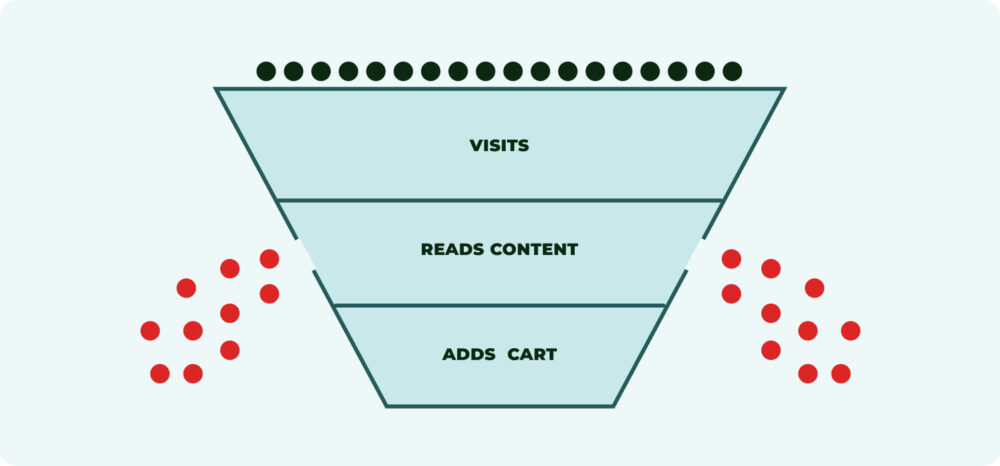
A technical specification sheet must be specific and contain relevant keywords, explain what the product is and what it is for without salesy phrases or exaggerations, and detail measurements, materials, and other concrete features.
An optimised and consistent product listing acts as a silent salesperson 24/7. If the information provided is fragmented, the salesperson is “mute” or, worse still, giving erroneous information. The loss of sales due to a lack of trust is the most direct and hardest cost to recover.
2. Poorer positioning in search engines and within the retailer
SEO is not limited to Google. Within Amazon or any marketplace, the algorithm rewards listings that are complete and follow their data standards. If a brand sends non-standardised data, it is likely that its products will not appear in search filters (for example, filters for colour, material, or size).

Google Merchant Center is very strict with data specifications. If listings are inconsistent or do not meet technical requirements, products can be rejected for Google Shopping campaigns, drastically reducing the brand’s visibility at the moment of highest purchase intent.
Something similar happens within marketplaces. Amazon, for example, uses listing information to understand product relevance. A poor title, uninformative bullet points, or incomplete attributes limit the algorithm’s ability to connect the product with relevant searches.
The consequence is clear: if content is not well normalised and optimised, the product can lose organic traffic both inside and outside the retailer.
3. Loss of brand consistency
Every touchpoint with the buyer is an opportunity to reinforce, or erode, brand perception. When a product is presented differently across each retailer, the brand message loses coherence. A buyer who has seen the product on one channel with a clear value proposition and arrives at another channel where the presentation is generic experiences dissonance, which affects trust and brand recognition.

Brands working on premium positioning are especially vulnerable: inconsistency in content communicates a lack of care, regardless of the actual quality of the product.
Standardisation helps protect the brand narrative. It allows you to define which information must remain stable across all channels and which elements can be adapted to the context of each retailer.
4. More returns, complaints, and customer frustration
A deficient product listing does not only affect conversion: it also drives up after-sales costs. When customers buy based on incorrect, incomplete, or unclear information, returns and complaints become inevitable. A description indicating a material different from the actual one, incorrect dimensions, a lack of assembly information, or images that do not faithfully reflect the colour of the product generate wrong expectations that end in frustration.
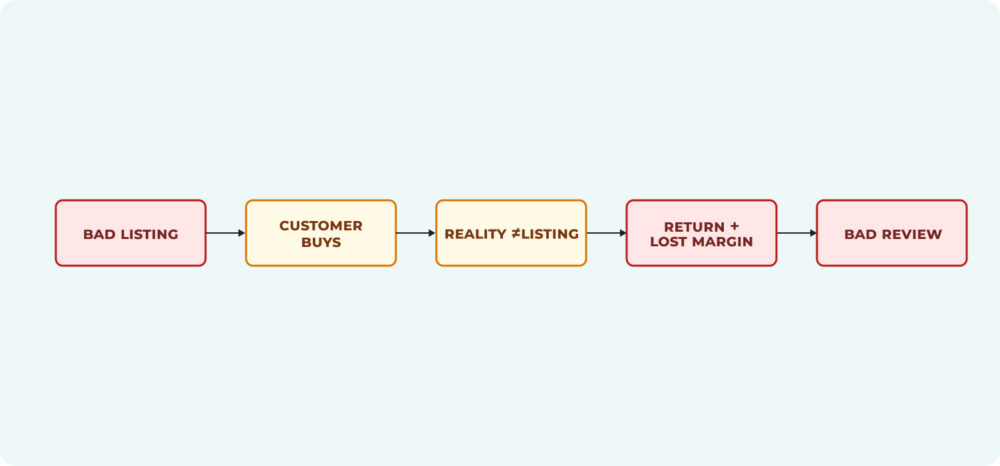
The economic impact is direct. Reverse logistics involves the cost of return transport, reconditioning the item and, in many cases, the loss of the profit margin. Furthermore, both retailers and brands must dedicate more time and resources to managing incidents and correcting errors manually. Added to this is a less immediate but equally relevant damage: negative reviews and low ratings, which affect product positioning and deteriorate consumer trust for months.
5. Operational inefficiency and increased burden on teams
Keeping content updated across multiple retailers without a centralised system is a task that consumes resources disproportionately. Every product update involves working retailer by retailer, format by format, often manually.

When information is incomplete or distributed across different systems, the result is always the same: slower processes and a higher operational burden. E-commerce or trade marketing teams end up spending hours on repetitive data maintenance tasks that could be invested in growth strategies and higher-value activities.
Product data standardisation allows for the reduction of this double work. It also facilitates the incorporation of new references, expansion into other marketplaces, and the management of bulk changes.
6. Regulatory or reputational risk in sensitive categories
In certain product categories—food, cosmetics, health, children’s products, electronics with specific technical requirements—listing information has legal implications. An outdated ingredient list, the absence of safety warnings, or failure to meet labelling requirements on a specific channel can lead to serious regulatory issues.

Google Merchant Center product data specifications state that published content must comply with Shopping Ads policies, landing page requirements, and currency and language requirements, among others. Each retailer adds its own demands. Without systematic control of published content, it is very difficult to guarantee compliance across all points of sale.
Standardisation ensures that critical and mandatory information is present on all channels, protecting the company from potential legal sanctions and reputational crises.
Standardising Does Not Mean Publishing Exactly the Same on All Retailers
One of the most common misunderstandings when talking about standardising product listings is thinking that it implies publishing identical content on all channels. In reality, standardising means something else: having a single, verified, and updated data source from which to adapt content to the specific requirements of each retailer.
Each platform has its own language and its own audience. For example:
- Amazon requires long titles loaded with keywords for its A9 algorithm.
- Instagram Shopping prioritises visual impact and short texts.
- Google Shopping needs very specific technical attributes in its feed (GTIN, brand, product category).
- Other retailers may require specific nomenclatures for sizes, colours, formats, or units of measurement.
Standardisation provides the foundation: correct, updated, and consistent data. The key lies in combining consistency and adaptation. Consistency to protect essential data and the brand. Adaptation to maximise visibility and conversion on each channel. Both are necessary and are not mutually exclusive.
Digital Shelf Intelligence as a Protective Shield
To combat inconsistency at scale, technology is the only viable solution. Knowing what content is actually being published on each retailer’s site is the first step to correcting any problem. And this is where Digital Shelf Intelligence platforms play a fundamental role.
These solutions allow for continuous monitoring of how products appear across different digital sales channels: what title the listing has, which images are being shown, if key attributes are present, if the content meets brand standards, or if it has undergone any unauthorised modification.
This real-time auditing capability transforms product content management from a reactive process—correcting when a problem arises via a complaint or a drop in sales—into a proactive one: detecting the deviation before it has a commercial impact.
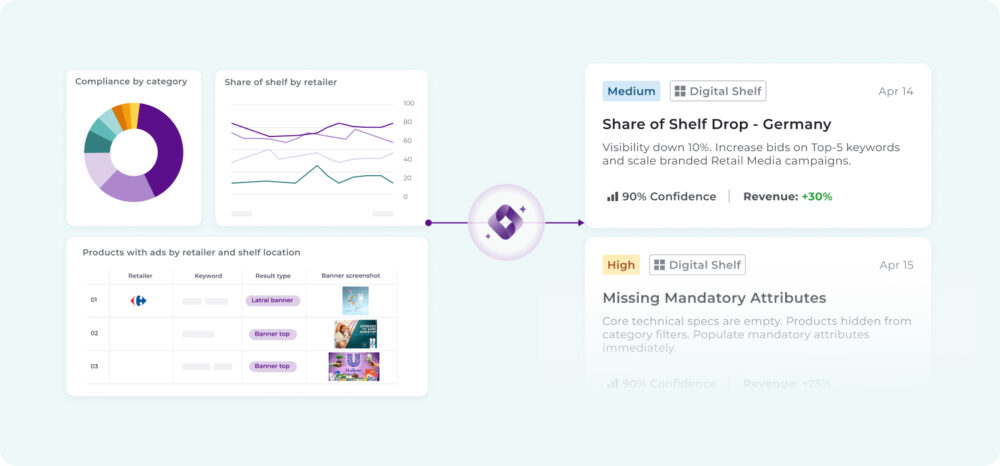
Platforms like flipflow, specialised in Digital Shelf Intelligence, allow brands and manufacturers to have visibility over the actual state of their listings across multiple retailers simultaneously, identify where there are content gaps, and prioritise corrections based on potential impact on sales or brand compliance. Furthermore, these tools facilitate collaboration between e-commerce, trade marketing, sales, content, and customer service. Everyone works with a shared vision of the product’s actual status on the digital shelf.
The combination of a single source of data for well-managed products with a layer of continuous Digital Shelf monitoring closes the loop: you control both what is sent and what is actually published and how it evolves over time.
Conclusion: How to Start Correcting the Problem
Inconsistent product content across retailers rarely appears in any profit and loss report, but its economic impact is real and cumulative. It manifests in conversions that don’t happen, in positioning that degrades, in returns that increase, and in teams spending time on maintenance tasks instead of value creation.
Correcting it requires addressing the problem on two fronts. The first is internal: establishing a single source of truth for product data, with clear processes for updating and multi-channel distribution. The second is external: implementing verification mechanisms that allow you to know, at all times, what content is actually published at each digital point of sale.
For brands that want to start, the first practical steps are relatively concrete: audit the current state of content across the main retailers, identify the products with the highest turnover or margin where inconsistencies have the most impact, and define the minimum attributes that must be present and correct across all channels.
Because in e-commerce, every product listing is a direct touchpoint with the consumer. And when a brand loses control over how its catalogue is presented, it doesn’t just lose consistency: it loses sales, trust, and the ability to compete. In the end, the problem is often not with the product itself, but with everything that happens before the customer can correctly evaluate it.