
Price, Packaging, Reviews, and Logistics: The Attributes that Will Most Impact Conversion Rates in 2026
TL;DR
E-commerce conversion is penalised by minor frictions in key attributes such as price, logistics, packaging, and reviews. To prevent basket abandonment, brands need to analyse customer feedback in a granular way using Customer Sentiment Intelligence tools, such as flipflow.
In 2026, e-commerce conversion depends on a combination of signals that consumers interpret in seconds. Price still carries significant weight, but logistics, packaging, reviews, availability, and post-sale experience also play a role. Flipflow is based on a very useful idea for this context: consumer opinion is a commercial data point that impacts conversion, ranking, and revenue, and it must be analysed by attributes, not just by overall sentiment.
This approach fits a very clear reality: most conversion drops do not stem from a single failure, but from small, accumulated hurdles. Baymard Institute calculates that the average shopping basket abandonment rate is around 70%. Of this percentage, the most common avoidable reasons are unexpected extra costs (39%), insufficient delivery speed (21%), and unsatisfactory return policies (15%). The practical takeaway is simple: every attribute that generates friction can push the user out of the buying process.
For brands and retailers, the challenge lies in identifying which attributes are hindering conversion for every product, category, channel, and competitor. This is where customer sentiment analysis becomes invaluable. Solutions like Customer Sentiment Intelligence from flipflow help transform reviews, ratings, and customer feedback into actionable insights to understand which attributes build trust and which are penalising the purchase decision.
This article analyses which attributes will penalise conversion most this year, why they do so, and how to detect them before the damage becomes irreversible.

What does it mean for an attribute to penalise conversion?
An attribute penalises conversion when it introduces enough friction for the buyer to abandon or discard the product. This friction can be objective — for example, a high price — or perceptive, such as packaging that conveys low quality even if the product meets requirements.
This distinction is key: a brand may be correctly positioned on price and yet still lose sales if it projects low reliability, if recent reviews raise doubts, or if the return policy is not visible. In these cases, the problem is not with the product itself, but with the perception the user builds from multiple signals.
The impact of these attributes is spread across the funnel. Before the purchase, when the user compares options and decides whether to move forward; during and after, when factors like delivery, the unboxing experience, or returns come into play. Consequently, beyond the product’s appeal, a critical indicator is the volume of objections it triggers at each stage.
Analysing only aggregated metrics can hide these dynamics. Two products with the same conversion rate may be losing sales for very different reasons: price, distrust in reviews, or logistical frictions, among others.
In fact, according to VWO, only 22% of companies say they are satisfied with their conversion rates. Even so, most optimisation still focuses on technical aspects, such as loading speed or checkout design, sidelining the attributes that consumers evaluate even before adding to the basket.
Identifying which attribute is penalising conversion for a specific product or category is the first step toward correcting it. And for that, as we will see later, quantitative data is not enough.
The attributes that will penalise conversion most in 2026

1. Price and perceived value
Price is usually the first filter in the purchase decision, but its impact depends less on the figure itself and more on how value is perceived. A high price does not automatically penalise conversion; it does so when the consumer feels that what they receive does not justify what they pay. This perception deteriorates when the product does not explain its benefits well, the brand does not convey trust, or the proposal feels poorly differentiated.
In this context, the growth of private labels (3.6% globally and double digits in Western Europe) is precisely a response to a better perception of value for money. When a brand does not clearly communicate why it is worth its price, it leaves room for cheaper alternatives or even the retailer’s own offering.
Reviews act as a direct thermometer of this friction. Expressions such as “too expensive”, “not worth it”, or “for this price I expected more” show a mismatch between price and perceived value.
Furthermore, price is not evaluated in isolation, but in constant comparison. A product may seem competitive in absolute terms but lose conversion if others offer a more complete proposal: better price, faster delivery, higher ratings, or a higher volume of positive reviews.
2. Logistics: availability, delivery speed, and hidden costs
Logistics has gone from being a competitive advantage to a baseline expectation. The 2026 buyer assumes the product will arrive quickly, in good condition, and with no surprises in shipping costs. When any of these assumptions fail, the penalty on conversion is immediate.
Baymard notes that 21% of buyers who abandon their basket do so because delivery is too slow. And 39% abandon when extra costs, mainly shipping, are higher than expected. These two reasons combined represent more than half of avoidable abandonments.
Delivery speed has created a self-reinforcing standard: the more accustomed consumers become to receiving items within 24-48 hours, the more intolerable they find a five-day wait. Fast-moving categories (food, household goods, or consumer electronics) are particularly sensitive to this attribute.
Logistical transparency also penalises conversion. Failing to show the estimated delivery date on the product page, or only doing so at the checkout, generates uncertainty that acts as a hurdle. A buyer who does not know when their order will arrive has one more reason not to buy.
3. Packaging: protection, sustainability, and the unboxing experience
Packaging is one of the most undervalued attributes in conversion analysis, and one that appears most often in negative reviews. Its influence operates at two distinct moments: before the purchase, as a signal of quality and brand values; and after, as part of the unboxing experience that builds or destroys repeat purchases.
In the online environment, packaging is the first physical contact the customer has with the product. A damaged box, excessive packaging, or materials perceived as unnecessarily polluting generate a negative experience that buyers voice in reviews. And those reviews directly impact the conversion of future buyers.
Sustainability is also gaining weight. Although consumers do not always pay more for sustainable options, they do penalise experiences they perceive as inconsistent or excessive. Oversized, poorly recyclable, or unnecessary packaging can generate negative comments, especially in categories where the brand communicates environmental values.
Packaging is particularly important in beauty, premium products, fragile items, gifts, or electronics. In these categories, the first physical contact with the product can strengthen or weaken trust in the brand. If packaging raises doubts about protection, sustainability, or practicality, it can end up affecting conversion and repeat purchases.
4. Reviews and ratings
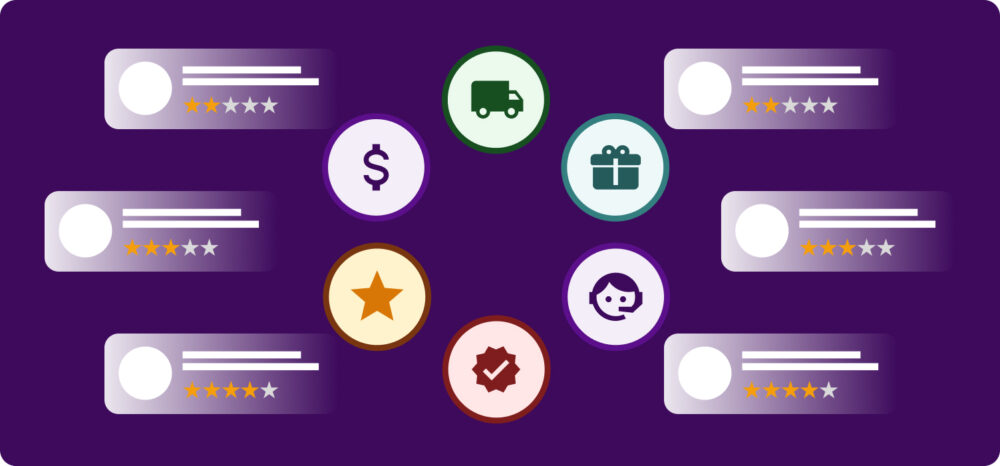
Reviews and ratings are one of the most visible attributes in e-commerce. They act as social proof and reduce uncertainty before buying. A low rating, few reviews, or recent negative comments can stall conversion even when the price is competitive.
Users do not just look at the average score. They also read comments, look for patterns, check photos from other buyers, and assess how recent the opinions are. A 4-star average may be insufficient if recent reviews mention serious issues. Similarly, a product with an acceptable rating can convert well if positive comments address the buyer’s main doubts.
Reviews make it possible to understand the real cause of friction. A low rating may be due to quality, size, compatibility, taste, delivery, packaging, durability, or unclear instructions. Each reason requires a different action.
Here, manual analysis falls short when a brand manages hundreds or thousands of references. The use of sentiment intelligence allows reviews to be classified by topic, detecting recurring attributes and prioritising improvements according to the severity and frequency of the problem.
5. Availability and stockouts
Lack of availability is one of the most direct frictions to conversion: if there is no stock, there is no sale. But the impact doesn’t end there. Faced with an out-of-stock product, the buyer turns to alternatives — often from the competition — and if the experience is positive, they are unlikely to return.
Furthermore, stockouts affect visibility on marketplaces. Algorithms tend to penalise products with recurring periods of unavailability, generating a vicious cycle: lower exposure, fewer sales, and an increasingly weak positioning.
In 2026, managing stock without real-time data is equivalent to managing it poorly. Models based solely on historical data, without continuous updates, often fail in contexts with seasonality or demand peaks that are difficult to anticipate.
This problem is especially critical in fast-moving categories, where consumers expect consistency. It also has implications for SEO and the Digital Shelf: attracting traffic to products without availability not only wastes opportunities but also deteriorates the experience. In terms of perception, stockouts convey a lack of foresight and weaken trust in the brand.
6. Returns, warranties, and post-sale service
The return policy influences the purchase decision before the buyer has even received the product. It is an element of perceived security: if I can return it easily, the risk of buying is lower. When that policy is restrictive, unclear, or hard to find, it acts as a hurdle.
DHL presents a particularly relevant data point: 79% of buyers abandon their basket if the return policy does not meet their expectations. This proves that post-sale service no only acts after the purchase; it intervenes before, as a lever of trust. Clear warranties, accessible support, and simple returns can make the difference between closing or losing a sale.
Not all attributes carry the same weight in all categories
The attributes that penalise conversion change according to the category, average ticket price, purchase frequency, urgency, and perceived risk level. Therefore, applying the same analysis to all products can lead to unhelpful conclusions.
- Fashion and footwear: reviews, returns, and the unboxing experience usually carry a lot of weight.
- Electronics: reviews regarding durability and the warranty weigh more than packaging.
- Online groceries: availability and freshness are decisive.
- Personal care: composition and reviews regarding results are the main filters.
Decision timing also changes. In impulsive purchases, hurdles are usually found in the checkout and cost transparency. In high-involvement purchases, the consumer compares more and looks for additional signals, such as ratings, guarantees, or proof of value.
Treating conversion as if all attributes had the same weight for any product is a frequent mistake. To optimise effectively, it is key to identify which factor is generating the most friction in each category and for each SKU at any given time. This requires analysing performance with greater granularity rather than relying solely on global averages.
The solution: Detect which attributes are penalising conversion with Customer Sentiment Intelligence
The most effective way to solve this problem is to stop looking only at aggregated metrics and start reading the voice of the customer through actionable dimensions. Sales data and conversion metrics tell you how much is being sold, but not why more is not being bought. To answer that second question, it is necessary to analyse what buyers say about products, systematically and at scale.
This is where flipflow’s Customer Sentiment Intelligence module comes in. The solution collects reviews from marketplaces and retailers, organises them by product, channel, and market, and links them to performance on the digital shelf. The result is not just a general rating, but a clear understanding of the factors driving or hindering conversion.
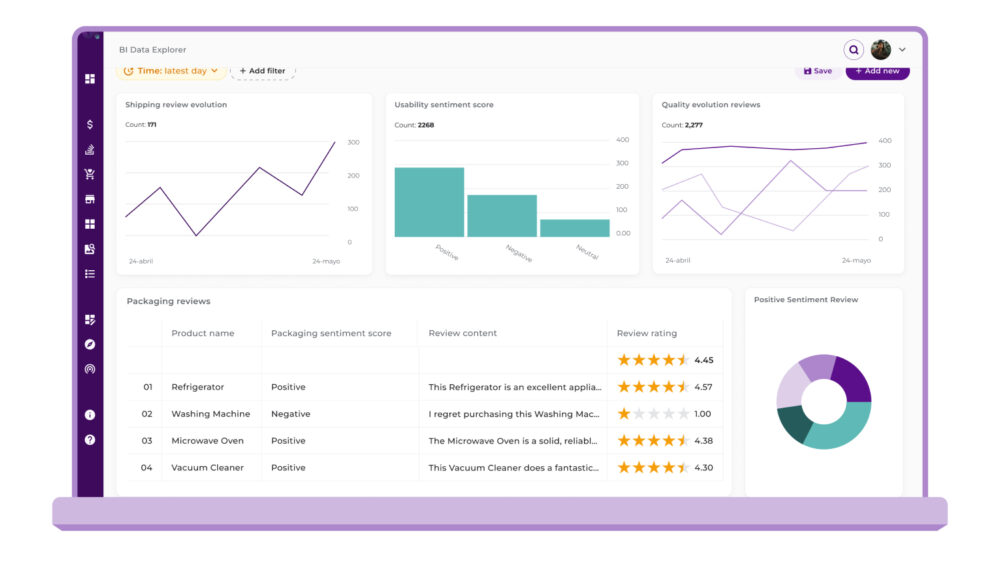
Flipflow classifies each review by attributes such as quality, perceived price, packaging, shipping, or usability, and detects actionable patterns. This makes it possible to identify specific frictions that are not always evident in traditional indicators. For example, a product may have a good average rating and yet accumulate recurring criticism about delivery or packaging, affecting repeat purchases and future perception.
Furthermore, attribute-based insights allow different teams to work from the same single source of truth, without divergent interpretations or information silos. Each area receives data relevant to its decision-making scope, aligned with real business performance. Finally, our solution also connects sentiment with Share of Search, organic ranking, prices, and availability, which helps interpret how perception affects commercial performance. In an environment where many conversion problems are hidden within unstructured feedback, this connection is especially valuable.
Identify friction before it costs sales
The conversion rate is not just a UX or price issue. It is the cumulative result of how the buyer perceives each of the relevant attributes for their decision: whether the price seems fair, whether they trust that the order will arrive on time, whether the packaging conveys care, and whether recent reviews reinforce or contradict what the product page promises.
In 2026, with a more cautious, more informed consumer with less tolerance for risk, any attribute that generates doubt can be enough to lose the conversion. The challenge for brands is to know precisely what that attribute is, for which product and at what moment, to be able to act before the damage accumulates.
Detecting these problems based on what buyers themselves say, in a continuous and structured way, is a competitive advantage today. Tomorrow, it will simply be a necessity.