
Shelf Leaders: Analysis of Share of Shelf and Formats in Soya, Protein, and Kefir Yogurts in Spain
TL;DR
Private label leads the protein segment, while kefir establishes itself as a haven for premium and artisanal brands. Current innovation focuses on on-the-go formats and sophisticated flavours that manage to balance health benefits with an indulgent experience.
The yogurt aisle in Spain has become strategic territory for dairy manufacturers: per capita consumption is around 9 kg per year and yogurt accounts for around 13.5% of household spending on dairy, making it one of the key categories within the chilled shopping basket.
In parallel, the total yogurt market maintains value growth supported by higher value-added segments (such as protein, kefir, and plant-based), the extension of flavour ranges, and formats designed for convenience, especially drinkable and single-serve options. Furthermore, plant-based yogurts are undergoing a phase of recovery and acceleration, with a 16.7% increase in volume between 2023 and 2024 and a value close to 93 million euros, driven by consumers seeking healthy and plant-based options.
In this context of maturity, concentration, and the search for differentiation, Share of Shelf and innovation in formats become decisive levers for competing in the soya, protein, and kefir types.
The Shelf Split: Who Dominates Visibility?
Presence on the shelf is the most direct indicator of a retailer’s commitment to a brand or category. In the Spanish market, the balance between manufacturer brands and private labels (MDD) varies drastically depending on the type of yogurt.
Kefir: The Haven for Premium Brands
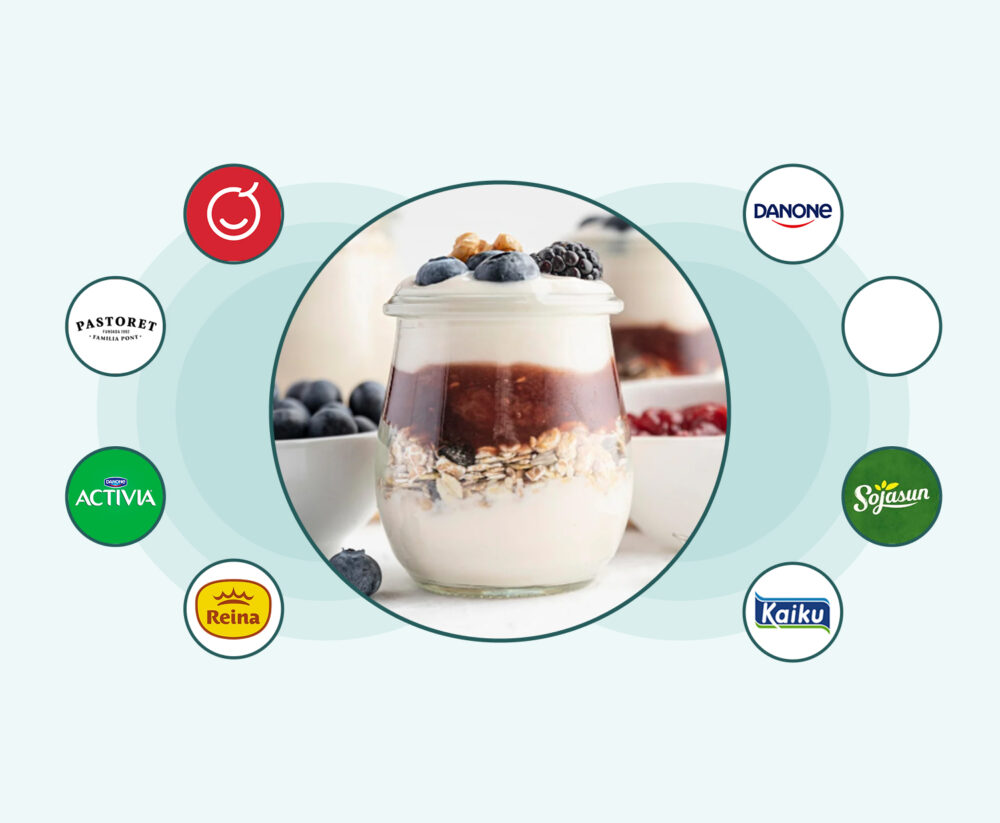
The kefir segment stands out for a structure where leadership is set by manufacturers with an artisanal or premium profile. Pastoret and Kaiku concentrate the bulk of the range, defining the category’s quality standard. Pastoret leads with a 15.8% share of presence, followed very closely by Kaiku with 14%.
In this category, private labels play a less dominant role compared to other segments. Carrefour is the chain offering the deepest own-brand range (14%), competing directly in number of references with the leaders. Conversely, other chains like Mercadona (Hacendado) maintain a kefir offering more oriented towards the basics, with fewer variants and a clear focus on price. A relevant data point is that the kefir shelf still leaves room for organic and artisanal proposals, indicating that the consumer of this product values origin and production processes over savings.
Protein Yogurts: Private Label Territory
If kefir is the haven for premium brands, protein yogurts are the true battlefield for private labels. In this segment, the store brand captures 50% of the total shelf space. This figure represents a record level of concentration that puts traditional manufacturers under significant pressure.
Hacendado leads visibility with 16.7% of the shelf, followed by the Danone Group brand YoPRO with 14.8%. This direct competition between the retail leader and the manufacturer leader has generated what we can call a “visibility war”. Behind them, Carrefour and Dia also maintain a very strong presence with their own protein lines. In this scenario, it is extremely difficult for a new manufacturer to gain space without disruptive innovation or massive advertising investment.
Soya: A Specialists’ Market
The shelf for soya plant-based alternatives shows the highest concentration in the study. Two brands, Alpro and Sojasun, together exceed 53% of total visibility. Alpro is the absolute dominator with a 28.6% share, while Sojasun follows with 24.5%.
This structure indicates that the soya consumer is very loyal to specialist brands that have mastered flavour and texture. Private labels play a secondary but relevant role here as a follower; Hacendado and Carrefour act by covering basic price needs, but they do not lead in innovation or the volume of references.
Innovation in Formats: Convenience as a Purchase Driver
Packaging design and product quantity are factors that determine the moment of consumption. The analysed data shows that each category has found a “hero format” that responds to customer needs.
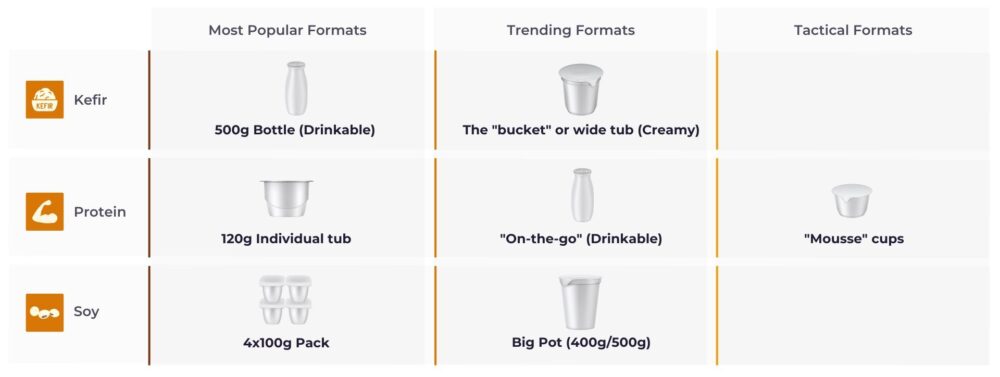
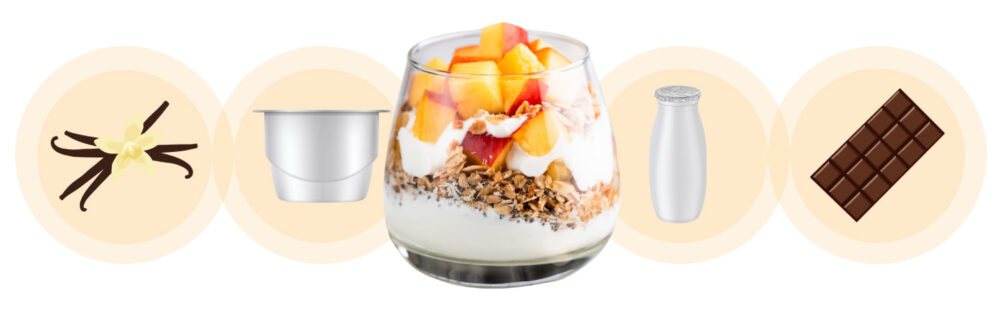
- In Kefir: The big winner is the 500g drinkable bottle. This format has allowed kefir to move beyond breakfast to be consumed in liquid form throughout the day. However, we are seeing a growing trend towards the “bucket” or wide pot, especially for creamier versions seeking a healthy dessert positioning.
- In Protein: The 120g individual pot remains the standard, but real growth is in on-the-go formats. Drinkable protein shakes have gained a lot of space because they allow for immediate consumption after exercise. Additionally, tactical formats like “mousse pots” are appearing, which attempt to bring protein into the realm of guilt-free sweet treats.
- In Soya: The family or multipack format is king. The 4x100g pack is the most popular, but large 400g or 500g formats (known as Big Pots) are gaining ground. These large containers suggest recurring consumption at home, where the product is used both on its own and as an ingredient in other recipes.

The Flavour Map: From Natural to Sophistication
Flavour is the final filter in the purchasing decision. Although natural flavour remains the foundation of the market, innovation is opening up very interesting new market niches.
In kefir, natural flavour is the absolute core. Nevertheless, brands are introducing what they call “healthy fruits” (blueberries, strawberries) to soften the product’s characteristic acidity. Exotic flavours are also appearing tactically to attract a younger, more curious audience.
In protein yogurts, chocolate and vanilla are the basic flavours that guarantee volume. But the true innovation retaining customers is flavours inspired by fine patisserie: salted caramel, cookies & cream, or stracciatella. The goal for brands is to offer a flavour perceived as an indulgence or a treat, while maintaining a healthy nutritional profile.
In the soya segment, we see a clear division. On one hand, natural and chocolate flavours cover basic demand. On the other, more sophisticated flavours oriented towards an adult palate are being introduced, such as coffee, hazelnut, or praline. This indicates that soya is looking to position itself as a plant-based pleasure for adults, beyond being a simple alternative to cow’s milk.

Innovation Insights by Type
The report synthesises well how innovation in formats and flavours is used to defend margins and build consumer loyalty.
Kefir: Migration towards creamier and more premium proposals
In kefir, a clear margin protection strategy is evident:
- Migration from cheaper liquid proposals towards more solid and creamy products in premium-style packaging.
- Leveraging territories such as organic, artisanal, or origin-based to justify higher price points.
Innovation is concentrated on packaging (wide pots, differentiated formats on the shelf) and the consumption experience (denser textures, more elaborate recipes) without losing the functional anchor associated with digestive health.
Protein: Indulgent flavours to retain the consumer
In protein, the price decrease observed in the period is accompanied by an effort to reinforce the appeal of the type through flavour.
- Brands are working on flavours that evoke “pleasure” while maintaining a nutritional profile aligned with healthy consumption.
- The on-the-go format becomes the axis of innovation to connect with consumption moments such as snacking, post-workout, or a quick afternoon snack.
In this way, protein is established as a satiating and healthy snack, with an offering that competes against other impulse and convenience categories.

Soya: Sophisticated flavours for an adult consumer
In soya, innovation is oriented towards a consumer seeking pleasure within a plant-based choice.
- Compared to the “gym flavours” of protein or the purist profile of kefir, soya explores more sophisticated flavours such as coffee, hazelnut, praline, or red berries.
- The combination of these flavours with big pot formats or multipacks positions the category as a recurring alternative in households seeking to reduce animal-based dairy consumption.
This strategy is supported by the global growth trend of plant-based products and the recovery of plant-based yogurt consumption observed in recent years.
Keys to Leading the Yogurt Shelf in the Coming Months
The Spanish yogurt market has proven capable of constantly reinventing itself. Shelf visibility is not a static state, but the result of a strategy that combines the right format with the flavour the consumer is expecting at any given time.
Companies that want to stand out must understand that innovation is no longer limited to launching a new flavour every season. The key to current success lies in the ability to adapt the product to new lifestyles. On-the-go formats and proposals that balance nutrition and pleasure are the ones winning the battle for space in the supermarket.
In conclusion, success on the Spanish shelf will depend on the agility to read these trends. Brands that manage to combine solid visibility with a differentiated flavour offering and convenient formats will be the ones that secure loyalty from a consumer who, although price-sensitive, continues to highly value innovation and quality in their daily diet. The yogurt aisle will remain one of the most interesting spaces to observe the evolution of consumption in Spain.