

Walmart, Sparky and the Next Frontier of Retail Advertising
Walmart is making a move in a field that could redefine how we shop and how brands engage with consumers: adverts within its artificial intelligence shopping assistant, Sparky. What was previously a “neutral” conversational experience, focused on helping users find the right product, is starting to become new advertising inventory within the Walmart ecosystem.
What Is Sparky and Why This Advance Is Important
Sparky is the generative AI-powered shopping assistant that Walmart has integrated into its app and digital properties. Its goal is to accompany the user throughout the entire shopping journey, from inspiration to the final decision. Instead of browsing through traditional categories and filters, customers can pose a query in natural language — for example, “I need ideas for a healthy dinner for four people” — and receive recommendations, review summaries and product comparisons in a conversational format.
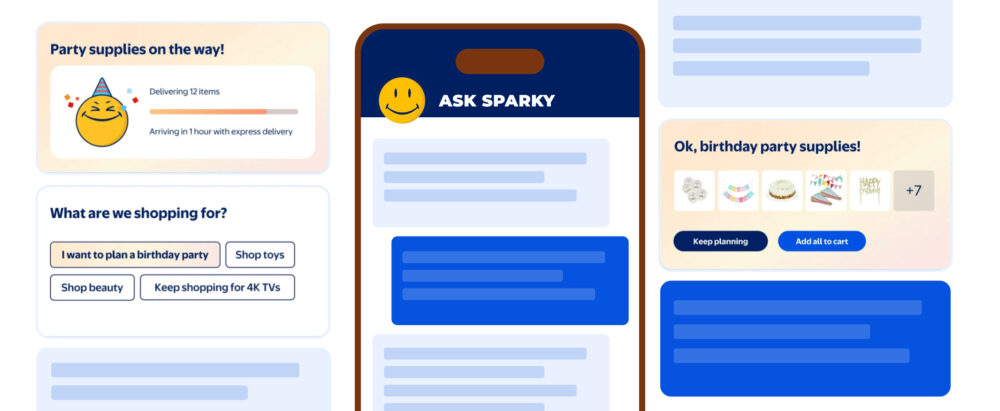
This approach aligns with Walmart’s vision of building a “super agent” capable of understanding context, cross-referencing catalogue data and providing actionable answers, rather than just showing a list of results. Sparky aims to be that intelligent layer. It will organise the shopping experience, reduce friction and, at the same time, generate high-value data regarding the user’s real intent in every interaction.
From Assistant to Advertising Channel
According to information released by The Wall Street Journal, Walmart is testing the incorporation of ad formats within Sparky, specifically a model of “Sponsored Prompts”, or sponsored messages that are integrated directly into the conversational flow. This means that when a user makes a query, featured recommendations from brands paying for priority visibility may appear among the AI-generated responses. Sponsored responses will always appear in a context intended to be relevant to the expressed intent.
Specialised adtech and retail media outlets suggest that these tests began on a limited basis in September 2025, with a small group of advertisers, and that their goal was to measure both the impact on revenue and the user’s perception of the experience. The move fits with Walmart’s broader strategy to accelerate its Retail Media business and compete more directly with giants like Amazon in the monetisation of its digital traffic and its first-party data.
How “Sponsored Prompts” Could Work
In a typical scenario, a user might ask Sparky something like “which laptop do you recommend for remote working and occasional video editing?”. They would expect to receive several reasoned and comparable options. The difference is that, with the new formats, some suggestions may be organic results. These would be selected by the AI based on relevance, price or reviews. Others, by contrast, could appear marked and prioritised as sponsored content by certain brands or manufacturers.
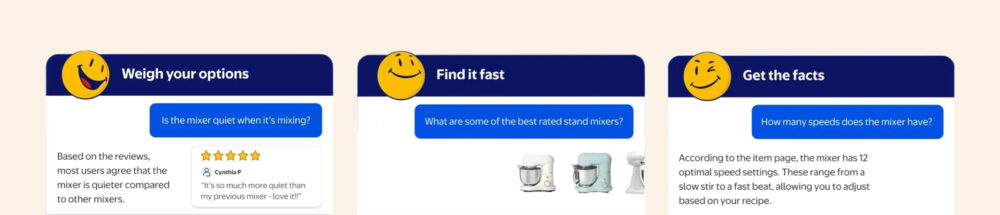
The key lies in how this information is presented. Industry sources indicate that Walmart seeks to maintain a tone consistent with the conversation. The goal is for ads to integrate naturally into the responses. This avoids breaking the feeling of assisted dialogue. At the same time, the challenge is to ensure sufficient transparency for the user. They must be able to identify which recommendations are organic and which are part of advertising agreements. This is particularly sensitive in conversational AI environments, where the line between content and advertising can become blurred.
Business Opportunities for Walmart and Brands
For Walmart, Sparky is not just a customer experience tool; it is a strategic piece in the expansion of its advertising business. The ability to monetise real-time queries (in which the user expresses a clear purchase intent) turns the assistant into extremely valuable, high-intent inventory, comparable to or even superior to traditional searches within the website or app.
For brands, this new space opens the door to more contextual advertising formats that are closer to the moment of decision. Instead of relying solely on banners or classic sponsored results, advertisers can position their products within a recommendation flow that is already filtered by the customer’s intent and stated needs. In this way, advertising moves from interruption to accompaniment: the brand enters the conversation at the precise moment the consumer is asking for help to decide.
Risks and Challenges in the User Experience
However, the revenue potential comes with significant challenges. The main one concerns user trust. Until now, Sparky’s promise has been built as that of an assistant that “works for the user”. Its function is to help make better choices and reduce information overload. The introduction of explicit commercial interests into that same channel requires extreme care. This affects both the design of the experience and the labelling of sponsored messages.
Various voices in the marketing sector warn of this risk. Conversational AI can shift from being an impartial advisor to an environment perceived as biased. In such a scenario, those who pay the most gain visibility. If the user suspects that recommendations are based on commercial deals, trust suffers. They would no longer be perceived as responses to real needs. This could slow the adoption of Sparky. It would also damage not only the advertising project but also trust in the Walmart brand itself.

Sparky and the Future of Conversational Advertising
Walmart’s initiative with Sparky is not an isolated event. It is part of a broader trend where retailers and tech platforms explore how to integrate advertising into AI-based agents, from shopping assistants in marketplaces to recommendation experiences in video and social commerce environments.
In this context, Walmart plays with a differential advantage: the combination of scale, first-party data, a unique physical and digital inventory, and an already mature Retail Media business. If it manages to integrate advertising into AI-generated conversations in a credible and transparent way, Sparky can become a benchmark for so-called conversational media and a new hub for attracting advertising investment.
As the tests evolve, we will see more sophisticated formats, greater behavioural targeting and new transparency rules. This will anticipate what advertising will look like in the next decade of e-commerce. For marketing and e-commerce teams, the message is clear: AI agents will stop being simple service tools and consolidate as full business channels, where visibility will be contested within conversations and not just through clicks or impressions.
Understanding these new environments, the data that sustains them and the rules that govern them will be decisive for remaining competitive in an ecosystem increasingly mediated by artificial intelligence.