
Mastering the Shelf: Visibility and Innovation Strategies in the Spanish Spirits Sector
TL;DR
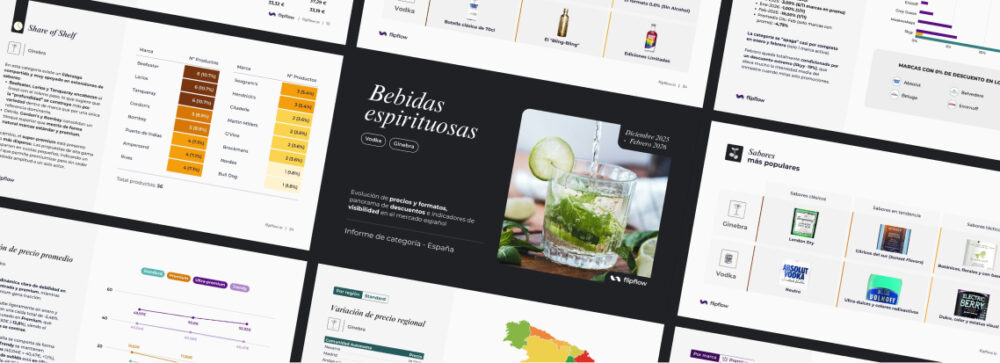
Analysis data: evolution of Share of Shelf and innovation in formats and flavours for different tiers and brands of gin and vodka in the Spanish market, between December 2025 and February 2026, based on information from our SaaS (full details in the downloadable report).
The spirits market in Spain continues to go through a phase of adjustment and changing habits. In 2024, sales in the sector fell by 2.4% to €2,075 million, while volume consumption declined by 3.7%. Data for 2025 has not yet been published, but forecasts at the end of the year pointed to a further 2% decrease in market value.
Even so, Spain remains one of the main European markets for spirits, with a vibrant hospitality culture (on-trade) and a grocery channel (off-trade) that has gained strategic weight in purchasing decisions for home consumption.
In this context, understanding which brands are winning shelf space and how they are innovating in their assortment is key to anticipating competitive moves. It is not enough to look at price or promotions: the breadth of the range, the choice of formats, and the focus on specific flavours are increasingly conditioning brand visibility and the ability to capture the consumer in a digital and omnichannel environment. Below, we analyse how the major gin and vodka brands are managing their presence and which product trends are setting the tone in this 2026.
The Battle for Share of Shelf: Quantity or Exclusivity?
The Share of Shelf measures a brand’s participation on the shelf—that is, how many references (SKUs) it occupies within a category and its weight compared to its competitors. In a market like spirits, this metric is particularly useful because it shows who dominates through assortment breadth, who bets on variety, and who prefers to concentrate on a few highly recognisable references.
According to the data analysed between December 2025 and February 2026, the gin and vodka categories present very different visibility structures.

Gin: Leadership through variety
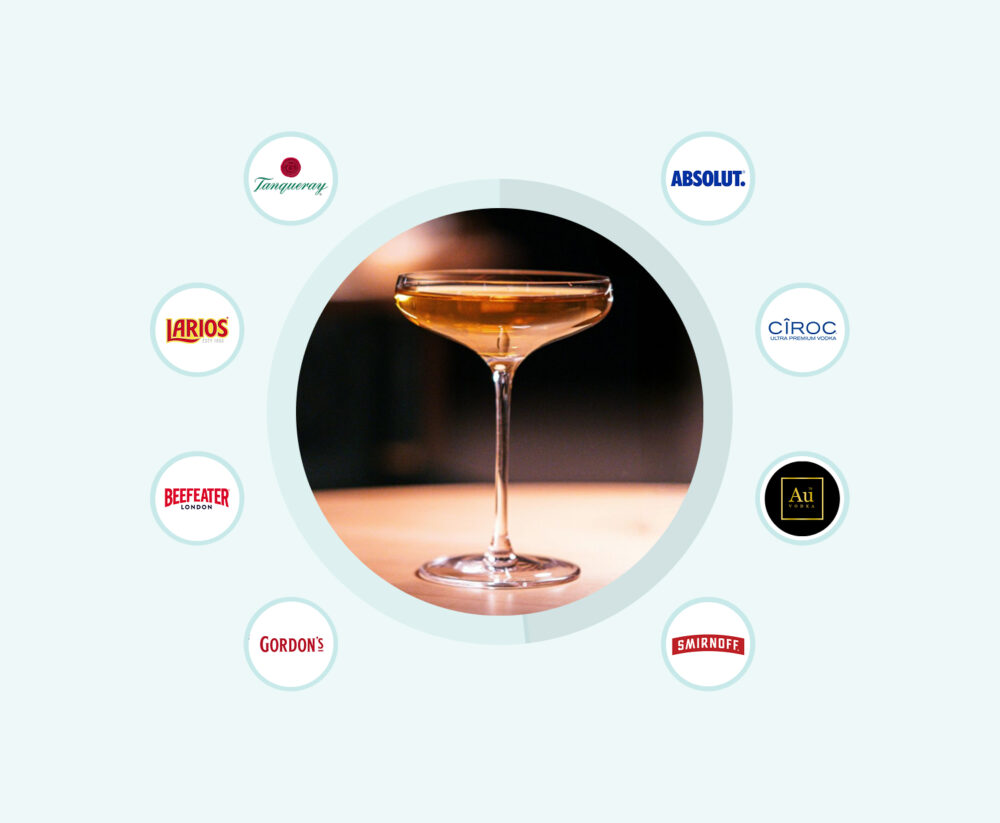
In the gin category, there is no single brand that dominates absolutely. Instead, we find leadership shared by three giants: Beefeater, Larios, and Tanqueray. Each of these brands holds a 10.7% share of shelf, with 6 different references or products in the analysed market.
This equality suggests a clear strategy: brand “depth” is built through variety. By launching multiple versions—especially focused on flavours—these brands manage to saturate the shelf. This saturation phenomenon forces retailers to maintain their presence, often displacing smaller brands that cannot offer such a wide range of options.
Just behind, brands like Gordon’s and Bombay maintain a solid block with an 8.9% share each (5 products). It is interesting to observe how in this upper segment, brands classified as “standard” and “premium” are mixed, demonstrating that the Spanish consumer seeks a balance between trust and quality.
At the top end of the market, the picture changes. Brands with a more exclusive profile appear in a more fragmented way. Martin Miller’s, Nordés, or Bull Dog have a shelf share of between 3.6% and 1.8%. A different logic is seen here. More premium or botanical gins seek to maintain a curated presence without the need to over-expand their assortment. This decision protects positioning but limits the ability to gain visibility against those who do work with a more extensive offering.
Vodka: Portfolio breadth dominance
Unlike gin, the vodka market in Spain is much more concentrated. Here, a single brand dictates the pace of the shelf: Absolut. With an impressive 20.8% Share of Shelf and 10 active references, it is the exception in the spirits market.
Its strategy is based on using a historical heritage of flavour innovation to take over entire shelves. By offering variants such as Citron, Raspberri, or Vanilia, the brand ensures that, regardless of consumer preference, there is always one of its bottles available.
Other brands like Ciroc and Au Vodka (both with a 12.5% share and 6 products) complete the leading group. Collectively, these three brands control almost half of the available assortment, leaving the rest of the market to ultra-premium proposals operating under a logic of fragmentation and exclusivity.
The conclusion is clear: in vodka, the shelf rewards the player who manages to combine a strong brand with a wide assortment. Basic references remain relevant, but the ability to attract attention and cover different consumption occasions increasingly depends on variants, flavours, and designs with greater visual impact.
Innovation in Formats: Packaging as a Storyteller
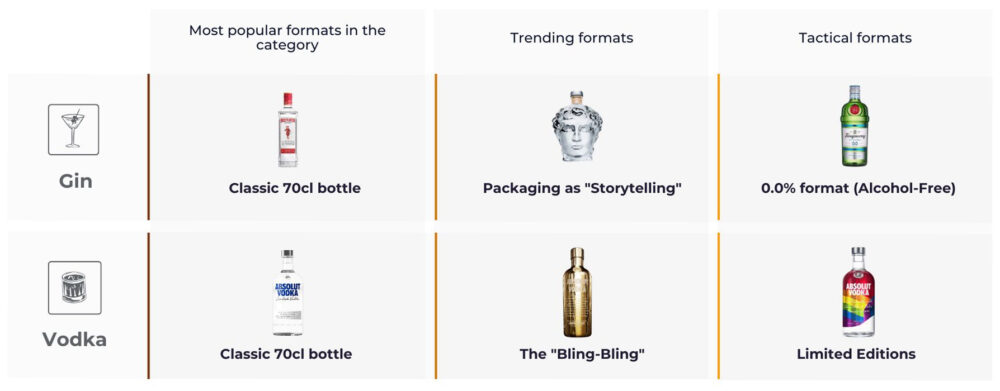
The report reveals that while the classic 70cl bottle remains the market standard, brands are using packaging design to build value and justify premium price positioning.
Design as “Storytelling” and status
In gin, packaging has become a tool for storytelling. The design and the narrative regarding the origin of the botanicals help build a perception of value that goes far beyond the liquid. The consumer is no longer just buying a spirit; they are buying a narrative of craftsmanship or geographical origin.
In the case of vodka, the dominant trend is “Bling-Bling”, whose main premise is to “shine like stars”. Brands like Au Vodka and Ciroc opt for striking visual codes that convey status. These containers are designed to be recognisable from a distance, especially in nightlife settings or for sharing on social media. The goal is to capture the purchase through aesthetics and the consumption occasion associated with social success.
Tactical formats and limited editions
Innovation also responds to specific market needs:
- 0.0% Gin: The alcohol-free format has gained weight as a tactical lever to expand consumption occasions. It allows brands to be present in moments where alcohol is not an option, without replacing their main product.
- Limited editions in vodka: These are used as novelty accelerators. By creating a sense of urgency and exclusivity, vodka brands manage to revitalise their presence on the shelf without needing to permanently change their base recipe.
The Revolution of Colour and Flavour: “Instagrammable” Profiles
If the format builds the first impression, flavour is defining the shelf’s renewal. The trend towards “premiumisation”, defined by the maxim of “drinking less, but drinking better”, has driven a radical shift in the flavours we find in shops.
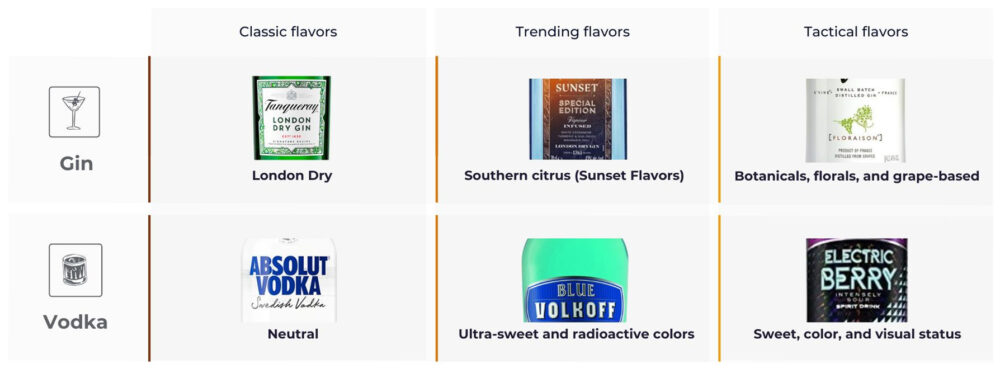
Our report shows that the classic remains relevant, but innovation is moving towards more striking, more recognisable profiles that are easier to communicate digitally.
The rise of visual flavours
Flavour must now be visually attractive to be shared on digital platforms. In gin, this translates into an expansion towards southern citrus and floral botanical profiles. Grape-based proposals are also gaining ground, offering a clear sensory and visual differentiation compared to traditional dry-cut gin.
In vodka, the trend is even more extreme. Ultra-sweet variants and those with striking colours are growing. The main appeal here is “sweetness, colour, and visual status”. These brands act as “visual blockers” on the shelf. They need several references of different colours so as not to go unnoticed by a consumer who chooses based on the visual impact of the bottle or the colour of the mixer.
The role of “core defenders”
Faced with this explosion of colours and flavours, traditional brands like Gordon’s, Bombay, Smirnoff, or Eristoff maintain efficient volume by focusing on their core product. Their strategy is defensive: they maintain a couple of innovations in sweet flavours to prevent the competition from stealing younger consumers, but they protect their original recipe as the main sales driver.
The case of Seagram’s stands out; despite being a high-volume premium brand, it maintains a strategy of containment. It relies on its original recipe and only introduces very measured innovations to preserve its identity.
What Does this Tell us About the Market?
The first major takeaway is that visibility no longer depends solely on price. In a more rational consumption scenario, with lower purchase frequency and more sensitivity to value, brands need additional reasons to enter the basket. The shelf, packaging, and flavour variety become tools as important as promotion.
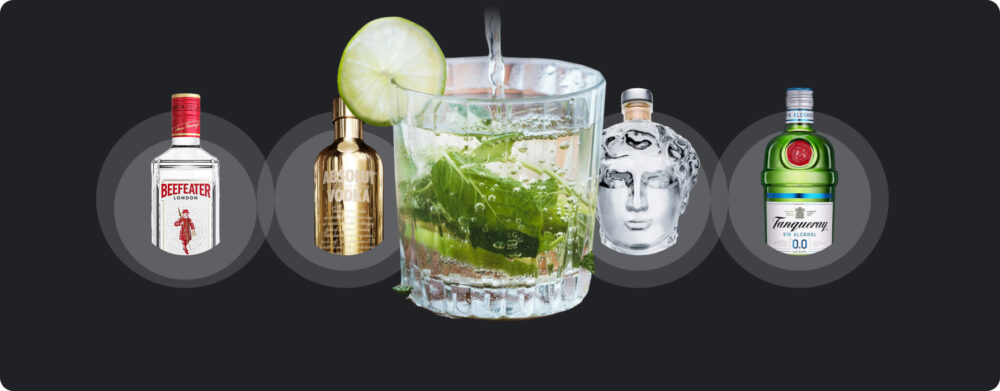
The second takeaway is that premiumisation is still very much present. Consumers accept drinking less, but seek better, more curated experiences that are more aligned with a specific occasion. This explains why products with a better brand story, differentiated design, and a richer flavour proposal are thriving.
The third takeaway is that innovation is increasingly linked to digital visibility. In an environment where purchases are consulted, compared, and discovered online as well, having a broad and coherent range helps protect share, gain space, and reinforce brand perception.
Implications for Manufacturers and Distributors
For manufacturers, the message is quite clear: winning visibility requires making good decisions about where to expand the assortment and where to concentrate efforts. In gin, leadership is built with range depth and extensions that bring novelty without breaking brand territory. In vodka, however, a broad assortment seems almost a prerequisite for competing with guarantees.
For distributors and retail, the challenge lies in balancing variety and efficiency. An assortment that is too narrow limits innovation and leaves out proposals with potential; one that is too broad can dilute turnover and complicate stock management. The key is to build an assortment that combines defensive brands, high-turnover references, and differential bets.

For brands, there is also a clear opportunity in designing more coherent portfolios. The references that work best are not necessarily those that compete only on price, but those that provide a clear signal of occasion, flavour, or visual style. In categories so exposed to impulse and image, that clarity is worth a lot.
Conclusions: Visibility as a Competitive Advantage
The report data underlines that success in the Spanish spirits market does not depend on a single variable. Gin requires constant management of flavour variety to avoid losing space to competitors, while vodka rewards those players capable of building a broad and visually impactful portfolio.
Innovation has shifted from the content to the container. Packaging design, the ability to generate social media content through the colour of the liquid, and adaptation to new trends like alcohol-free consumption are the levers moving the shelf.
For companies in the sector, the current challenge is to find the balance between protecting the main product—the one that generates volume—and experimenting with flavours and formats that capture the attention of the consumer looking for novelty and status. In a market where visibility is bought with variety, understanding your own Share of Shelf and that of the competition is the first step towards a winning commercial strategy.